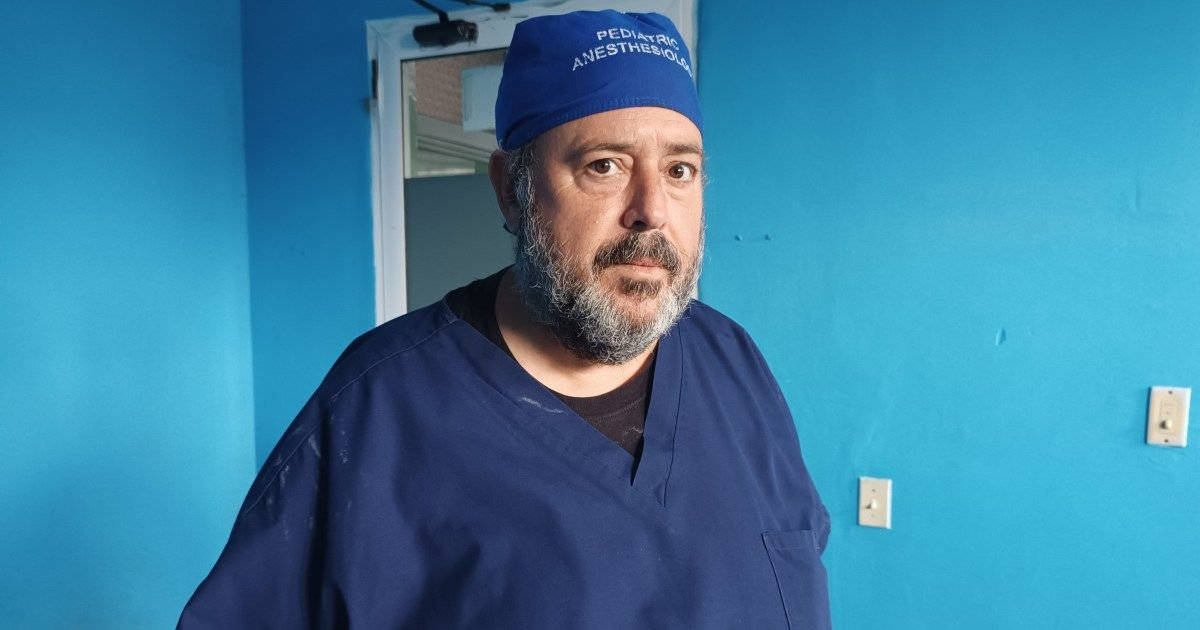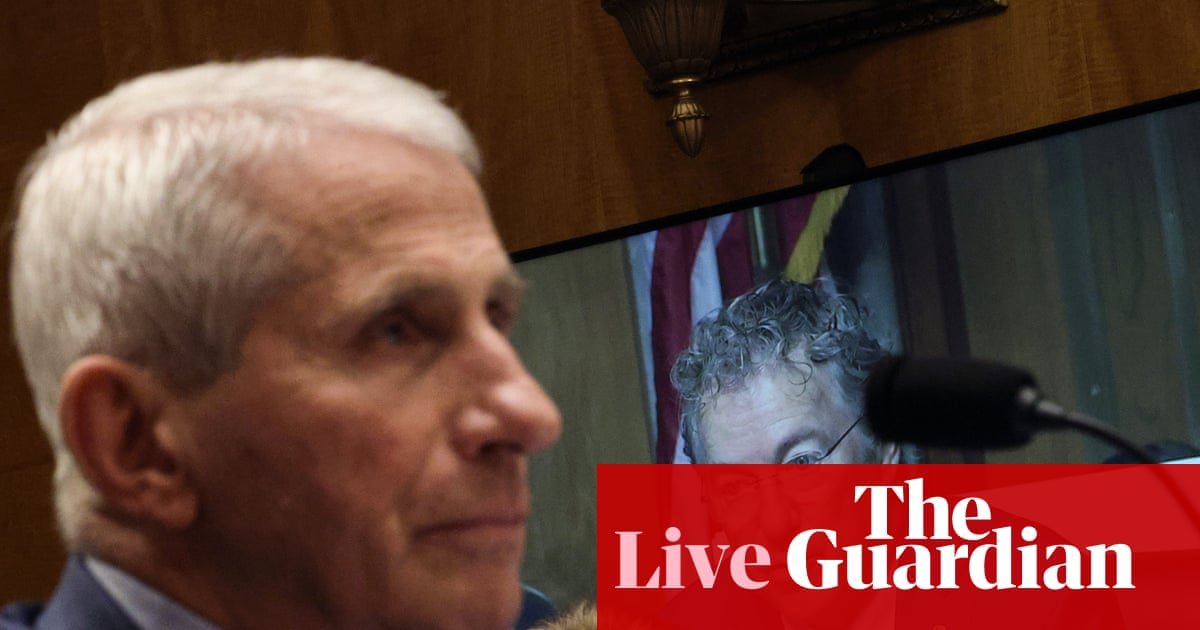
Fauci was escorted by police as he left the three-hour-long hearing. By some counts, he invoked the fifth amendment over 100 times
Fauci invokes fifth amendment and declines to testify
Sign up for US Breaking News email
1h agoComey fresh push for 'seashells case' to be thrown out
1h agoFed holds interest rates steady despite Trump’s renewed calls to lower them
1h agoSenator Cornyn cancels meeting with Blanche
3h agoUS-Saudi strikes in Iraq push region into ‘uncharted territory’, analysts warn
3h agoSenate committee to vote on whether to hold Fauci in contempt for refusal to testify
5h agoSenators continue to ask Fauci questions as medical adviser pleads the fifth
6h agoTop Democrat warns Fauci becoming 'scapegoat' for pandemic response
6h agoAnthony Fauci's attorney removed from room after request by Rand Paul
6h agoFauci invokes fifth amendment right not to answer questions
7h agoAnthony Fauci testimony gets under way
7h agoBiden pardon will not cover Fauci's hearing, says Comer
7h agoFauci expressed disillusionment with ‘rambling, crazy’ Trump in journal
9h agoFauci to face questions from Senate Republicans over pandemic origins
As the hearing comes to an end, chair Rand Paul says the committee will vote next week on whether to hold Anthony Fauci in contempt for his refusal to testify today.
In his closing statement, he asks, “Did [Fauci’s] actions lead to the largest man-made plague in human history? Are the millions dead the result of his experiments or experiments he approved?”
Fauci was escorted by police as he left the three-hour-long hearing. By some counts, he invoked the fifth amendment over 100 times.
Donald Trump is due to announce a $22bn plan to rebuild Washington’s Dulles international airport today after he personally weighed in on the design of the capital’s main international gateway.
A White House official confirmed an announcement would be made, after CBS News reported that Trump had scrutinized 3D models from contractors competing to carry out the overhaul at the White House, and offered proposed changes.
An announcement is scheduled for 3pm ET at the White House, where Trump will be joined by Sean Duffy, the US transportation secretary, Scott Kirby, United Airlines chief executive, and officials from the Metropolitan Washington Airports Authority (MWAA), which operates the airport under a 50-year lease from Congress.
The planned overhaul of Dulles forms part of a broader pattern of Trump personally directing changes to Washington, from a proposed White House ballroom to a planned 250ft arch.
Unlike some of those projects, the president’s push to remake Dulles has drawn a more tepid response, given longstanding complaints about the airport’s distance from the city, its jet-fuel-scented concourses, and its reliance on ageing shuttle vehicles.
The scheme is expected to include five new terminals to replace the airport’s existing four, with the underground train system expanded so passengers no longer need Dulles’s much-maligned “mobile lounges” – the slow-moving shuttles that ferry travelers across the tarmac to their gates. A new underground pedestrian tunnel and additional moving walkways are also planned.
People briefed on the proposal said the approved design leans on glass and gold, including gold-mirrored ceilings throughout the terminals.
United, which handles roughly 70% of traffic at Dulles, has agreed to help finance the project, which is expected to take years and cost more than $20bn, according to the Washington Post. MWAA is expected to fund much of the work through new bond issuances, and had already approved a separate $7bn capital plan for the airport in 2025.
United and MWAA did not immediately respond to a request for comment.
Trump has made no secret of his dissatisfaction with the airport, telling reporters in December that Dulles “should be a great airport” but “it’s a terrible airport”.
The Senate was due to vote today on the latest Iran war powers resolution at 3.30pm ET, less than a week after it voted down efforts to curb Donald Trump’s military action in Iran. However, Politico hears that the vote could be delayed to tomorrow due to GOP “attendance issues”.
Indeed, several Republican senators including South Carolinians Tim Scott and Darline Graham are due to attend the funeral for the late senator Lindsey Graham in their home state. And with Mitch McConnell still recovering at home from last month’s fall, the three absences will eat into the majority’s numbers, Politico notes.
Last month, the upper chamber delivered a symbolic but significant rebuke to Trump’s deeply unpopular conflict when it approved a war powers resolution preventing the president from continuing hostilities against Iran.
That resolution passed by a 50-48 vote, with four Republicans – Susan Collins of Maine, Lisa Murkowski of Alaska, Bill Cassidy of Louisiana and Rand Paul of Kentucky – breaking with their party to support its adoption. John Fetterman, of Pennsylvania, was the sole Democrat to vote against the resolution. The absences of two Republicans, Dave McCormick of Pennsylvania and McConnell of Kentucky, who was admitted to the hospital the week prior, also helped its passage.
But last week’s resolution failed by a vote of 49-47 after Fetterman joined Republicans once again, while Collins joined Democrats. It marked the 12th time the Senate has attempted to pass legislation limiting Trump’s ability to attack Iran.
The House, meanwhile, has twice passed such measures to direct Trump to withdraw the US military from the conflict.
Democrats have been forcing votes regularly since Trump launched his war against Iran with Israel on 28 February. As noted above, though, the resolutions are largely symbolic, and Trump has continued to attack Iran regardless. But they do serve to force lawmakers to go on the record with their stance on the war – which has exacerbated the US cost-of-living and affordability crisis – as November’s midterm elections creep ever closer.
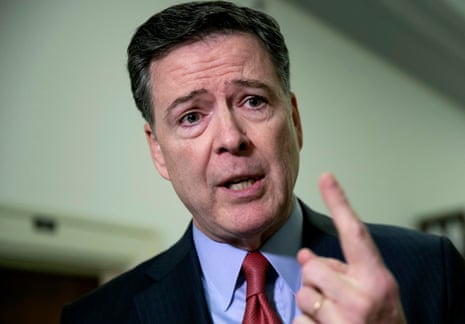
Lawyers for former FBI director James Comey have alleged that US Secret Service agents illegally surveilled him, Donald Trump requested regular updates into the investigation, and law enforcement turned to ChatGPT and a known mafia killer as they scrambled to find justification for criminally charging Comey for posting a picture of seashells that spelled out “8647”.
The claims were laid out in a motion to dismiss a criminal case the US Department of Justice filed against Comey in April, in which it said the post by Comey – whom Trump fired in his first term – was a threat on the US president’s life.
In the motion filed yesterday in federal court in North Carolina, Comey’s lawyers said the case should be dismissed for vindictive and selective prosecution.
Comey filed a separate motion earlier this week, seeking dismissal of the case on grounds that the post was protected speech and not a “true threat” against the president.
Trump has long fumed over the way Comey handled the investigation into Russian interference in the 2016 election while he served as director of the FBI. Comey has also been an outspoken critic of Trump.
You can read the rest of this story here. There’s movement on another thorn in Trump side, too, E Jean Carroll – stand by.
The US Federal Reserve held interest rates steady today, leaving rates unchanged for the fifth time since December despite Donald Trump’s renewed calls to lower rates.
Cooler inflation data published earlier this month eased expectations for an imminent rate hike. But the tenuous peace deal between the US and Iran has made energy prices creep up again, strengthening the case for an increase. The Fed’s federal open market committee voted 9-3 to maintain rates, with three dissenting members who preferred to raise the rate by a quarter-percentage point.
At the Fed’s June meeting – its first under its new chair, Kevin Warsh – half of the central bank’s 18 members predicted at least one rate hike by the end of the year. Interest rates currently sit at a range of 3.5% to 3.75%.
“Inflation remains elevated relative to the Committee’s 2 percent goal, in part reflecting supply shocks that have driven price increases in certain sectors, including energy,” the Fed’s open market committee said in its statement, which is once again noticeably shorter after Warsh’s recent calls for more streamlined communication.
Texas Republican Senator John Cornyn has canceled a meeting that was scheduled with Todd Blanche, as the acting attorney general scrambles to obtain approval for his nomination to the job – and the senator digs in over unresolved concerns about the controversial $1.8bn “anti-weaponization” fund tied to Trump allies.
Is the fund truly dead or a raging zombie? Critics demand to know from Blanche.
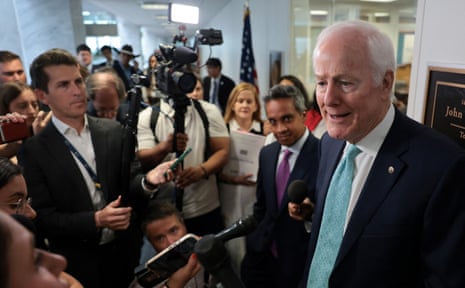
Cornyn on Wednesday canceled a meeting with Blanche ahead of a vote by the Senate judiciary committee on Thursday, saying he was unwilling to support Blanche’s nomination to be the US attorney general unless and until the justice department provided written assurances addressing his concerns.
These concerns center on Trump’s extraordinary legal settlement with his own administration, which included the fund for allies of Trump and an agreement designed to protect Trump and associates from having their taxes audited.
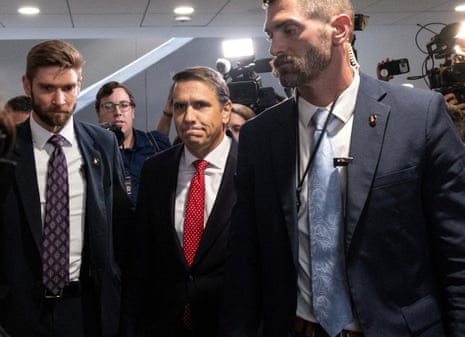
The US Postal Service is emerging as a pivotal player in the midterm election season that will determine control of Congress, only about six weeks before the first midterm ballots are mailed out.
Donald Trump is seeking greater control over mail balloting through an executive order while a change to how the agency processes mail is leading to criticism that it’s failing to deliver ballots on time, the Associated Press reports.
Democratic officials have raised concerns over the past week about how quickly the postal service will process ballots after tens of thousands of them in California and hundreds in Wisconsin arrived at local election offices too late to be counted in elections earlier this year. The top election offices in Kansas and Michigan are urging voters who want to cast their ballots early to avoid the mail and instead drop them off in person.
The postal service replied to those concerns by saying it remains “committed to fulfilling our role in the electoral process.”
The postal service faced similar questions about mail delivery in 2024, but the scrutiny this year is heightened because of an executive order Trump issued in March that seeks to create a national voter list to guide the postal service in deciding who gets a mail ballot.
The order has sparked multiple lawsuits and federal court orders, leading to a case now before the US supreme court. Trump has lied for years about voter fraud to try to explain away his loss to Democrat Joe Biden in 2020, and mail balloting is a favorite target.
Here’s a deep dive on election security for the midterms from our own George Chidi.
Hello, US politics blog readers, it’s been a lively morning on Capitol Hill and there is plenty more to digest, with news expected out of the Federal Reserve, the US Senate and the US president.
Here’s where things stand:
A closely watched hearing in Washington DC saw former top public health official Anthony Fauci grilled for about 3.5 hours in the Senate, during which he declined to answer any questions about the coronavirus pandemic, including on conspiracy theories about the origins of the virus.
One of Fauci’s attorneys was removed from the hearing at the insistence of the hearing’s instigator – Kentucky Republican Senator Rand Paul – when the lawyer, David Schertler, repeatedly tried to interject while his client remained tight-lipped.
During the hearing, some Republican senators aggressively attacked Fauci and made great efforts to besmirch his reputation, while some Democrats vociferously defended him as a public health hero.
Anthony Fauci, the former veteran director of the National Institute of Allergy and Infectious Diseases (Niaid), invoked the fifth amendment of the US constitution during a hearing before the US Senate homeland security and governmental affairs committee, refusing to answer any questions.
Republican Senator James Comer tried in vain to claim that Fauci would not be allowed to invoke his fifth amendment right to silence during the hearing, arguing unsuccessfully, ultimately, that having been given a preemptive pardon by Joe Biden during that president’s administration, he was not eligible.
Diary entries, released by Rand in an attempt to damage Fauci, show the former top US government science adviser’s growing disillusionment with Donald Trump in the first year of the Covid-19 pandemic, calling the president “rambling”, “crazy”, “desperate”, “bumbling”, “incompetent”, “an idiot”, “a true embarrassment”, “totally nuts” and “truly an obnoxious adolescent”.
US-Saudi strikes on Iran-backed militia in Iraq on Wednesday have pushed the region into “uncharted territory”, analysts have warned.
Amid stark warnings of a widening and increasingly “unpredictable” conflict, Riyadh’s decision to publicly join the US in striking sites associated with Iraq’s Popular Mobilisation Forces (PMF), killing at least 20 fighters, has added another complicating dimension to the war.

The US-Saudi strikes on Wednesday came after a brief lull in direct US attacks on targets in Iran, with Tehran’s allies in Yemen and beyond becoming increasingly drawn in.
Iran, meanwhile, launched missiles at US military installations in Jordan, in its first attack in the region since the pause in fighting with the US began.
After the tit-for-tat strikes, the pause in fighting appeared to be at an end, with Donald Trump saying the US would be “be hitting [Iran] hard”, even as he claimed the strikes in Iraq were coordinated with the government, despite Baghdad’s condemnation.
Dr Anthony Fauci, who served as a key adviser to Donald Trump and Joe Biden during the Covid-19 pandemic, has refused to answer questions at a high-profile congressional hearing, accusing Republican senator Rand Paul of having an “unhinged obsession” with him.
Fauci, the veteran former director of the National Institute of Allergy and Infectious Diseases (Niaid), invoked his constitutional right against self-incrimination when appearing before a Senate committee today.
Fauci said Paul had, who called the hearing, led a years-long investigation into him and the origins of the pandemic aimed at “embarrassing and intimidating me”, and ultimately landing him “behind bars”.
“Therefore, although it pains me to do so, because of the respect I have for the legislative branch of government and my decades-long record of cooperating with Congress, under the advice of my attorneys I will invoke my right under the fifth amendment of the constitution to refrain from answering your questions,” Fauci said in his opening statement.
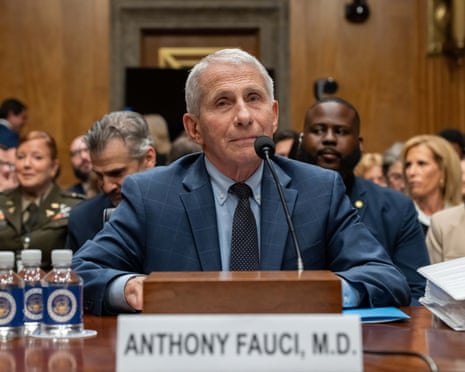
Fauci, 85, served under seven US presidents and through numerous health crises, including the HIV crisis, Ebola outbreaks and the first coronavirus outbreak, called Sars-CoV-1. He became a household name overnight when the Covid-19 pandemic halted social life in 2020.
Quickly after opening statements, the hearing became a back-and-forth between Paul and Fauci. Paul grew visibly agitated as Fauci refused to answer, threatened the scientist with “repercussions”, and then tossed one of Fauci’s attorneys from the hearing room.
Members of the audience, which conspicuously included rightwing media figure Laura Ingraham, applauded.
While Republicans characterized their work as investigating “the origins of Covid-19 and risky taxpayer-funded life science research”, scientists have characterized the investigation as “vilification and harassment” of Fauci, who led Niaid for 38 years before retiring in 2022.
The hearing was a continuation of Paul’s years-long support of the so-called “lab leak” theory, or the idea that the Covid-19 pandemic began as a release from the Wuhan Institute of Virology, a theory many virologists contend is improbable.
Since 2020, the “lab leak” theory has gained significant traction in Republican circles. In just one example, the White House published a treatise on the theory in April 2025 that served as a rationale for defunding the National Institutes of Health (NIH).
A 2024 survey of virologists from the Global Catastrophic Risk Institute found that most believed the pandemic began as a so-called spillover event, or a virus jumping from an infected animal to a human. Similarly, a group of virologists argued in the Journal of Virology that the “preponderance” of evidence points to a spillover, even as the “lab leak” theory received outsized attention.
The hearing comes just days after Paul released what he described as Fauci’s “diary”, a more than 1,100-page document characterized as revealing Fauci’s inner conflicts about the lab leak theory. Scientists have said this is a normal part of scientific debate.
The diary also contained entries about Trump, who he advised closely during the early days of the pandemic. He described the president as “rambling”, “crazy”, “desperate”, “bumbling”, “incompetent”, “an idiot”, “a true embarrassment”, “totally nuts” and “truly an obnoxious adolescent”.
Gary Peters, a Democratic senator of Michigan, described the hearing as damaging to science and ignoring ongoing public health threats, such as the outbreak of the food-borne parasite cyclospora and measles, both at record highs.
“It’s attempting to turn one person into a scapegoat for a crisis that that hundreds of officials across the Biden and Trump administrations’ were responsible for handling,” said Peters, who did not ask Fauci any questions. “This is only going to deter other scientific experts from public service.”
In a statement reported by NBC News, Anthony Fauci’s lawyer, David Schertler, said in a statement that it was “outrageous” for chair Rand Paul to “exclude his counsel for making a legitimate legal point”.
“It proves the baseless and vindictive nature of this proceeding and Rand Paul’s personal vendetta against Dr Fauci,” Schertler said.
Paul had Schertler removed from the room after he repeatedly tried to interject after Paul had wrapped his questioning.
After all members of the panel concluded their questions, Rand Paul gave lawmakers an extra five minutes each to ask Anthony Fauci further questions.
Republican senator Bernie Moreno, of Ohio, repeatedly asked Anthony Fauci if he knew what the fifth amendment said, before having one of his aides give him a small copy of the constitution.
Fauci had responded again that he was invoking his fifth amendment right.
“Do you feel like you’re in deep shit?” Moreno asked. He then asked Fauci to turn around and look at audience members who were critical of the government’s Covid response.
Dr Fauci, can you just turn around and look at the people behind you? You’re not willing to do that? It’s not a question … It’s a request. All you have to do is look up from your lawyers and look at the people who were absolutely shamed for saying what we know now to be the truth. You can’t even look at them?
Citing an alleged incident where a mom was arrested for not wearing a face mask at a football game, which he says spurred him to run for office, Moreno asks Fauci: “Who the fuck do you think you were for doing that?”
Democratic senator John Fetterman, of Pennsylvania, says he’s not here to attack or defend Fauci, and instead acknowledges his own family members who died from Covid and people he met who lost businesses through the pandemic.
Fetterman also acknowledged the struggle to “protect life and protect the economics” during the pandemic, and says he’s unsure if he even got it right.
He adds that he has a regret regarding the lab leak theory, which he says became seen as a “rightwing theory”. He says he hopes in the future, such theories won’t become so partisan.
US-Israel war on Iran