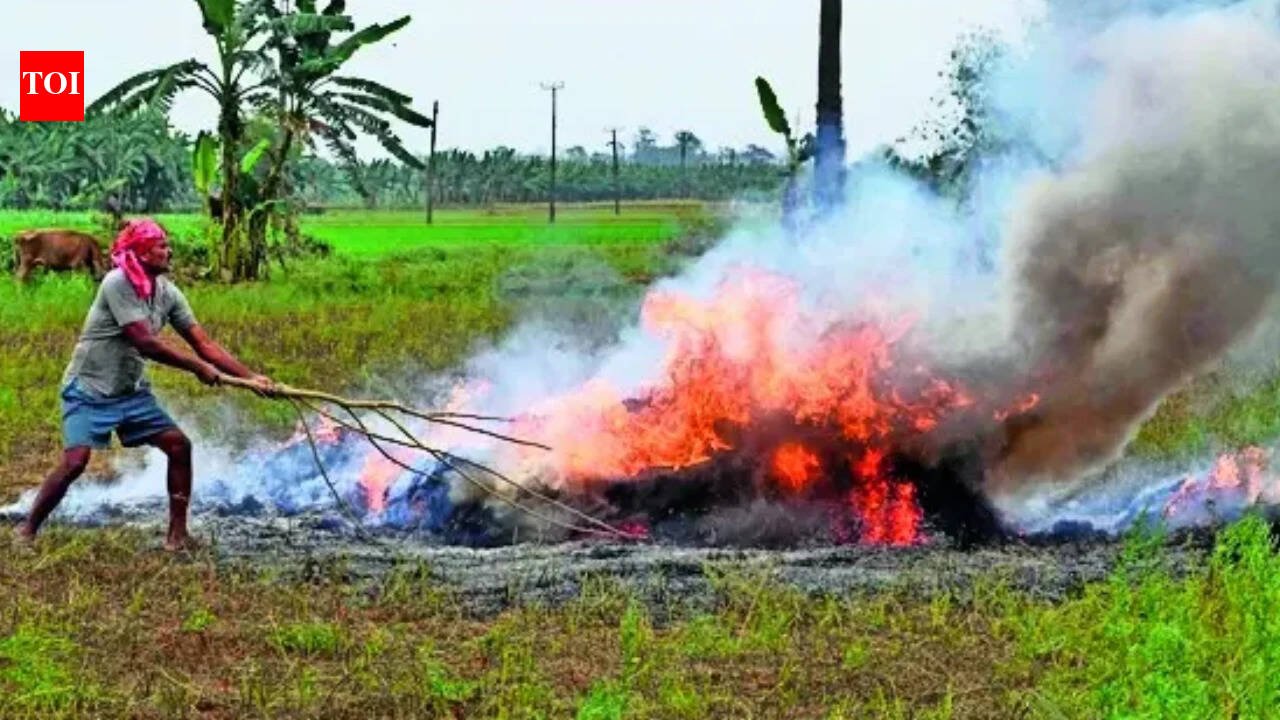
NEW DELHI: Seeking to make rules to act against stubble burning cases more stringent, the Centre has proposed to mark land revenue records of erring farmers with a ‘red entry’ for a period of 15 months that may potentially be much more consequential than just an existing fine.The rules, once finalised, will be applicable in Delhi, Punjab, Haryana and National Capital Region (NCR) of Rajasthan and Uttar Pradesh.
Stubble burning episodes in these areas lead to a substantial increase in the level of air pollution in Delhi-NCR every winter.Though the draft rules to this effect, notified by the Union environment ministry, have not spelt out the consequences of the ‘red entry’ mark in the land revenue record, officials hinted that they may potentially disallow farmers to sell their lands and stop them from availing benefits of govt schemes.
They may even include restrictions on getting registered for selling their produce at minimum support price (MSP) at designated ‘mandis’ for a certain period.The proposed rules, which will be finalised after analysing stakeholders’ comments and suggestions, have a provision to extend the ‘red entry’ tag for a further period of 15 months if any subsequent incident of stubble burning is found on that land or the erring farmers fail to pay environmental compensation (fine) within the first tag period.
The existing rules, framed in April 2023 and amended to increase quantum of fine in Nov 2024, have the provision for ‘red entry’ till the penalty by the erring farmer is made, but the draft of the new rules proposes land record-based compliance mechanism by introducing the continuation of the tag for 15 months and its further extension for the next 15 months in case of repeat incidents of stubble burning.Stakeholders are expected to send their comments and suggestions to the ministry within 60 days.
The draft was published on Wednesday.The proposed new rules retain the existing quantum of penalty provisions whereby the farmers having an area of land of less than two acres will have to pay an environmental compensation (fine) of Rs 5,000 per incident; those having an area of land of two acres or more but less than five acres need to pay Rs 10,000 per incident; and the farmer having an area of land of more than five acres will have to pay Rs 30,000 per incident as a penalty.Join conversation Share your thoughts in the comments Be respectful · TOI community guidelines The fine collected under the rule will be deposited in the account of the respective State Pollution Control Board or Pollution Control Committee.The draft proposes that the collected amount will be utilised for various activities including subsidising residue management technologies such as in-situ crop residue management equipment and machinery; incentivising crop diversification programmes; and supporting development and operation of biomass utilisation and storage infrastructure among others in Delhi-NCR and adjoining areas.