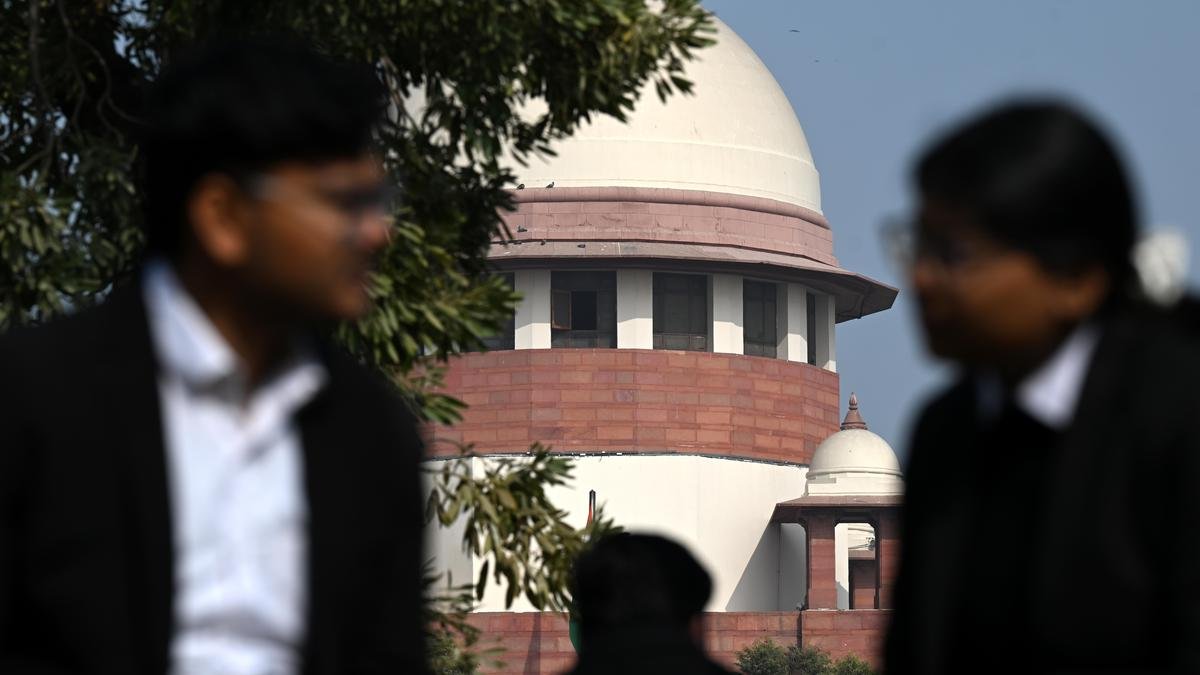
The Supreme Court on Wednesday (July 22, 2026) directed all States and Union Territories (UTs) to consider raising the retirement age of judicial officers from 60 to 61 years, pending its final decision on whether the age of superannuation should be uniformly enhanced to 62 years across the country.
The direction was issued by a Bench comprising Chief Justice of India (CJI) Surya Kant and Justices Joymalya Bagchi and V. Mohan while hearing a petition filed by the All India Judges Association. The long-pending matter concerns stagnation in career progression and disparities in pay scales and promotional avenues among members of the subordinate judiciary.
“All State governments and Union Territories are directed to take a decision, in consultation with their respective jurisdictional High Courts, on this issue. In case they agree, judicial officers in such States shall be permitted to continue in service up to the age of 61 years. Such continuation shall remain subject to the final outcome of these proceedings,” the Bench ordered.
The court, however, clarified that the interim arrangement would not prejudice its adjudication of the larger question of whether the retirement age of district judicial officers should be uniformly enhanced from 60 to 62 years across the country.
“We clarify that the question of law formulated at the outset shall be decided by this court independently, irrespective of the stand that may be taken by the States or the High Courts,” the Bench observed.
The Bench directed all States and UTs, after consulting their respective High Courts, to place their stand on record within two weeks. It also directed the jurisdictional High Courts to file their responses within the same period.
On Wednesday, the apex court was also informed that the Full Court of the Madhya Pradesh High Court has passed a resolution recommending enhancement of the retirement age of judicial officers from 60 to 62 years. It was, however, pointed out that certain High Courts, including the Punjab and Haryana High Court, continue to oppose the proposal, citing the fact that the retirement age of government employees in their respective States remains 60 years or below.
Interim mechanism
Observing that the issue requires an early resolution in view of the differing positions adopted across the country, the Bench put in place the interim mechanism permitting an increase to 61 years wherever there is consensus between the State government and the High Court.
Earlier, a Bench headed by the then CJI B. R. Gavai, since retired, had raised the retirement age of judicial officers of Madhya Pradesh from 60 to 61 years. The Bench, in its interim order, had referred to a similar decision taken by the Telangana High Court.
“It is needless to say that judicial officers as well as other employees of the State government draw salaries from the same public exchequer,” the Bench had said, adding that the retirement age of other State gGovernment employees was 62 years.
The dispute stems from the top court’s 2002 judgment declining to accept the recommendation of the Justice K. Jagannatha Shetty Commission, which had proposed raising the retirement age of district judges to 62 years. Since then, some States, including Telangana, and Madhya Pradesh, have moved towards increasing the retirement age.