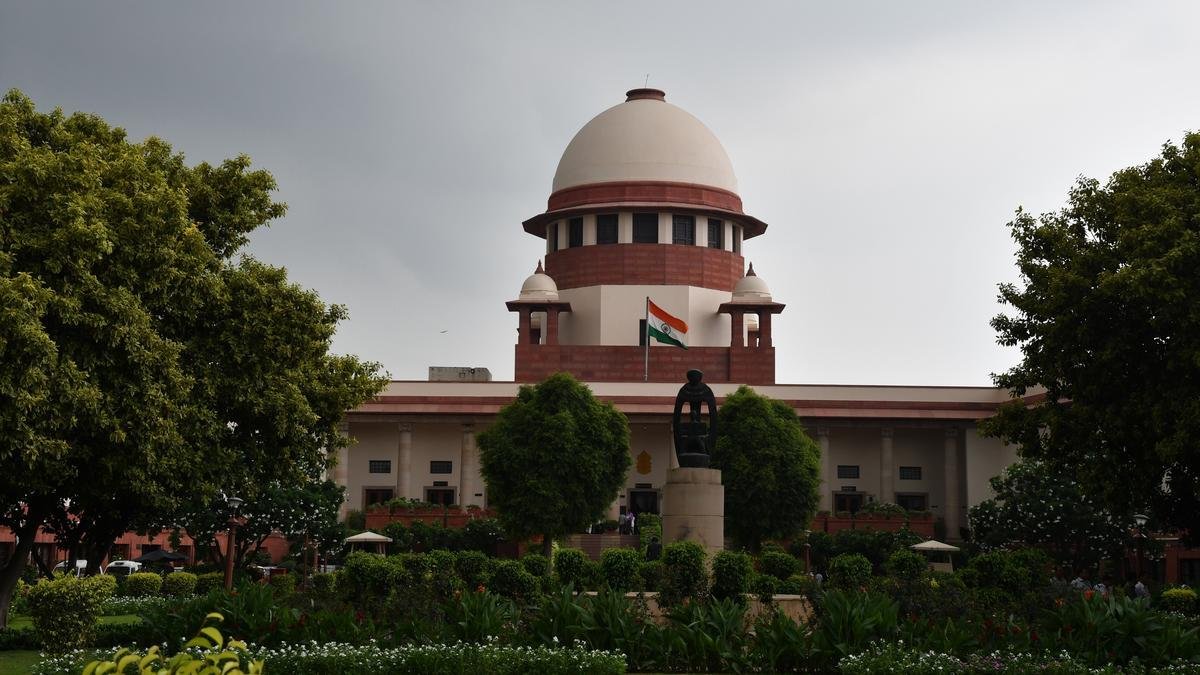
The Supreme Court stated on Friday (July 17, 2026) that the Special Intensive Revision (SIR) is only linked to elections even as a petition said the West Bengal government is using SIR data to delete names from schemes ensuring food security, women’s welfare and Backward Caste certifications.
Justice Joymalya Bagchi, one of the three judges on the Bench headed by Chief Justice of India Surya Kant, said the Supreme Court, in its May 27 judgment in the Bihar SIR case, had made it very clear that the SIR outcome cannot be used for any other purpose, least of all to conclusively determine citizenship.
“The Election Commission has a corresponding duty to refer the matter to the government for adjudication under the Citizenship Act… Until and unless that is done, for all other purposes, the status must go on.
The EC is not a constitutional authority regarding Articles 9, 10, 11 and 12 [dealing with citizenship rights] of the Constitution,” Justice Bagchi observed.
The court issued notice to the Election Commission of India, West Bengal government, and the Chief Electoral Officer of the State on a petition filed by Prasenjit Bose, chairperson of the SIR committee, West Bengal Pradesh Congress Committee, that deletion from electoral roll has resulted in serious civil consequences extending beyond the right to vote.
Mr.
Bose, represented by senior advocate Gopal Sankaranarayanan and advocate Neha Rathi, drew the court’s attention to three orders passed by the West Bengal government in May and June.
The petition said that the State government issued a notification on May 19 that purged voters must not remain beneficiaries of the Annapurna Yojana scheme for cash transfer to women unless they had filed appeals before the SIR tribunal.
On June 4, the State directed the deletion of beneficiaries under the Public Distribution System (PDS) on the basis of the outcome of the SIR.
Again, on May 14, the State government issued an order calling for authorities to re-verify and cancel caste certificates of names deleted from the SIR list.
“They have even linked the PDS to voting,” Mr.
Sankaranaraynan submitted.
The petition sought directions for streamlining the appellate process before the SIR tribunals, disclosure of data, publication of standard operating procedure and a time-bound disposal mechanism.
He said these orders coincide with the snail’s pace at which the tribunals are hearing appeals of persons excluded or wrongly added to the electoral roll in the State.
Only 38,000 appeals have been disposed of out of a total 34 lakh filed in West Bengal.
Out of the 38,000 appeals, 70% have been cleared for re-inclusion in the electoral roll.
“If only 38,000 appeals of the 34 lakh appeals have been disposed of, over 33.5 lakh appeals are still pending adjudication by the 19 tribunals… The delay in the hearing of the appeals are affecting civil rights.
Mechanisms should be put in place to ensure transparency and accountability in the appellate process.
The 19 tribunals should have a website to upload their orders and their standard operating procedure,” the senior counsel submitted.
He said that since 70% of the appeals heard by the tribunals have been allowed, there ought to be only a “minimum documentary threshold” for faster disposal of the appeals.
“If you have a passport, that should be a clear pass for citizenship,” Mr.
Sankaranarayanan argued.
Opinion | Electoral roll purges raise constitutional questions Why West Bengal’s decision of linking social security benefits to SIR is being challenged | Explained The petition flagged the absence of publicly available guidelines on the filing of documents, issuance of notices, conduct of hearings, entitlement of excluded electors to file appeals, supply of reasoned orders or timelines for disposal of the appeals.
“These adversely affect those whose names have been deleted in the SIR process and could possibly lead to their names being deleted as beneficiaries,” the senior counsel contended.
Exclusion from rolls doesn’t repeal voting rights forever, says Supreme Court “Civil rights of voters are at risk here.
Many of the voters excluded from the electoral rolls are poor, illiterate and uneducated.
It is impossible for them to file appeals either online or offline unless ground-level legal assistance is provided and comprehensive guidelines are issued in local languages.
The absence of clear procedures and accessible mechanisms disproportionately affects poor, rural and marginalised electors and impairs meaningful access to appellate remedies,” the petition said.
Considering the issues involved, the court agreed to hear the case at an early date.
Farmers’ group flags ration risk for lakhs in West Bengal