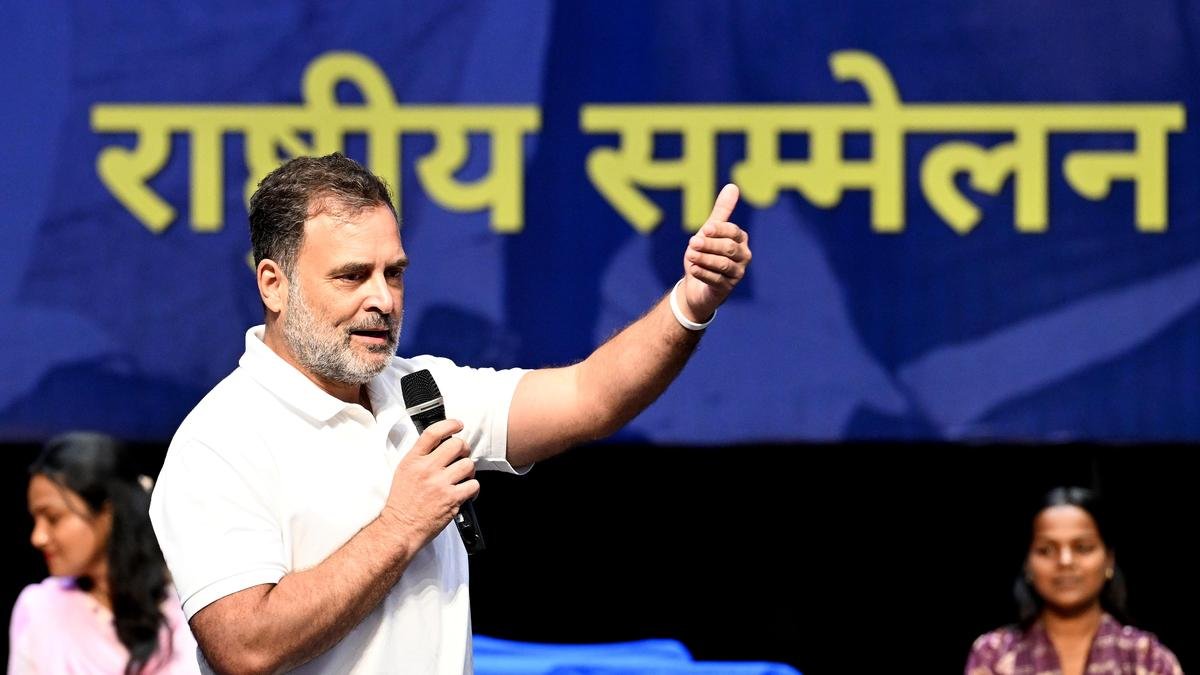
The Supreme Court on Friday (August 14, 2026) quashed a hate speech case against Leader of Opposition (LOP) in Lok Sabha, Rahul Gandhi, over his alleged remarks about Hindutva ideologue V.D.
Savarkar after the Uttar Pradesh government failed to grant sanction for his prosecution.
The private complaint was filed by a Lucknow resident Nripendra Pandey against Mr.
Gandhi, accusing the latter of making derogatory comments against the Hindutva ideologue during the Congress leader’s ‘Bharat Jodo Yatra’ in Maharashtra in 2022.
Not filed complaint over 'Mafiveer' or ‘British agent’ labels: Savarkar’s grandnephew tells Pune court “Have you given the sanction?” Justice Dipankar Datta, heading a Division Bench, asked Additional Solicitor General K.M.
Nataraj, appearing for the Uttar Pradesh government.
Mr.
Nataraj said the State had not done so.
“Sanction is required.
But there is no sanction.
If there is no sanction, there is no case.
You have to follow the law,” said Justice Datta addressing both the State government and the complainant.
The Bench proceeded to pass the order quashing both Mr.
Pandey’s complaint and the summons issued by the Lucknow Magistrate.
Supreme Court judge says it’s high time to decriminalise defamation Section 196 of the Code of Criminal Procedure requires prior government sanction before a court can take cognisance of sensitive cases involving offences against the state, including promoting disharmony, hate, or insulting religious beliefs.
In July last year, the apex court had stayed the Magistrate’s summons against Mr.
Gandhi, represented by senior advocate Abhishek Manu Singhvi and advocate Prasanna S.
At the time, the court had issued a stern warning to Mr.
Gandhi to not indulge in making such “statements against our freedom fighters who gave us freedom”.
Justice Datta had even cautioned the Leader of Opposition that the apex court would take suo motu cognisance if he made such comments in future, and then there would be no question of sanction before initiating proceedings against him.
“This is not the way to treat our freedom fighters.
They have given us freedom,” Justice Datta had said.
Savarkar defamation case: Rahul Gandhi withdraws threat perception plea The Judge had asked what had prompted Mr.
Gandhi to make these statements in Maharashtra where Savarkar was “worshipped as God”.
Referring to Mr.
Gandhi’s remarks that Savarkar had addressed himself as “most obedient servant” in a communication to the British authorities, Justice Datta had asked Mr.
Singhvi, “Does your client know that even Mahatma Gandhi used ‘your faithful servant’ while addressing the Viceroy?
Does he know that his grandmother, while she was Prime Minister, sent a letter to somebody praising this gentleman, the freedom fighter?” In his petition, Mr.
Gandhi had submitted that freedom of expression was essential for a dignified life and guaranteed under Article 19(1)(a) of the Constitution.
The Congress leader had argued that the proceedings against him were “clearly frivolous, vexatious and designed to inflict the criminal process as a virtual punishment to and deterrent for the free exercise of his freedoms and from freely performing his duty as a responsible Opposition leader at the national level”.
The trial court, while summoning Mr.
Gandhi, had observed that he had spread hatred and ill-will in society through his speech in which he had said that Savarkar was a servant of the British and that he took a pension from the British.
Gandhi had been accused of offences under Section 153A (promoting enmity) and 505 (public mischief) of the Indian Penal Code (IPC).