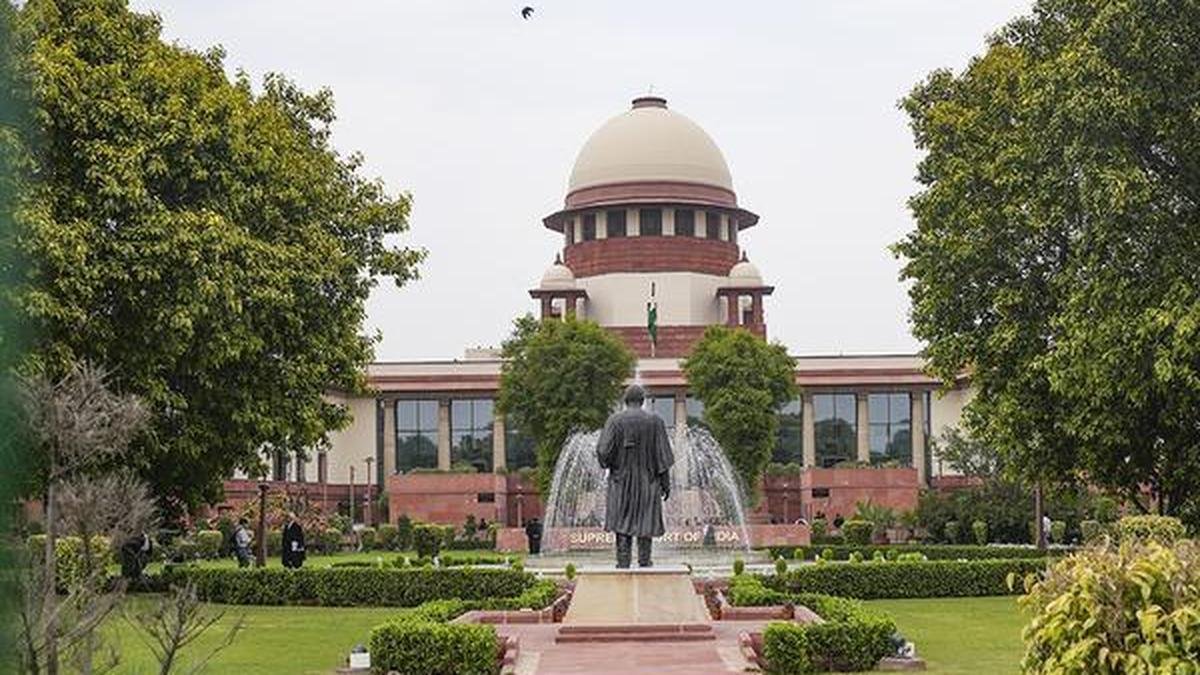
The Supreme Court on Thursday (September 24, 2026) reserved orders on a Union government plea seeking prospective operation of a March 11, 2026 judgment to re-assess OBC non-creamy layer status as per a 1993 Office Memorandum by excluding parental salary income and agricultural income from the income/wealth test.
A Bench of Justices P.S.
Narasimha and R.
Mahadevan heard an application filed by the Centre, represented by Solicitor General Tushar Mehta and Additional Solicitor General Aishwarya Bhati, which also sought a “reasonable time” of two years to undertake the necessary exercise of establishing equivalence of posts, after consulting stakeholders and formulating an appropriate and uniform policy/mechanism for determination of OBC creamy layer status.
OBC creamy layer income-test issue stuck between Ministries, says House panel chief The government said a retrospective implementation of the Supreme Court verdict would have significant consequences for recruitment, service allocation, cadre allocation, seniority, admissions and the administration of OBC reservation generally, affecting lakhs.
‘Unintended consequences’ “The court has power under Article 142 of the Constitution to declare its judgment prospective.
If the judgment is not given prospective effect, it will entail several harsh and unjust unintended consequences on employees/ appointees who were not even parties to the litigation and complete administrative chaos.
It is therefore prayed that the judgment (Union of India versus Rohith Nathan) be given prospective effect so that ongoing and past recruitment processes are not affected,” the Centre urged the Bench.
Ms.
Bhati submitted that an implementation of the March 11 judgment, particularly with retrospective effect, may affect allocation of services since 2012.
Retrospective re-allocation would impact existing seniority and gradation and affect recruitments undertaken by major employers like the railways, banks, postal service and paramilitary services.
The implementation of the judgment currently would not only affect admissions in higher educational institutions but also candidates involved in ongoing examinations/ recruitment processes post the judgment.
Bhati said an immediate move would have consequences on OBC reservation policy across the country.
OBC creamy-layer income test: What did the Supreme Court rule, and why is the Centre seeking clarification? | Explained She said the government required sufficient time for determination of a new policy to correct hostile discrimination as pointed out by the court in the judgment.
Delaying tactics: candidates Senior advocate P.
Wilson, who represents the candidates, objected while contending that the Centre was merely trying to delay, even undo a final judgment of the top court.
He criticised the Department of Personnel and Training (DoPT) for failing to comply with court directions, Parliamentary Committee recommendations, and its own 1993 rules.
He said the government could very well create supernumerary posts to accommodate eligible OBC candidates.
In its judgment, the court had directed the DoPT to create supernumerary posts within six months to accommodate eligible Other Backward Castes-Non-Creamy Layer (OBC-NCL) candidates who were wrongfully denied service allocations due to improper creamy layer classification.
OBC reservations: Should ‘creamy layer’ be junked in favour of sub-categorisation? | In Focus podcast Under the 1993 Office Memorandum, the government had devised a policy to exclude salary income and agricultural income of parents to calculate whether an OBC candidate belonged to the OBC creamy layer, that is, a high-income group excluded from reservation.
However, in 2004, the DoPT had issued a clarification counting in the salaries of parents working in Public Sector Undertakings (PSUs), banks, or private companies, while ignoring the salaries of government employees in equivalent posts.
This had led to wards of PSU employees getting disqualified for OBC reservation benefits after being included in the creamy layer bracket unlike similarly placed children of government officers.
OBC creamy-layer criteria: Supreme Court to set up special Bench to hear Centre’s plea The Supreme Court, in the March judgment, confirmed that treating PSU employees differently from government employees without proper job equivalence created a “hostile discrimination”.
The top court judgment found that creamy layer exclusion was meant to be based on social status and not solely on total household salary.
It held that salary income cannot be mechanically added to deny PSU employees’ children OBC quota by pushing them into the creamy layer.
How did the SC read the OBC creamy layer test? | Explained