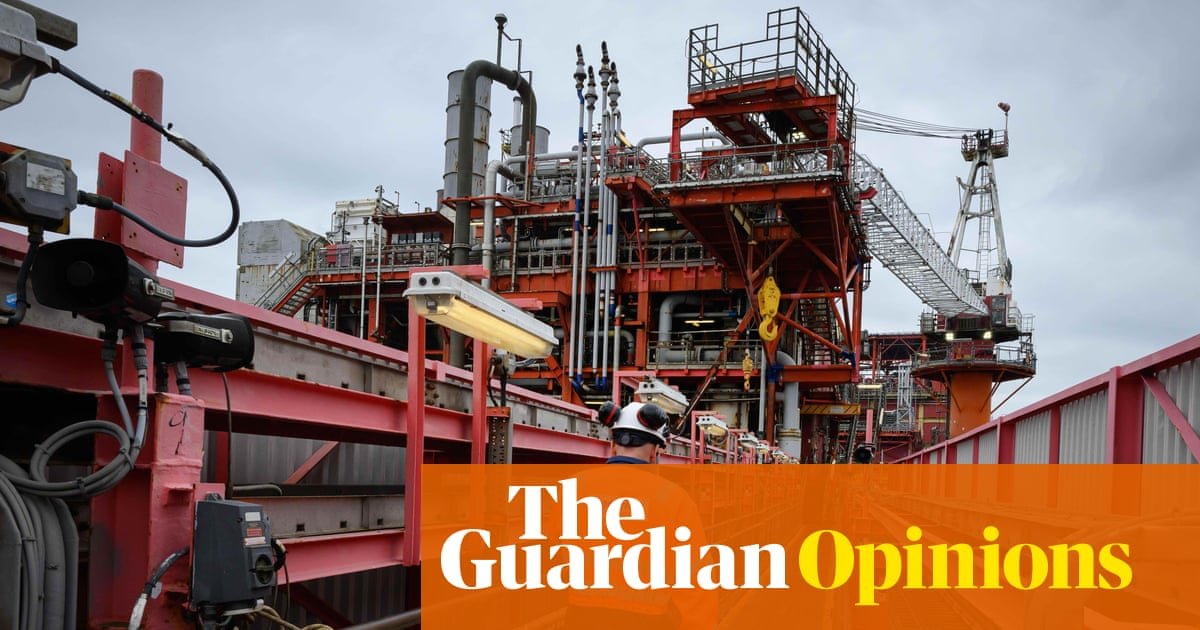
The Rough gas storage platform, off the Yorkshire coast.
Centrica has warned it will close the facility unless it receives long-term support.
You have a politically tricky decision to make on whether to approve production at the Jackdaw gasfield and the Rosebank oilfield.
But here’s another one that can’t wait much longer: what’s the broader plan to ensure Britain avoids a gas supply crisis in 2030?
By way of reminder, one of the more alarming reports published by the energy department under Ed Miliband was the one that warned of “an emerging risk” to gas supplies at the turn of the decade if an important piece of kit – an import terminal, say, or the critical 725-mile Langeled pipeline from Norway – were to be out of the action during a severe cold snap.
“In the unlikely event of the loss of the single largest piece of gas infrastructure, gas supply falls short of demand for all pathways in 2030-31,” said the report from the government’s in-house adviser, the National Energy System Operator (Neso).
Unlikely maybe – but the risk can’t be wished away, which was the point of the report.
Now here comes Centrica, owner of British Gas, warning that it will close its Rough gas storage facility off the coast of Yorkshire unless it can agree a long-term financial support deal with the government to back a £2bn expansion.
Rough is Britain’s largest such facility and, while Centrica has been issuing dire warnings for a while, it clearly means it this time.
It has set a date for closure next April, in the absence of a deal.
The company isn’t even injecting gas into Rough for this winter.
“I think this [Rough] is essential for the UK energy security,” said Centrica’s chief executive, Chris O’Shea, on Thursday.
“I think it would not be good if this was to be allowed to close, and that’s why it’s really a decision for government now.
What we hear a lot is that this is a commercial decision for Centrica.
That is patently not true.” On his commercial point, O’Shea is clearly correct.
The economics of storage rely on buying low and selling high, but winter/summer spreads are often narrower these days.
Disruption caused by the closure of the strait of Hormuz worked in Centrica’s favour at Rough as it made a £57m top-line profit at the facility in the half-year, but last year it lost almost as much.
That is not a basis on which to sanction a £2bn investment without some form of regulated return.
Whether Rough is the right storage project for the country is another matter.
Gas folk refer to it as “a big balloon with a small straw”, meaning it can hold large volumes but extraction can be slow at the moment they’re urgently needed.
Maybe that feature could be re-engineered away if the £2bn investment happens.
Or maybe a different storage solution would be preferable – more on-shore salt caverns, for example, which comprise most of the rest of Britain’s storage capacity.
Or the economics favours other ideas in the Neso report: expanding interconnector capacity to the continent, or building more LNG (liquefied natural gas) import terminals (Britain only has three).
Or a combination of the above.
The future of North Sea gas production is not incidental to this debate either.
The basin may be in long-term decline, but the rate of decline matters (and Jackdaw alone would be 6% of domestic production).
If the gas system operator knows the stuff is coming, that is storage by proxy.
The point is that a joined-up strategy is needed.
Gas still accounted for 35% of the UK’s total energy demand in 2024, according to government statistics.
Even if it dwindles to next to nothing for the purposes of electricity generation by 2030 with the rollout of renewables, demand for gas for domestic heating will be slower to shift since there are 24m households with a gas connection.
The short-term question for Fahnbulleh, then, is whether to pay Centrica to fill Rough for this winter.
The argument in favour is that storage on the continent, which Britain usually taps during the cold months, is projected to be low after the Hormuz disruption.
There is a risk of price spikes.
A fuller Rough might dampen them. skip past newsletter promotion after newsletter promotion The longer-term issue is the overall strategy to decide where the gas will come from in 2030.
The storage question is central, and so is the policy on North Sea production.
There is a strong sense that both have been dodged until now.
The government’s interim response to its own “gas system in transition” review is due within weeks.
Real choices have to follow because none of these projects – more connectors, more terminals, or more storage – will be quick to build if they are needed.
In the meantime, that “emerging risk” of a supply crunch has, presumably, already emerged a bit further.
Explore more on these topicsGas Nils Pratley on finance Energy industry Commodities Centrica Miatta Fahnbulleh Energy storage comment Share Reuse this content