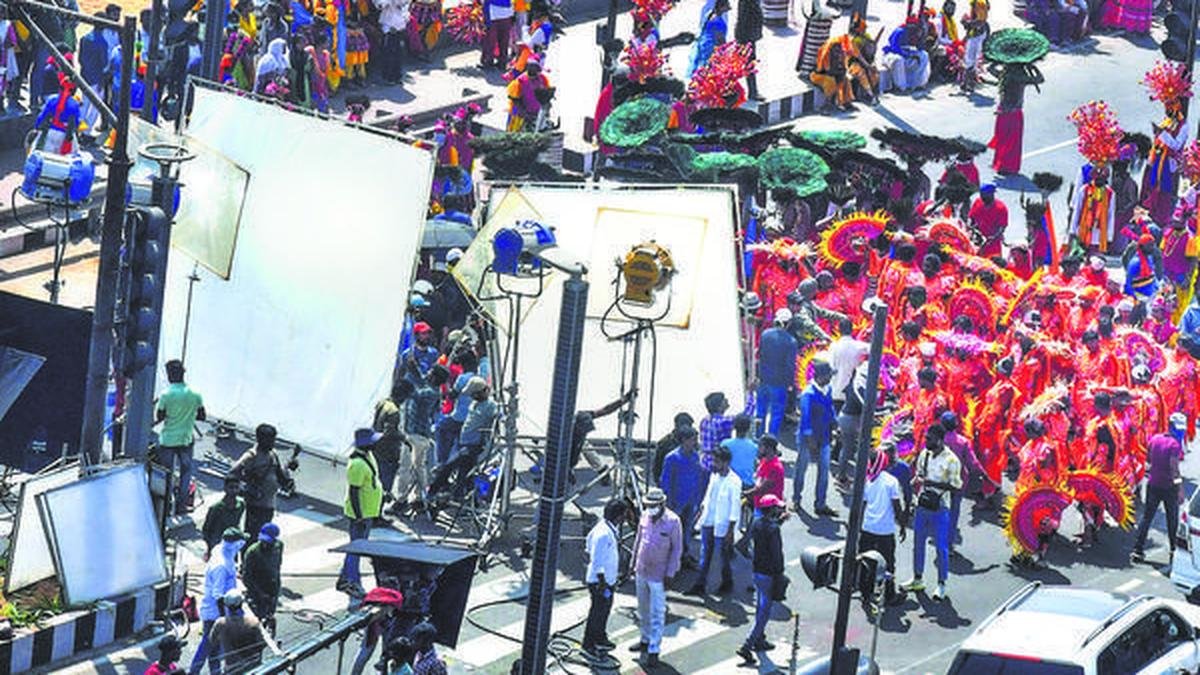
Long before the glass towers in Hyderabad defined Telugu cinema, filmmakers had pointed their lenses at the shores of Visakhapatnam. For over 60 years, this coastal city – home to beaches, hills, colonial-era architecture, university campuses, and lush valleys – has shone on the silver screen.
What started with a landmark black-and-white film in the early 1960s gradually evolved into a tradition that has drawn directors from Telugu, Tamil, Odia and other film industries to the city.
One among them is Tollywood director Praveen Kandregula, who says filming in Visakhapatnam rarely feels like work, asserting that the city is one of the most versatile outdoor filming destinations in southern India. His one of the recent directorial stints was Subham (2025).
The nearly 25-day shooting schedule for the film, primarily shot in Bheemili, a town 30 kms away from Visakhapatnam, felt more like a holiday than a shooting schedule, he says. “We chose Bheemili as the primary location for the film because the town’s expansive beach, wide frames, and infinity views gave us the visual scale.”
“It doesn’t feel like you’re travelling somewhere else. It feels like you’re in your own hometown,” says the director, who grew up in Visakhapatnam and worked as a cinematographer on films shot in the city before becoming a director.
His experience is merely the latest chapter in a cinematic relationship that spans more than six decades.
For a retired professor who watched her first major film shoot as a child, a veteran actor whose journey from theatre to cinema began in Visakhapatnam, and a contemporary filmmaker who continues to return home with his camera, the city remains much more than a backdrop. It is an enduring character in its own right.
Before the cameras arrived
For Dr. Rachakonda Parvathi, 70, retired Professor of Physiology at Andhra Medical College, Visakhapatnam’s association with cinema predates the arrival of large film units. She remembers the Beach Road of her childhood as a spectacular drive where the road climbed gently towards Andhra University, offering uninterrupted views of the sea, red dunes and dense greenery.
Among the elegant villas overlooking the coastline lived actor and dancer Jayashree, known for her performance alongside L. Vijayalakshmi in Kanchu Kota. The city also has an early association with Waheeda Rehman, who spent part of her childhood in Visakhapatnam while her father was posted here.
Dr. Parvathi recalls that Rehman studied at St. Joseph’s Convent before making her Telugu debut in Rojulu Marayi. These recollections form part of the city’s lesser-known cinematic history.
Yet it was Kula Gothralu (1962), starring Akkineni Nageswara Rao and Krishna Kumari, that firmly established Visakhapatnam as a filming destination. Film historians generally regard it as the first feature film to be extensively shot in the city. “The shooting of Kula Gothralu became the most talked-about event in Visakhapatnam,” says Dr. Parvathi. “ANR and Krishna Kumari were showered with affection. People treated them as though they belonged to the city.”
Every morning, residents eagerly waited to learn where the unit would shoot next.
One day it was Scandal Point overlooking the sea. Another day it was the Sri Satyanarayana Swamy Temple inside Andhra Medical College. On another occasion it was the Simhachalam temple. “The whole town seemed to revolve around the film,” she says.
The film became an inadvertent visual archive of Visakhapatnam in the early 1960s. The duet filmed against Dolphin’s Nose captured the coastline from the sea. Lawson’s Bay’s casuarina groves, the coconut plantations of Yarada, the stone steps leading to Simhachalam temple and sweeping views from Isuka Konda all appeared on screen.
Even Peerla Koneru, behind what is today the Vizag Central shopping complex, and clusters of thatched houses found a place in the film, preserving images of a town that has since transformed beyond recognition.
Theatre opened the door to cinema
If Kula Gothralu introduced the city to filmmakers, the flourishing theatre movement of the 1960s and 1970s helped supply actors. Among them was Susil Kumar Misro, whose acting career began while studying at A.V.N. College around 1965. Later, he completed diploma courses in acting and direction at the Department of Theatre Arts, Andhra University, while continuing to perform with his own theatre troupe.
His entry into films came unexpectedly. Producer A.P. Gangadhara Rao and director B.V. Prasad were scouting Visakhapatnam for locations and new faces when they watched a rehearsal at the Convocation Theatre. “They watched our rehearsal quietly and left,” Mr. Misro recalls. “Later they came back and told me there was a role for me.”
The opportunity became his screen debut in Needaleni Adadi (1974), after which further offers followed. “We never dreamt of entering cinema,” he says. “We simply looked at it as another role, much like acting on stage.”
Balachander discovers Vizag
Few filmmakers are remembered in Visakhapatnam with as much affection as K. Balachander. His landmark film Maro Charitra (1978), starring Kamal Haasan and Saritha, transformed the city’s dramatic coastline into one of the most recognisable visual landscapes in Indian cinema.
Mr. Misro, who played Saritha’s brother-in-law in the film, says Balachander fell in love with the “city’s geography”. “He loved Visakhapatnam – the hills, the beaches and the waves,” he recalls. “Marina Beach in Madras has a shoreline, but it doesn’t have the rocky coastline and hills that Vizag has. He was perhaps the first filmmaker to fully exploit the city’s natural beauty on screen.”
The film was shot across Gangavaram, the red hills near the coast and Bheemunipatnam. Its climax was filmed inside a dilapidated building near Bheemunipatnam that Mr. Misro believes dates back to the Second World War.
Balachander’s influence extended beyond locations. Coming from a theatre background himself, he cast several local artistes, including Dr. Tambu and Dr. Adams, alongside established actors.
“The atmosphere on his sets was never formal,” Mr. Misro says. “He behaved like a friend.” His admiration for Visakhapatnam left a lasting impression on later filmmakers. Mr. Misro remembers that director K. Viswanath, with whom he later worked in nearly nine films, generally avoided using locations that Balachander had already filmed, partly out of professional respect.
Among Viswanath’s films, Sagara Sangamam (1983) was partly shot at the Park Hotel in Visakhapatnam. Mr. Misro recalls that two adjacent buildings at the then Park Hotel were used as neighbouring houses in the film. Over the years, he acted in around 55 films and more than 30 television serials, a career that, he says, brought him “more respect than money”.
For contemporary filmmakers, Visakhapatnam continues to offer a rare diversity of landscapes. Within a few hours’ drive lie beaches, fishing villages, forested hills, waterfalls, coffee plantations, colonial buildings and heritage institutions.
Mr. Kandregula says Andhra University’s century-old buildings remain among his favourite filming locations. “They have a timeless character that’s difficult to find elsewhere,” he says. “The campus is filled with large trees, and visually it works beautifully.” His recent film Subham made extensive use of Bheemunipatnam’s Dutch-era buildings and clock tower, while other portions were filmed at Rushikonda, Tenneti Park and along Beach Road.
Further inland lies Araku Valley, which he describes as “our own mini-Ooty”. “We’ve returned there repeatedly for songs and outdoor sequences. It’s one of the most beautiful places to shoot,” the Subham director says
“There isn’t just one good location here,” he says. “There are countless places suitable for filming.” Equally important, he adds, is the atmosphere. “Vizag is away from the chaos. The sea gives you peace. Shooting here is mentally calming.”
An untapped film hub
Despite its cinematic legacy, Visakhapatnam has never evolved into a permanent production centre comparable to Hyderabad or Chennai. Most actors, directors and technicians who begin their careers in the city eventually migrate elsewhere.
Mr. Kandregula believes that should change. “There is extraordinary artistic talent in Vizag,” he says. “Many people move to Hyderabad, Mumbai or even abroad. I’ve always felt Vizag has the potential to become a major centre for entertainment and cinema.”
He points to the availability of coastal locations, varied landscapes and relatively smooth shooting permissions as advantages that could encourage greater investment in film production. Whether that vision materialises remains uncertain. Unlike Hyderabad, where studios, post-production facilities and allied industries developed together over decades, Visakhapatnam has largely remained an outdoor location rather than a fully integrated production ecosystem. Yet the city’s relationship with cinema continues to deepen.
In recent years, Telugu films such as C/o Kancharapalem, Majili, Jaanu, HIT: The Second Case and Waltair Veerayya, along with Tamil productions such as Singam 3, have continued to showcase Visakhapatnam’s beaches, neighbourhoods, harbour and other landmarks, reaffirming the city’s enduring appeal as a filming destination.
For Dr. Parvathi, the city has changed almost beyond recognition since she watched Kula Gothralu being filmed more than six decades ago. The quiet beaches have become busy promenades. Coconut groves have given way to apartment blocks. The small town where film stars attracted crowds wherever they went has grown into one of India’s largest port cities.
Yet one thing has remained remarkably constant.
Filmmakers continue to return.