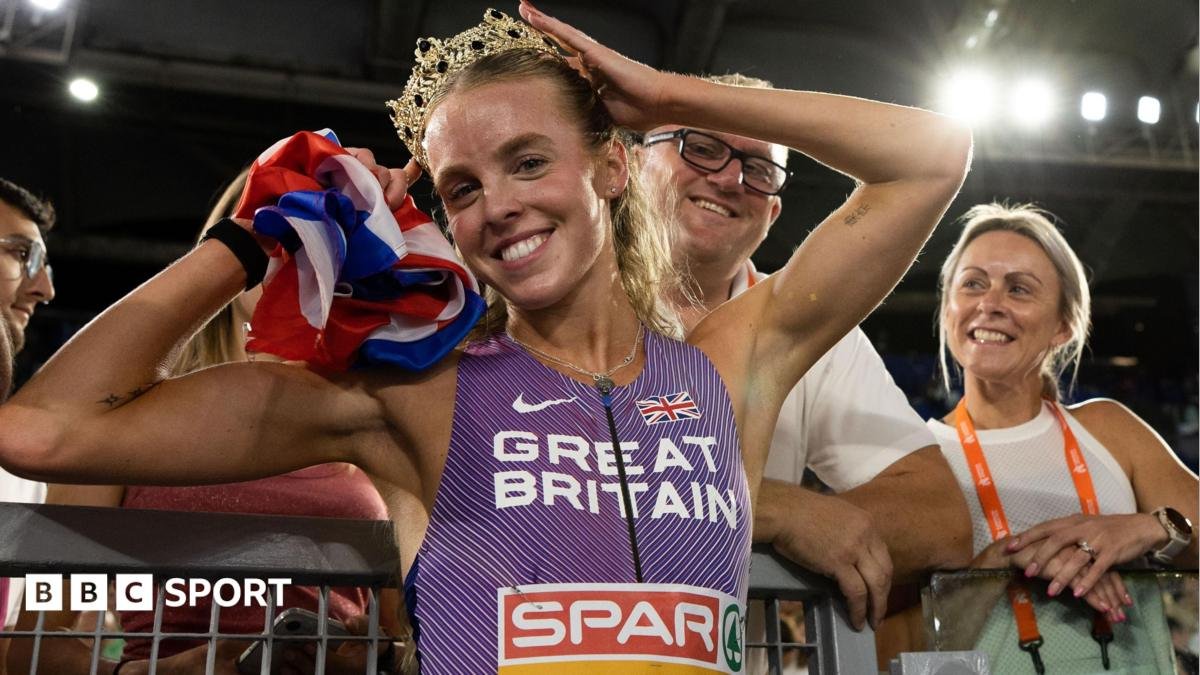
ByHarry PooleBBC Sport journalist The Olympic champion and the world silver medallist over 800m embrace by the side of the track after surviving their latest brutal training session together during an east Manchester downpour.
A short while ago, Keely Hodgkinson lay flat out on the track.
Coach Trevor Painter, aware it may be some time before Hodgkinson can move again, places an opened umbrella beside his star athlete to shield her from the incessant rain, before running for cover.
It requires the assistance of two team-mates to eventually peel her off the ground.
Georgia Hunter Bell, meanwhile, uses the little energy she has left to take herself away to be sick.
Observing it all, Painter jokes he is mostly disappointed that relatively few of their team-mates have suffered the same fate on this occasion, when the cameras are rolling.
This is, after all, what it takes to be part of M11 Track Club, where the emphasis is on fun until the stopwatch starts.
Named after the postcode in which it is based, the near-30 strong international training group continue to create history under the guidance of the meticulous Painter and partner Jenny Meadows, a world medallist who has put herself through all the anguish she now oversees.
There is no doubt in the mind of Hodgkinson, winner of six global medals in as many years as a professional athlete, about the important role of this support system in her monumental achievements.
"I think it's everything," the 24-year-old Hodgkinson tells BBC Sport.
"I probably wouldn't be the person I am without it.
We have a very fun approach to training, I love everybody in this group.
"Environment is everything.
We have people from all around the world training here.
We all get along really well, we're all respective of each other's journey, and we all know that if we want to continue being the best, we've got to train with the best.
"And it works." Image source, Getty Images Image caption, Keely Hodgkinson has 11 senior international medals - six at global level - as she looks to add to her haul at this week's European Championships in Birmingham The sense of community and camaraderie among individuals from around the globe is instantly evident as the team arrive and gather in a small room to begin their activation work and receive light physiotherapy.
Newest recruit Gaia Sabbatini, who has traded training in Rome to be here, is welcomed with happy birthday wishes and balloons - but there is a prevailing sense of apprehension among the athletes about what lies in store.
The miserable weather is the least of their worries, and it will not be long before the Italian is telling us all that she feels like she is "dying".
Painter might be the only one laughing and joking at that stage, but that is mostly founded in the knowledge that, by the time they are done here, they will each be sufficiently exhausted to know they are another step closer to realising their goals.
This is, after all, part of the deal.
"I'm really passionate about the environment we've created," Painter says.
"There are a lot of friendships, it is like a family.
But, when the time comes, you roll your sleeves up.
"There will be people bent over being sick and going to a very dark place during training, but the friendships and the fun that we have make it that little bit easier." A lactic acid-inducing session comprising 400m intervals in early June signals the start of a specific 800m training block to prepare for the summer's major targets.
That Hodgkinson was able to run a British 800m record in Stockholm just a few days before, having not begun her event-specific work, was cause for significant optimism, albeit she was outshone by Swiss athlete Audrey Werro clocking the fastest time since the world record was set 43 years ago.
Despite the conditions, Painter informs us that Hodgkinson, perhaps motivated by that unexpected defeat, has outperformed all expectations.
She has beaten her personal best splits for this session, going faster than times posted in the lead-up to an outstanding indoor season in which she captured world gold and the indoor 800m world record.
Image caption, Keely Hodgkinson, who joined local club Leigh Harriers at the age of nine, has been coached by Trevor Painter since she was 17 The M11 foundations were in place long before Hodgkinson's father suggested the group's now globally recognised title.
Painter, who boasts a background in rugby league and an impressive 47-second 400m time, has overseen Hodgkinson's development since she was 17.
Before then, he coached Meadows to international success.
It has taken just two years for Meadows' vision of an official Manchester-based training group to become reality and earn a global reputation.
"I think everyone thought I was quite deluded.
I had a vision of this happening, but I didn't quite know how we were going to achieve it," says Meadows.
"At first, when we would hear people from other nations talk about M11, I was almost like, 'oh my gosh, they've said M11'.
It's almost like a project that I brought home from school, and people are talking about it.
"Now people know instantly: that's Jenny and Trevor, that's some of the best athletes in the world.
You don't have to explain what M11 is.
It's pretty incredible." Reaching that stage was never a given.
The process was undoubtedly accelerated by Hodgkinson's rise to Olympic gold, and further medals at Paris 2024 for team-mates Hunter Bell and Lewis Davey.
The sustained success on the track has allowed Painter and Meadows to expand the scale of their operation, with backing from big-name sponsors helping to add an assistant coach, track-side physiotherapist and dedicated physiologist.
"Back in the day, it was difficult because you're working on a shoestring budget, trying to make things happen," says Painter.
"But, as Keely comes along and does well, you get a little bit of help from here and there.
"Then, as more people come and we have more success, we can go back to the sponsors and they give us a little more.
It pays for strength and conditioning support, nutrition support, trackside physiotherapy - all which keep the athletes healthy.
"If they're healthy, they can do their job of running as fast as they can." Defiant Hodgkinson says home European title would mean as much as Olympic gold Published 12 hours ago Hunter Bell eyes ambitious sweep after Glasgow gold Published 31 July Image source, Getty Images Image caption, Trevor Painter helped partner Jenny Meadows achieve world 800m bronze in 2009 among her seven major international podium finishes The public-use SportCity track in the shadows of Manchester City's Premier League stadium, the occasional car park in Wigan, and the famous dirt track ascending 'hell hill' on South Africa training camps are humbling, no-nonsense settings for some of the world's top athletes to be honing their craft.
But they are very much in keeping with the values which Painter and Meadows have instilled in a group that continue to hit spectacular heights.
There are no egos among a carefully hand-picked selection of athletes who push each other on and, when needed, pick each other up.
The knock-on positive impact on athletic performance, in what is typically considered an individual sport, is at the heart of what Painter and Meadows have built - and why they continue to prioritise protecting that ecosystem.
"The team aspect is so powerful.
It doesn't matter which athlete it is; if someone's having a bad day, there's always someone to put their arm around you or give you that little motivational comment that helps you back out of your mood," says Painter.
"We celebrate each and everybody's wins - and we suffer each and everyone's losses, pains and injuries.
"People who come into the squad, they look around and they see the Olympic champion on her hands and knees being sick, and the next minute she's getting ice poured over her.
It's like, 'oh, right, that's normal, is it?'" Despite social media evidence to the contrary, Painter pleads he is "not always the culprit" when it comes to the pouring of ice buckets.
Image caption, Keely Hodgkinson has made clear her intention to break the women's 800m record, which stands at one minute 53.28 seconds and was set in 1983 As the group's pursuit of global titles and world records has gathered momentum, it has left no shortage of prospective athletes desperate to be invited in.
Painter and Meadows are inundated with applications from eager individuals via social media, email and in person, while sponsors Nike will also suggest athletes for their consideration.
Although most athletes on the circuit are known to them, Painter and Meadows are extremely thorough in their process of identifying those that are the right fit and will seek to gather information on any names which come their way.
If they appear suitable, and if they decide there is room for development, the M11 coaches will arrange an informal chat with the athlete, before inviting them to take part in a session and observe how they fit into the group.
"We look at where athletes are, what the trajectory is like, what they've done in the past," says Painter.
"Some athletes have done far too much as youngsters.
They've been pushed too hard and there's not much you can do to fix them.
There's others that haven't done enough and you've got to work out how to take them from where they are to what I think they need to do.
"But character-wise is the most important factor because I'm going to get them to do some horrific things in training.
"Whether that's hill sessions or track sessions, there's no getting away from the pain.
"Those that are prepared to do that, and have fun along the way, are welcomed in.
It's a long process, but we've got to protect the environment." Image source, Getty Images Image caption, Georgia Hunter Bell still worked full-time in 2024, the year she completed a remarkable rise to the Olympic podium Painter and Meadows were crowned BBC Sports Personality Coach of the Year winners in 2024.
They remain resolutely modest when it comes to their own achievements, while the results continue to speak for themselves.
The demand for their attention is no surprise.
When Hodgkinson joined Painter, she could run 400m in around 57 seconds and 800m in two minutes and 4.26 seconds.
Having lowered those personal bests to 51:14 and 1:54.33 respectively over seven years, she has established herself among the sport's leading stars.
Hunter Bell was in full-time work when she re-established contact with childhood coach Painter at the end of 2022, having not worn a pair of spikes for five years after falling out of love with the sport during her time on a track scholarship in the United States.
The 32-year-old has gone on to win six international medals, including Olympic bronze, world silver and the world indoor 1500m title.
Meadows famously joked "that ship has sailed" upon learning the former English schools champion had got back in touch with Painter.
But Hunter Bell is arguably as good a reference as Hodgkinson of Painter's talent for developing athletes, evident once again at this year's World Indoors when the pair celebrated their respective 800m and 1500m triumphs together on the track.
It is not only athletes who are desperate to join the project.
Some 180 applications were received for the role of physiologist alone, with Rachel McCormick willing to uproot her life from Australia to take the job.
Concerns held by Painter and Meadows over whether M11 was "going to be enough" for McCormick to justify the move across the world were soon dispelled.
"When I was applying for the job, I thought 'I didn't know there was a dream job out there, but this could genuinely be it'," says McCormick, who has published more than 50 research papers.
Having joined in late 2025, McCormick has taken time to pore over data from each athlete, measuring how they respond during and after sessions, and how well they recover and adapt, and is now in the first season of using that to feed into training.
"This is an incredibly elite group, and Trevor and Jenny have a history of success, so I haven't exactly come in here and revolutionised anything," McCormick says.
"What I've been trying to look for are the small wins.
Where can I get the biggest gain without changing or drastically shifting anything that they're already doing?" Image source, Getty Images Image caption, The M11 group will often escape to warm weather training camps during the year The fine details in which McCormick specialises were not as readily available to Meadows during her own career on the track.
Meadows says their new team member's credentials "absolutely petrified" her and Painter initially.
Today, McCormick is busy chasing after athletes to take blood lactate levels in between their efforts, and she will continue to process and analyse them long after the session has ended.
A smart ring, worn on the finger of the athletes, assists in monitoring their data away from the track.
The training methods at M11, centred on gruelling intensity in sessions and the utilisation of cross-training to aid recovery, are different to anything McCormick says she has seen before.
Her readings back that up.
"Middle distance is really interesting in that there are so many ways to train for the events," says McCormick.
"Georgia and Keely are very different athletes, yet in the 800 they're within a second of each other.
I'd like to think that the data I'm collecting will give us insights that most people don't have." Meadows says: "We might think athletes are adapting to training a certain way because we know what the stopwatch says, but Rachel can give us in-depth data about that and help us to make smarter decisions.
"We are hunting for a world record with Keely in the 800m, Georgia might decide to double up on events at the next Olympics, so it's asking 'how do we get all of that right?'." Image source, Getty Images Image caption, Georgia Hunter Bell and Keely Hodgkinson achieved an M11 double on the world 800m podium in Tokyo There is perhaps no greater indication of the strength of the environment which Painter and Meadows have fostered than the handling of last year's World Championships in Tokyo.
Hodgkinson, fighting to recover from two hamstring tears earlier in the year, was joined by the ever-improving Hunter Bell in setting sights on the same 800m gold.
It was a potentially awkward scenario that would end with two medals - and the two M11 athletes singing karaoke together late into the night.
With both set up to achieve success based on the best individual plan for them, Hodgkinson and Hunter Bell were able to proceed as normal, even performing warm-up drills together in the corridor of their hotel to escape the stifling humidity outside.
The pair have become close friends since Hunter Bell returned to the sport, and closer still following their shared experience in Tokyo.
That is something Hodgkinson feels is "the opposite of what a lot of people might think would happen".
Despite being overhauled and pipped to silver by her team-mate in a dramatic finish, Hodgkinson celebrated together with Hunter Bell on the track.
"I feel like we're like sisters," says Hunter Bell.
"Obviously, when we step on the start line, we both want to win.
But day-to-day, it's just like being with your best mates and it allows us all to train really hard." That is a sentiment echoed unequivocally by Hodgkinson, who said: "We have a great relationship.
In a weird way, [competing against each another] actually made us better friends.
"I'm just grateful to have her to train with because I think it genuinely pushes us on to be better and better." But it all comes back to the coaches who have led them here.
"Together they're a really good guiding force, but you do see them like family, like second parents," says Hunter Bell.