
Rolling coverage of the latest economic and financial news
33s agoDebt interest bill hits August record at £8.8bn
9m agoONS: borrowing higher than the official forecast
12m agoIntroduction: UK borrowing jumps to £18.3bn in August

Good morning, and welcome to our rolling coverage of business, the financial markets and the world economy.
Britain’s national debt is rising faster than expected after the government borrowed more than expected, again, to balance the books.
The latest public finances data, just released, shows that the UK borrowed £18.3bn in August, which is £2.9bn more than in August 2025, as spending rose faster than government income.
This is higher than the £15.6bn forecast by the City. But more importantly, it’s £3.5bn above the Office for Budget Responsibility (OBR)‘s forecast for August.
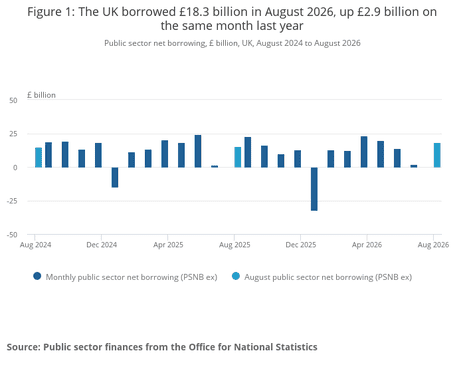
And it means that so far this financial year, the UK has borrowed £8.1bn more than the OBR’s forecast.
This all adds up to a headache for chancellor John Healey as he works on next month’s budget, as the recent bond market turmoil has eaten into his ‘headroom’ to keep within the fiscal rules.
Emeritus professor Joe Nellis, head of economic research at accountancy and advisory firm MHA, says this morning’s data is “another reminder of the fiscal straightjacket facing the Government” ahead of the budget.
But why is the deficit proving so hard to reduce? The weakness lies mainly on the expenditure side. Higher inflation is impacting spending on public-sector pay, state benefits and pensions. And last week’s announcement that inflation has hit 3.1% will not have helped. On top of this, the cost of servicing the national debt remains exceptionally high. Public sector net debt is just below £3 trillion, representing around 94% of GDP, the highest since the early 1960s.
But why is the deficit proving so hard to reduce? The weakness lies mainly on the expenditure side. Higher inflation is impacting spending on public-sector pay, state benefits and pensions. And last week’s announcement that inflation has hit 3.1% will not have helped.
On top of this, the cost of servicing the national debt remains exceptionally high. Public sector net debt is just below £3 trillion, representing around 94% of GDP, the highest since the early 1960s.
The agenda
7am BST: UK public finances for August
10am: UK Treasury Gilt 2032 Auction
11am BST: CBI industrial trends report
3pm BST: Eurozone consumer confidence report
The cost of servicing the UK’s national debt has hit a record high for any August, as rising inflation drove up interest payments.
Today’s public finances show that central government debt interest bill was £8.8bn in August – the highest August figure since monthly records began in 1997.
This includes a £2.1bn bill on index-linked gilts – bonds where the repayments is linked to the RPI inflation rate.
August’s debt bill was lower than in each of the first three months of the current financial year, the ONS points out.
These debt payments are soaking up money which could otherwise be used to fund schools, hospitals, defence, or all the demands on the public purse.
Nabil Taleb, economist at PwC UK, explains:
Higher debt servicing costs absorb a greater share of government revenues, reducing fiscal room and leaving the public finances more exposed to future economic shocks. “A better near-term borrowing outturn would help, but it would not remove the pressure created by higher government borrowing costs. Thirty-year gilt yields recently reached their highest level since 1998, which matters because it raises the cost of long-term financing at a time when fiscal room is already tight. While higher gilt yields do not feed through into debt interest costs immediately, they make it harder for improvements in the monthly borrowing figures to translate into lasting fiscal headroom. For the Budget, that leaves the government relying not just on better borrowing data, but on some easing in borrowing costs as well.”
Higher debt servicing costs absorb a greater share of government revenues, reducing fiscal room and leaving the public finances more exposed to future economic shocks.
“A better near-term borrowing outturn would help, but it would not remove the pressure created by higher government borrowing costs. Thirty-year gilt yields recently reached their highest level since 1998, which matters because it raises the cost of long-term financing at a time when fiscal room is already tight. While higher gilt yields do not feed through into debt interest costs immediately, they make it harder for improvements in the monthly borrowing figures to translate into lasting fiscal headroom. For the Budget, that leaves the government relying not just on better borrowing data, but on some easing in borrowing costs as well.”
Self-assessed (SA) Income Tax receipts over the last two months jumped notably, today’s public finances show.
SA income tax payments in July and August were £18.6bn in total, which is £1.9bn more than in the same period last year.
ONS senior statistician Tom Davies said:
“Borrowing in the financial year so far was lower than over the same period last year. However, it was higher than the official forecast, largely because central government borrowed more than anticipated. “On the month, borrowing was up by almost a fifth on last August, as spending increased more than government income partly reflecting the impacts of inflation.”
“Borrowing in the financial year so far was lower than over the same period last year. However, it was higher than the official forecast, largely because central government borrowed more than anticipated.
“On the month, borrowing was up by almost a fifth on last August, as spending increased more than government income partly reflecting the impacts of inflation.”
There is one piece of good news in the public finances – the UK has borrowed less so far since April than a year ago.
So far this financial year, the UK has borrowed £77.3bn, which is £2.2bn less than in the same period last year (but £8.1 billion above the OBR forecast).
And as a share of the economy, it’s actually the 10th-lowest April to August borrowing since comparable monthly records began in 1993.