The Argiope bruennichi, spotted in Cheshire for first time, part of worrying trend that could threaten native species
She is an unlikely harbinger of the climate emergency: a venomous black and yellow spider who spins mysterious patterns in her webs and eats her mates for breakfast.
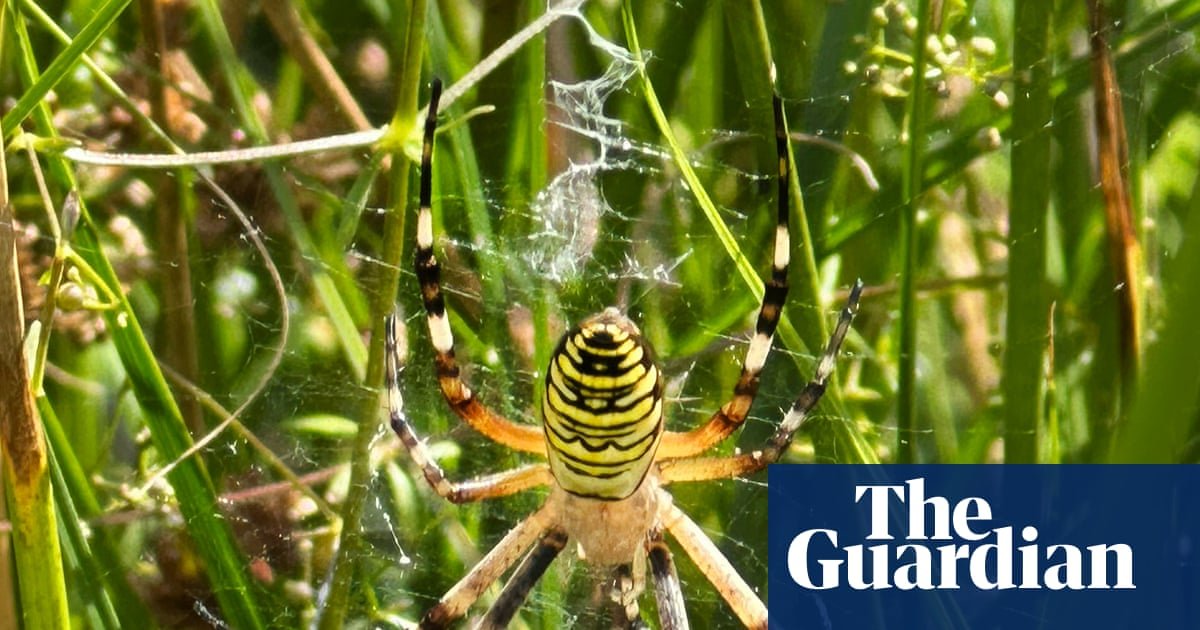
Native to mainland Europe, north Africa and Asia, the Argiope bruennichi – commonly known as a wasp spider – is rarely seen in the north and west of Britain. But a fully grown female has been spotted in Cheshire for the first time by conservationists from Chester zoo, who stumbled across the large, brightly striped arachnid in a rewilded field.
The species, which mimics a wasp to deter predators, is thought to be the latest “climate refugee” extending its range northwards as the planet heats.
Females can grow to about 2cm in body length, making it one of the largest spiders found in the UK.
“You know your big, chunky house spiders – the ones you think are massive and frighten the life out of you in your living room? A female wasp spider is probably a bit bigger than those,” said Scott Wilson, head of field programmes at the zoo.
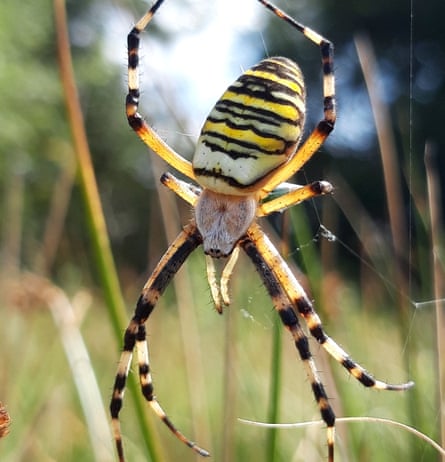
Although they are not dangerous to humans, they often attack and cannibalise their mates during or after copulation.
Males usually reach only about a quarter of the length of the females and studies have found that up to 80% die after their first mating attempt while the rest die after their second. Their body then provides the female with valuable protein as she produces her eggs.
It is not yet known how the spread of the wasp spider, which was also revealed to be moving west into counties such as Worcestershire, Herefordshire and Warwickshire last week, will affect local ecosystems in the north. “That’s quite often the risk with these ecological shifts – we don’t know what the implications will be,” said Wilson.
The spider recorded in Cheshire was discovered on the Chester zoo estate during a routine “bioblitz” to monitor biodiversity on 80 hectares of land being set aside for nature. An expert from the British Arachnological Society later confirmed it was the first recorded sighting of the species in the county.
“It was quite easy to spot,” said Wilson. “It’s a really big, colourful spider and the webs are huge and distinctive … They have this thick zigzag, which some people think is there to reflect UV light and attract insects, but nobody really knows.”
The wider zoo estate, which includes wet meadows,grasslands, woodlands and orchards, already supports a diverse range of important UK species, such as great crested newts, badgers and harvest mice. It also hosts nesting barn owls and dozens of dragonfly, moth and butterfly species.
Wasp spiders are typically found in sunny, open grasslands across Europe. The species was first recorded in the UK in the 1920s but Wilson said there had only been “a handful” of sightings north of the Midlands to date. Spiderlings are known to travel long distances by ballooning on silken strands in the wind and he fears the spider spotted in Cheshire – which the zoo has nicknamed ‘Wendy’ – is the latest indication of how the warming climate is affecting UK wildlife, creating “climate refugees”.
“Her arrival is part of a broader, more worrying trend,” he said. “You get quite excited about spotting a new species, but the bigger picture for climate change impacts on species is generally negative … We’re seeing lots of species change their range.”
Ruby Merriman, Chester zoo’s estate biodiversity manager, said wasp spiders were slowly moving north as their southern ranges in Europe warm too quickly for them to adapt. “Some conservation organisations refer to animals driven to migrate by climate change as ‘climate refugees’ – which is a good term. They are moving because of human activity, and we need to make space for them.”
Wilson is concerned the trend means invasive non-native species, such as Asian hornets, will spread northwards in the UK in the future, and that native species will go extinct because they are unable to either migrate or survive in the changing climate. As in other countries, the climate emergency poses a major threat to UK wildlife. “We don’t have the big high-profile animals like polar bears – but it’s as relevant to us as it is to any other country … In the UK, we’ve got a very fragmented landscape. So a species that is only found in heathland in a particular county will be under real threat if suddenly that heathland becomes too warm or too cold.”
Although the wasp spider can bite, it is unlikely to hurt a human unless harassed. Its venom is “probably about as harmful as a nettle sting”, Wilson said. “To us, anyway,” he clarified. “If you’re a small insect in its web, then it’s a different story.”