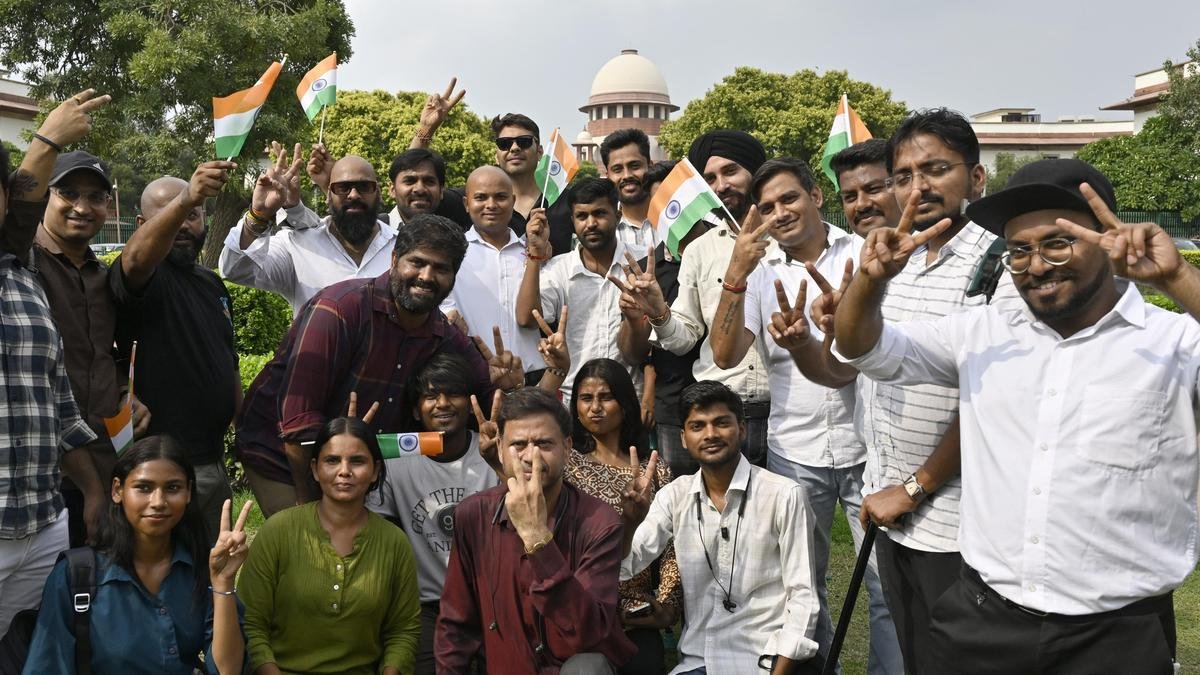
The story so far: The Supreme Court took an extraordinary step on Tuesday (September 1, 2026) to quash criminal cases registered against Gen Z protesters involved in nationwide protests linked to the Cockroach Janta Party (CJP) following the NEET-UG 2026 question paper leak.
A three-judge Bench headed by Chief Justice of India (CJI) Surya Kant exercised its absolute powers under Article 142 of the Constitution to do “complete justice” and ensure that the “FIRs will not be investigated, and will be closed for all intents and purposes”.
What is Article 142?
Article 142 empowers the Supreme Court to “pass a decree or make such order as is necessary for doing complete justice in any cause or matter pending before it, and any decree so passed or order so made shall be enforceable throughout the territory of India”. It gives the Supreme Court broad inherent powers.
How expansive is this power?
In Prem Chand Garg v. Excise Commissioner, U.P. (1963), a Constitution Bench considered whether the Supreme Court could frame a rule or issue an order under Article 142 that was inconsistent with a fundamental right. The court held that though the power under Article 142 is wide, it cannot be exercised to make an order that is plainly inconsistent with a constitutional provision. The judgment therefore placed an important constitutional limit on the otherwise wide power.
In I.C. Golaknath v. State of Punjab (1967), the court described Article 142 as a wide and elastic power that enables it to formulate legal doctrines where necessary to meet the ends of justice.
In Union Carbide Corporation v. Union of India (1991), the court took a broader view of the power, holding that limitations or prohibitions contained in ordinary laws do not, by themselves, operate as limitations on the constitutional power under Article 142.
The same year, in Delhi Judicial Service Association v. State of Gujarat (1991), the Supreme Court held that its powers under Article 142, read with Articles 32 and 136, could be exercised to quash criminal proceedings in an appropriate case to do complete justice. The court emphasised that Article 142 operates at a different level from ordinary statutory powers.
It was again recognised in Supreme Court Bar Association v. Union of India (1998), where the Constitution Bench described Article 142 as a plenary, supplementary and residual source of power available to the Supreme Court to ensure due process and do complete justice between the parties. But this judgment is equally important for establishing the limits of that power.
In Shilpa Sailesh v. Varun Sreenivasan (2023), the Constitution Bench gave perhaps the clearest illustration of the breadth of Article 142. It held that the Supreme Court can, in an appropriate case, depart from procedural as well as substantive law, provided the exercise is based on fundamental considerations of general and specific public policy. The court consequently held that it could dissolve a marriage on the ground of irretrievable breakdown and waive the statutory procedure for a second motion in a mutual-consent divorce.
What are the limits?
The first important limit came in the case of Prem Chand Garg, where the court made it clear that Article 142 cannot be used to pass an order inconsistent with the Constitution, including fundamental rights.
In Supreme Court Bar Association v. Union of India (1998), the court put the limit more precisely. It held that Article 142 is a curative power: it can supplement the law, but it cannot supplant substantive law. The court observed that the very nature of the power must lead the court to set limits for itself within which to exercise those powers, and ordinarily it cannot disregard a statutory provision covering a subject, except perhaps to balance the equities between the conflicting claims of the litigating parties by “ironing out the creases”. In that case, the court could not use Article 142 to suspend an advocate’s licence to practise because that power was vested by statute in the Bar Council.
In the case of Shilpa Sailesh, the court subsequently clarified that this does not mean every statutory requirement is an absolute bar on Article 142. The court said that it must consider the substantive law, but may depart from it where necessary to achieve complete justice, so long as the exercise does not violate fundamental considerations of general or specific public policy.
More recently, in High Court Bar Association, Allahabad v. State of U.P. (2024), the Constitution Bench reiterated that Article 142 must be used to do “complete justice” between the parties before the court and cannot be used to affect people who are not part of the case. The court cannot ignore the substantive rights of litigants. While it can issue directions to simplify or speed up court procedures, such directions cannot affect the substantive rights of those not before the court. The Bench made it clear that Article 142 cannot be used to violate the principles of natural justice, including the right to be heard before an adverse order is passed.
Over the years, this provision has been used to do “complete justice” in a given case and to fill what the court perceives as the legislative gaps.