Updated on: Aug 14, 2026, 11:53:13 IST By HT News Desk Prefer HTon Google Share via Copy link The Supreme Court on Friday stayed an order of the Madras high court, which quashed Tamil Nadu chief minister C Joseph Vijay's order providing government jobs to relatives of people who died in a stampede at Karur last year.
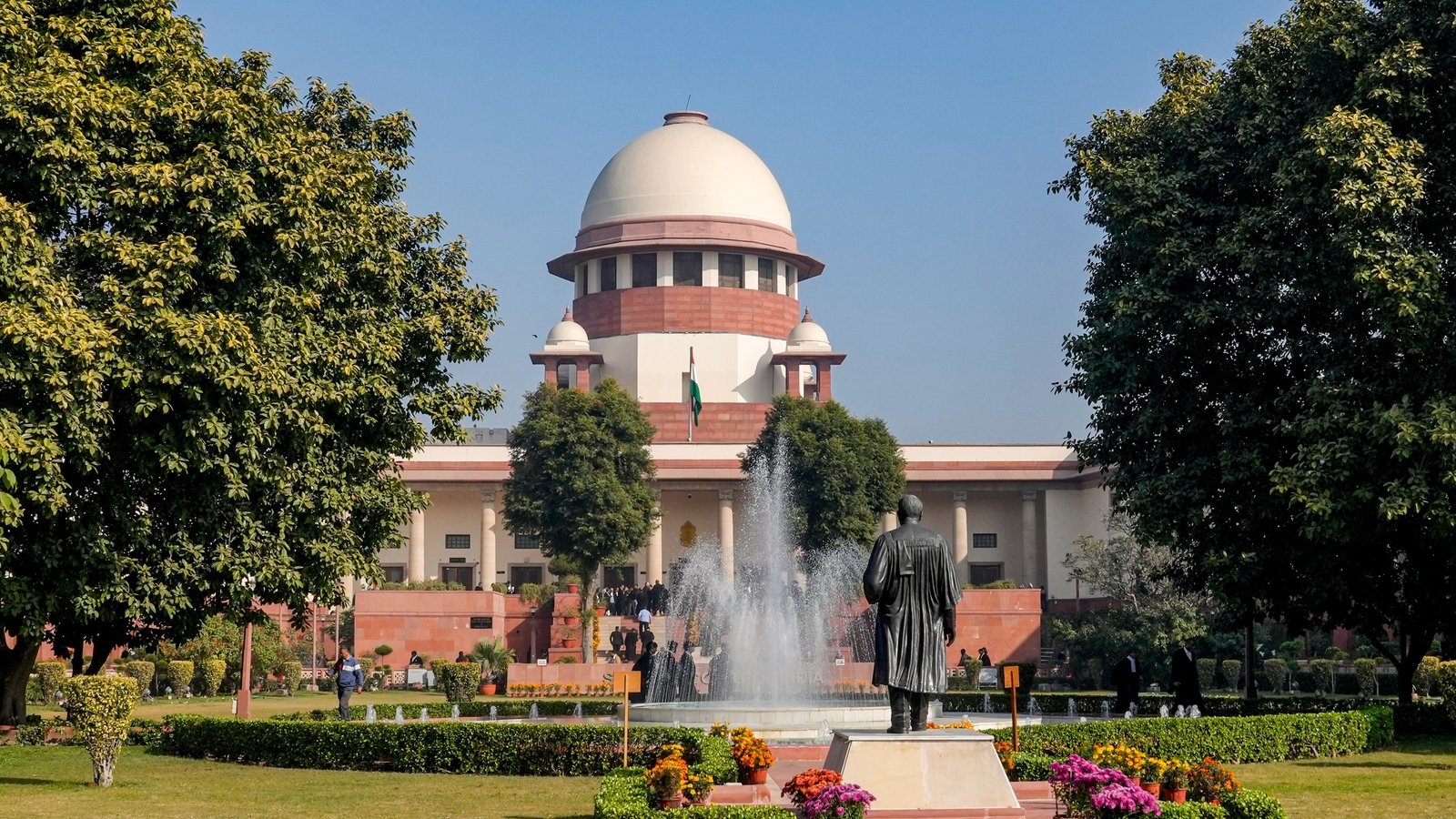
The Supreme Court of India. (PTI) A bench of Justices JB Pardiwala and K Vinod Chandran issued notice to the Tamil Nadu chief secretary and others.
“Who are you to question the policy of the government?
Suppose the sole member died in the tragedy, shouldn't the government give some employment to the son or daughter?” the bench told the PIL petitioner who had challenged the state government order.
The Karur stampede took place during a rally of Tamilaga Vettri Kazhagam chief and actor Vijay during the assembly election campaign on September 27, 2025, leaving 41 people dead and several others injured.
Vijay, who became the CM of the state after the TVK emerged as the single largest party in the assembly elections earlier this year, had visited Karur last month and participated in a series of government and party programmes, including the distribution of compassionate government job appointment orders to 32 legal heirs of victims who lost their lives in the Karur stampede.
The high court setback In what was viewed as a setback to the TVK government just weeks after the handing of appointment letters, the Madras high court on July 27 had quashed CM Vijay's order providing government jobs to relatives of people who died in a stampede at Karur, observing that it would open floodgates of similar demands.
A division bench comprising Justices CV Karthikeyan and R Sakthivel of the high court had held that it was not appropriate to overlook the needs of many who are awaiting compassionate appointments in government departments.
The court held that the CM's order violates Articles 14 (Right to Equality) and 16 (Equality of Opportunity in Government Employment) of the Constitution.
At the time, one of the advocates appearing for the petitioner said that the question of law was whether employment could be provided on compassionate grounds to the family members of those who died in the Karur stampede.
He said that they relied on an important Supreme Court judgment.
"The Supreme Court has already issued guidelines governing compassionate appointments.
Under that judgment, the Supreme Court laid down four guidelines.
According to those guidelines, the deceased persons in the Karur stampede do not fall within the eligible categories.
Therefore, they cannot claim employment under the existing guidelines for compassionate appointments...After considering our submissions, the court allowed our petition.
The government's main contention was that the jobs were given under a government policy.
Our submission was that the scheme was a political move.
Granting employment in this manner is not in accordance with the law or the applicable rules and regulations.
Therefore, it is not maintainable.
The court accepted our petition," Advocate Mohammed Rashid had said.
Operating round the clock, the desk brings together experienced editors, reporters and correspondents to deliver fast, accurate and contextual reporting across subjects that influence public policy, governance, business, society and international affairs.
The HT News Desk covers politics, elections, government policies, the economy, business and markets, science and technology, the environment, law and order, infrastructure, education, climate issues and geopolitics, while closely tracking developments across states, institutions and global capitals.
The team also leads coverage of major breaking news events, policy announcements, court proceedings, natural disasters, public emergencies and significant international developments.
Reports published by the newsdesk are based on information gathered from reporters on the ground, official statements, government agencies, court records, regulatory filings, recognised institutions and other authoritative sources.
Stories undergo editorial scrutiny and verification processes to ensure accuracy, fairness and relevance, and are updated as events evolve and additional information becomes available.