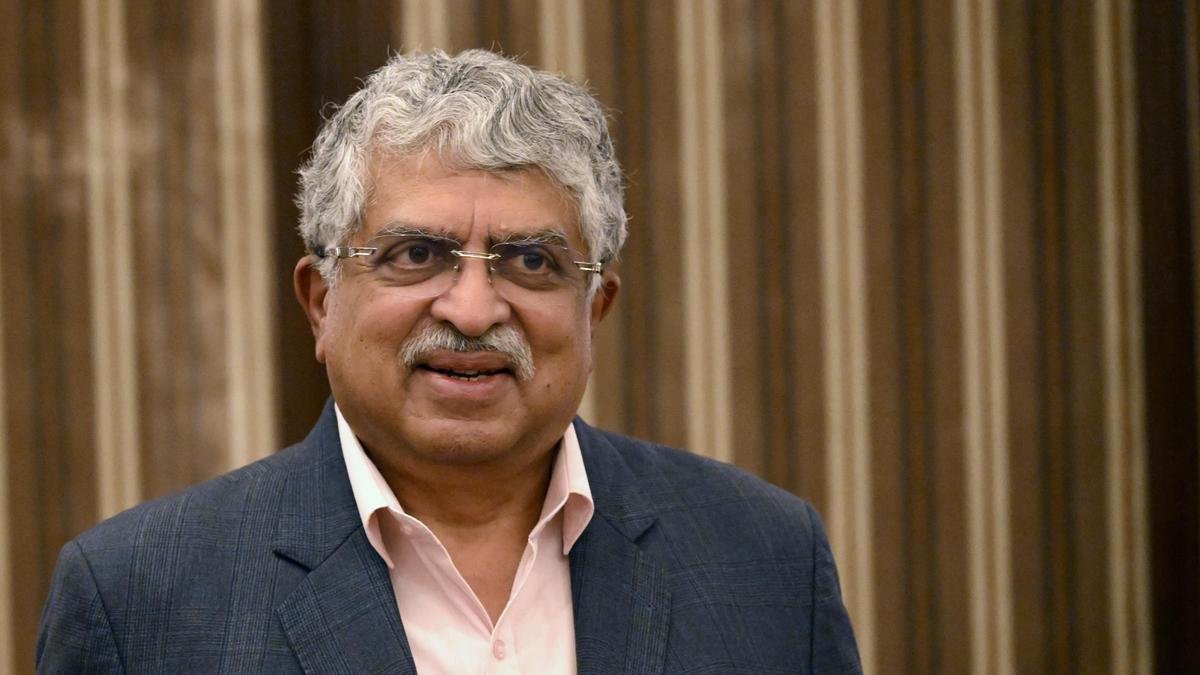
Nandan Nilekani, appointed by the Union government on Sunday (July 26, 2026) as the head of a high-powered task-force to bring about exam reforms, is an entrepreneur, technocrat, and bureaucrat. The techpreneur and co-founder of Infosys has transitioned from the private sector into public service and governance through several national and regional assignments.
Mr. Nilekani is a graduate in electrical engineering from the Indian Institute of Technology (IIT), Bombay. In 1981, Mr. Nilekani joined N.R. Narayana Murthy and five others to establish Infosys after leaving his job at Patni Computer Systems. Over the decades, he served as Managing Director, President and Chief Operating Officer in the company, and later went on to become the Chief Executive Officer (CEO) of Infosys from 2002 to 2007. During this time, the company rapidly expanded globally. He was later a Non-Executive Chairman of the Board in the company in 2017.
Mr. Nilekani stepped down from Infosys in July 2009 to serve as the founding chairman of the Unique Identification Authority of India (UIDAI), holding the rank of a Cabinet Minister. He was invited by the Congress-led government headed by the late former Prime Minister Dr. Manmohan Singh to serve as UIDAI Chairman. In this capacity, he spearheaded the conceptualization and implementation of Aadhaar, providing over a billion residents with unique digital identities.
In 1999, Mr. Nilekani coordinated with the Congress-led Government of Karnataka, led by then Chief Minister S.M. Krishna, to establish and lead the Bangalore Agenda Task Force. BATF was a quasi-governmental organization focused on improving urban infrastructure and governance in Bengaluru.
In January 2023, Mr. Nilekani was appointed as the co-chair of the G20 Task Force on Digital Public Infrastructure for Economic Transformation, Financial Inclusion, and Development.
Mr. Nilekani has led multiple high-level technology committees and task forces aimed at scaling digital governance frameworks across India.
These include Technology Advisory Group for Unique Projects (TAGUP), a specialized committee formed by the Government of India to formulate technology frameworks and guidelines for large-scale financial sector projects. His work through such initiatives also laid foundational frameworks that contributed to digital payment structures like the Unified Payments Interface (UPI).
Mr. Nilekani has been associated with administrations across various political lines that have engaged his expertise for national digital projects.
He also dabbled in politics and had formally joined the Indian National Congress in March 2014. Mr. Nilekani also contested the Lok Sabha general elections that year as an INC candidate from the Bengaluru South constituency, though he lost to the opposition BJP candidate Ananth Kumar.