The government apparently has an issue with paths for cyclists. Take it from someone who can’t ride a bike: this makes no sense
I’m out of gas. Not metaphorically. Literally, my car has the barest minimum amount of fuel in it. This is not because I like to live dangerously, a la the great literary hero Austin Powers, but because gas is more expensive than ever. I have nowhere to be today, so I’m allowing my car to sit idle, empty and alone, lest my bank account disappear into the Phantom Zone of negative balance. If things get sticky, I can take public transit or, God forbid, ride a bike.
Except I can’t ride a bike, thanks to my parents, who were too busy doing more important tasks than teaching me, like arguing or falling asleep. But for many Americans, riding a bike is a perfectly normal thing to do. Am I humiliated that one of the many basic skills for life that I don’t know is considered so simple that it became a common idiom for something that’s easy? Yes, of course. I don’t live dangerously, I live humiliatingly. Humiliation is my middle name. Dave Humiliation Schilling. Go on, point and laugh at the photo of me in this article. Get it out of your system so we can move along.
Thanks.
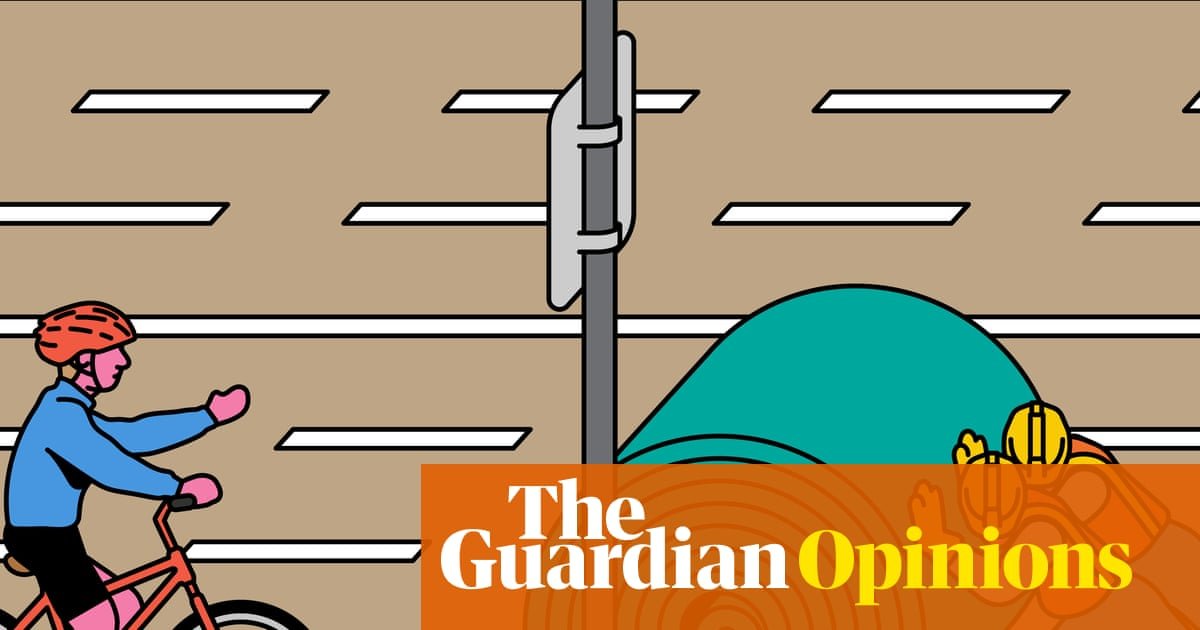
As I was saying, many people can ride a bike if they can’t drive a car for whatever reason, and they’ll be perfectly happy doing it. They smile broadly as the wind whips through the holes in their helmet and gently touches the exposed hairs on their head. They pedal like their lives depend on it (they do), dodging deadly automobiles operated by inattentive drivers. In some cities, there are dedicated lanes for these brave bikers, theoretically inoculating them from the dangers of cars pancaking them.
The United States has 4,400 directional miles of bike lanes, offering safety for anyone serious enough to risk it. The push for bike lanes began in the 1960s and grew in the ensuing decades. Theoretically, the lanes offer a carbon-neutral alternative to driving a car. If one chooses to bike instead of drive, it’s one fewer toxin-spewing death trap creating pollution and traffic congestion on the motorways. That sounds like a boon for the world, so naturally, the Trump administration wants to do away with it.
Condemning “DEI bike lanes”, the Trump administration has made a point of freezing or canceling related grants, referring to alternative transit options as unworkable in the United States, and suggesting removing the lanes that already exist. Their logic, if we are using that term loosely, is that bike lanes take space away from cars, create more traffic, and lead to chaotic roads.
I suppose that’s true, if we assume that there is an infinite number of cars and bikes are just extra, rather than an alternative that takes cars off the street. But that clashes with studies that say bike lanes actually make the roads safer by forcing drivers (sensible ones, at least) to slow down and avoid potential vehicular manslaughter charges.
Rhetorically, the administration’s charge of bike lanes being some form of diversity, equity, and inclusion makes no sense. If riding a bike is so easy, then how can we classify it as unique enough to be diverse? Children ride bikes. It’s far less exotic than, say, operating a motorcycle, which takes a special license in every state. Maybe if we had a dedicated lane for a penny-farthing, I’d buy this explanation. If I were tooling around on one of those, I’d never get where I was going, because scores of beautiful women would be stopping me every few feet.
Conservative disapproval for bike lanes stems from a blinkered, irrational view of culture, and more accurately, masculinity. Trumpists have teased Joe Biden and Pete Buttigieg for riding bikes. But I’ve been teased for not being able to ride a bike. Shouldn’t I be lauded for my commitment to machismo? My belief in the petrol-powered conveyance deserves commendation. My parents’ inattention to my development actually made me cooler, right?
If anything, I’m the diversity in this scenario. I can’t use a bike lane. I’ve been excluded from significant parts of the road. I can’t even walk in the bike lane. I should be furious, writing pointed, profane letters to my city councilperson, begging them to release me from my shackles. Or better yet, I should demand the city taxpayers pay for me to take bike lessons, so I can be accommodated. I’m the weirdo here. The one who has to explain my predicament, to feel excluded from the general population. Except, I’m not going to complain.
I might seethe when I have to swerve to avoid a biker. I might slam on my brakes when I try to turn right and a Schwinn comes screaming through the crosswalk. Maybe I complain for a living on the internet, but I’m also a responsible citizen of the world. I see the obvious benefits of bike access for those that choose to do it, for fitness or for affordability.
I can’t ride a bike now, but as my car becomes more and more of a money pit, voraciously hoovering up my meager income like the video game character Kirby, I see the benefits of learning, even if I’m in my 40s and will look absolutely ridiculous.
After all, I’ve been told it’s quite easy.
Dave Schilling is a Los Angeles-based writer and humorist