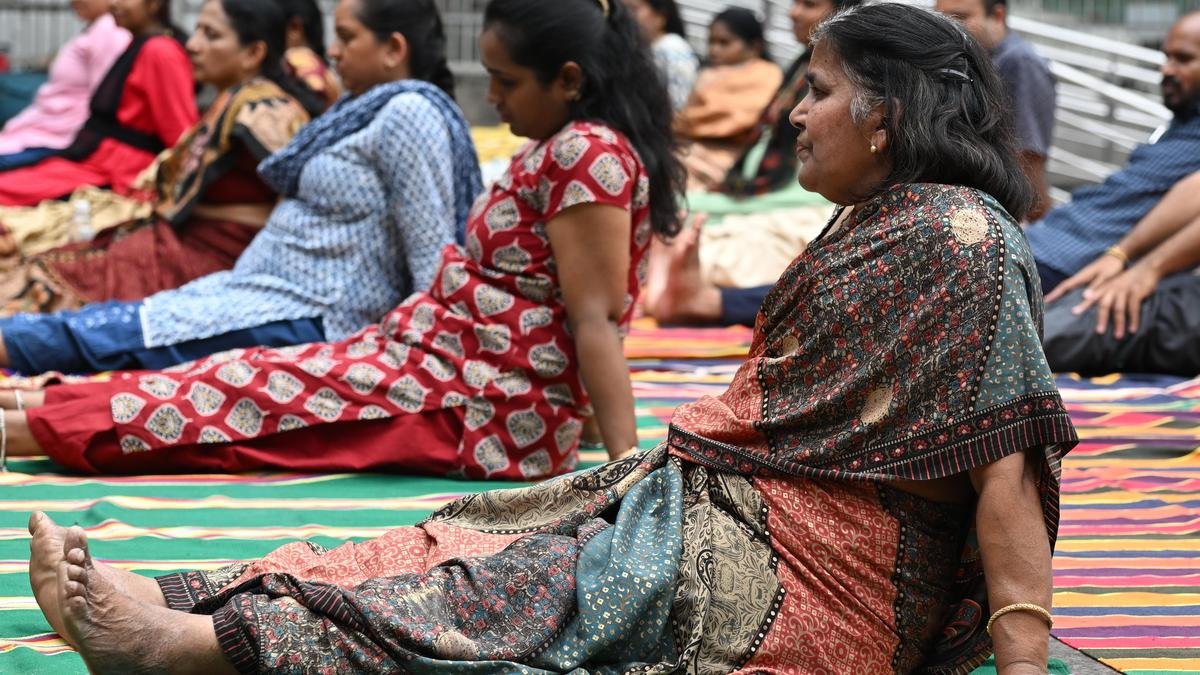
As the world observes International Day of Yoga, experts are highlighting how the ancient practice has evolved from a focus on physical postures to a broader approach centred on mental health, emotional resilience and preventive healthcare.
Recognised globally after the United Nations declared June 21 as the International Day of Yoga in 2014, the annual observance has helped bring attention to yoga’s potential role in promoting physical and mental wellbeing. Over the years, scientific research has increasingly examined yoga’s impact on stress, sleep quality, emotional regulation and overall health.
Dr Suhas H D BAMS MD (Ayu), Chief Medical Officer, Sri Sharada Dhanvantari Ayurveda Hospital, Sringeri, said the understanding of fitness has undergone a major transformation.
“In earlier times, fitness was often understood solely as physical fitness, and people practiced yogic postures mainly for this purpose under forms such as power yoga and fitness yoga. However, as times have changed, physical fitness alone is no longer considered sufficient. Today, equal importance is given to mental health and emotional balance,” he said.
Yoga, breath and the science of stress management
Explaining the connection between stress and the body, Dr Suhas said chronic stress activates the sympathetic nervous system, leading to increased heart rate, elevated blood pressure, reduced digestive activity, shallow breathing and higher cortisol levels.
“Stress and burnout directly stimulate the sympathetic nervous system, resulting in an increased heart rate and blood pressure, reduced digestive activity, shallow breathing, and elevated cortisol levels. Chronic stress is a major contributing factor to several health conditions, including hypertension, diabetes, hormonal imbalances, and various autoimmune disorders,” he said.
Quick Reads
US approves first new sunscreen ingredient in two decades as FDA clears bemotrizinol
South Africa launches groundbreaking HIV prevention injection amid access concerns
Highlighting the importance of breath control, he added, “The mind and breath are closely interconnected. When a person experiences mental stress, breathing becomes shallow and rapid. The practice of pranayama activates the parasympathetic nervous system, which helps reduce the heart rate, lower blood pressure, improve digestion, and promote deep mental relaxation.”
He also underlined the role of meditation in improving emotional strength.
“Meditation is a practice that induces a deep state of conscious relaxation. It slows the flow of thoughts, enhances concentration, and strengthens emotional resilience. It also promotes self-awareness and mental clarity, both of which are essential in today’s fast-paced world,” Dr Suhas said.
Referring to ancient yogic wisdom, he said, “As stated in the Bhagavad Gita, ‘Yogah Karmasu Kaushalam’—Yoga is excellence in action. It encourages individuals to perform every action with skill, awareness, and perfection.”
“Similarly, ‘Samatvam Yoga Uchyate’ teaches that yoga is the state of balance and equanimity. Through regular practice, yoga helps achieve harmony between the body and mind,” he added.
Yoga as a way of life, not just exercise
Dr Samhita Ullod, Assistant Professor, Department of Basic principles in Ayurveda, SDMIAH, Bengaluru, said the global acceptance of yoga reflects a shift from performance-driven fitness towards sustainable wellbeing.
“As stress, burnout, and lifestyle-related health concerns rise globally, yoga is evolving from a traditional fitness practice into a holistic wellness movement. Increasingly embraced for its ability to build emotional resilience, improve mental clarity, and support preventive healthcare, yoga reflects a broader shift away from performance-driven fitness toward sustainable wellbeing and long-term health,” she said.
Explaining Ashtanga Yoga, she said, “Yoga, more precisely Ashtanga yoga is defined as ‘Yogastu Chittavrutti nirodha’ meaning detachment of mind from disturbances and waving thoughts; ‘samatvam yogamuchyate’ - maintaining equilibrium of body and mind is Yoga; ‘Yoga Karma su koushalam’ to mean Yoga is a skilled practice of body and mind.”
She added that Ashtanga Yoga includes “Yama, Niyama, Asana, Pranayama, Pratyahara, Dharana, Dhyana and Samadhi,” with each limb contributing towards emotional stability, self-awareness, physical control and mental clarity.
“Yama refers to ethical restraints which promotes emotional stability and social harmony. Niyama are a set of personal observances and codes of conduct which helps in developing resilience and self awareness,” she said.
According to Dr Samhita, “Asana and Pranayama refer to achieving control over physical body and mind through postures and breathing. Pratyahara is all about withdrawal of one’s senses which help in emotional regulation and mental calmness. Dharana, Dhyana and Samadhi are about complete detachment of outer world and state of self realisation which gives profound clarity of life and helps understand purpose of life.”
Yoga and the future of healthcare
Dr Vandana, Bachelor of Naturopathy and Yogic Sciences (BNYS), MD Clinical Yoga, Kshemavana Naturopathy Centre, said resilience today should be viewed as both a psychological and physiological process.
“Considering the contemporary context where stress, information overflow, and emotional exhaustion have become constants, resilience goes beyond being a psychological phenomenon; it becomes a physiological one as well. Yogic sciences define resilience as a state of harmony between the body, mind, and surrounding environment,” she said.
“Yogic practices, including asanas, pranayamas, meditation, and relaxation, impact the autonomic balance through suppressing the sympathetic nervous system and activating the parasympathetic one,” Dr Vandana, BNYS, MD clinical yoga**,** Kshemavana Naturopathy Centre added.
She said yoga strengthens the body’s natural ability to adapt. “Yoga operates as a method of exercise and as a method of training resilience through life itself.”
Dr Narendra K. Shetty, CMO, Kshemavana, SDME Yoga Institute, said healthcare is increasingly shifting from treating diseases to preserving health.
“Globally, the concept of healthcare has changed from disease management to preservation of health, and yoga has become an important part of this health preservation model,” he said.
“The traditional concept of yoga has always advocated for prevention by means of maintaining harmony in the body, mind, emotions, and behavior on a daily basis. This is a fact supported by research that has found out the benefits of yoga therapy on various health aspects,” he added.
Dr Shetty said mindful practices can address several modern health challenges.
“Mindful exercises including breathing, relaxation, and meditation will be helpful when dealing with stress, physical inactivity, insufficient sleep, and poor emotional control, all of which lead to chronic diseases. Healthy living should not only seek to prevent illnesses but rather to build body resistance,” he said.
“Yoga can provide a guide to healthy living,” he added.
Dr Vidya K., BNYS, MD Clinical Naturopathy, Kshemavana Centre, said the definition of fitness itself is changing.
“Definition of fitness keeps changing. There appears to be an evolving change from achievement-based objectives towards sustainability of wellbeing and recovery,” she said.
“Unlike other training systems, whose only goal is high intensity and energy consumption, yoga works on several fronts at once, including physical well-being and emotional state,” Dr Vidya added.
According to her, “fitness is not only efficiency of the muscles; it should be the union of body, mind, and activity.”
“Fitness of the future means maintaining your health for life rather than training harder,” she said.