Get our breaking news email, free app or daily news podcast
12m agoOoshies trend helps Woolworths’ profit soar to $1.14bn
16m agoProductivity commissioner says ‘line was crossed’ by WA premier in GST scuffle
37m agoAlbanese shares Dolly Parton memory in tribute
1h agoNT chief minister says territory can power datacentres with Beetaloo gas
2h agoGreens say national cabinet needs to refocus on gendered violence ‘before it’s too late’
2h agoMan charged after allegedly stabbing woman with scissors

Woolworths’ net profit has boomed 18% to $1.14bn as customers face cost-of-living pressures, the company has reported.
Supermarket sales were up 4.6% in the year to June, its annual results today show. Sales have accelerated since the start of July as the company brought in its Ooshies collectibles promotion, to run 7.6% above the prior year. The company estimates the Ooshies program alone accounted for about a quarter of that growth rate.
The Australian supermarkets division increased the profit margin on its earnings from to 5.5%, from 5.3%. Its pre-tax earnings rose $232m to exceed $2.95bn.
Woolworth’s strong result was helped by Big W returning to profit in the year, with pre-tax earnings of $64m, from a $33m loss the year before. But the department store chain has seen its sales decline in the last eight weeks, despite its inclusion in the Ooshies program.
Woolworths attributed the drop to “ongoing cost-of-living pressures on households, particularly budget customers and weaker trade in the Everyday business”.

Angela Jackson, the commissioner of the Productivity Commission, said the body stands by the interim report into the GST, which found the deal with Western Australia to be a costly mistake that should be reversed.
Jackson spoke to RN this morning after WA premier Roger Cook said “east coast clowns” didn’t understand the state and any changes would “rip $6bn out of the Western Australia economy”.
The prime minister said earlier this week there would be no change to WA’s GST share while he is in power.
Jackson told RN Cook’s comments were unacceptable:
We are aiming, of course, to inform public policy debate, which can often get heated. Our view is that a line was crossed in terms of the nature of those comments from the Western Australian premier last month. We welcome debate and we welcome criticism of our work and our report more broadly because it makes our work stronger. But to undermine and I guess attack our integrity, I think is an additional bridge too far. And I think something that more broadly we are seeing in public debate internationally.
We are aiming, of course, to inform public policy debate, which can often get heated. Our view is that a line was crossed in terms of the nature of those comments from the Western Australian premier last month.
We welcome debate and we welcome criticism of our work and our report more broadly because it makes our work stronger. But to undermine and I guess attack our integrity, I think is an additional bridge too far. And I think something that more broadly we are seeing in public debate internationally.
Jackson went on to say the prime minister’s remarks were “disappointing”:
It’s important for us to indicate that that process will not be influenced by the prime minister’s comments, that we are above politics, and that’s a very important position that we hold within the public policy landscape in Australia.
Prime minister Anthony Albanese shared a tribute to the late Dolly Parton this morning, saying the singer had “made our world a better place in so many ways”.
And the big, radiant heart of the Dolly universe was a personality as strong as it was compassionate, a vivacious woman of great humour and a sense of humanity sustained in no small part by the humble strength of her roots.
Albanese also reflected on his tenure as transport minister when, in 2011, he heard that Parton was considering cancelling her tour after being told her custom tour bus was too large for Australian roads.
Dolly Parton doesn’t like flying around, right? So she has a bus that is larger than the regulations and the bureaucrats say is not allowed on New South Wales roads and on roads in Australia, so I intervened and said ‘for goodness sake, surely going from A to B with Dolly Parton’s bus [should be allowed]’.
Albanese said he was able to meet Parton at the time. He wrote this morning:
It was a magical experience meeting her, but what was even better was seeing her among her legions of local fans. There are a lot of broken hearts in Australia and across the world today. Wherever you are, turn your stereo or your phone to Dolly then turn the volume up.
It was a magical experience meeting her, but what was even better was seeing her among her legions of local fans.
There are a lot of broken hearts in Australia and across the world today. Wherever you are, turn your stereo or your phone to Dolly then turn the volume up.
Finocchiaro makes ‘no apologies’ for controversial changes to child protection laws
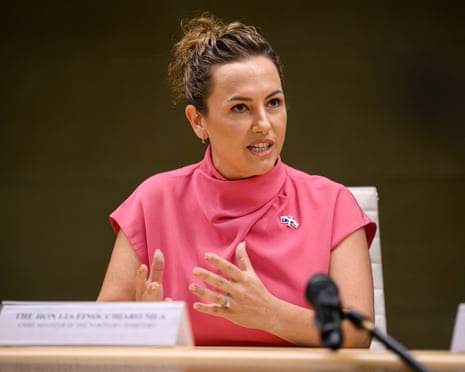
Lia Finocchiaro, the NT’s chief minister, said controversial changes to child protection laws in the territory were meant to “strengthen care and protection so that the safety of a child comes first”.
The government announced sweeping changes to the territory’s child protection laws in May, which replace the Aboriginal child placement principle with what it calls a “universal principle”. The NT’s children’s commissioner later resigned over the changes, saying the Finocchiaro government had “sidelined” her.
Finocchiaro told RN this morning:
I challenge any Australian sitting at home listening to this, what would you do when you are faced with a situation where a child is unsafe? Would you leave them just because that child is Aboriginal? It’s not right. Every child, no matter what their background, what their religion, what their race, where they come from or where they live, should be supported to live their very, very best life. And that starts with being safe. So we make no apologies for the care and protection reforms we have implemented.
I challenge any Australian sitting at home listening to this, what would you do when you are faced with a situation where a child is unsafe? Would you leave them just because that child is Aboriginal? It’s not right. Every child, no matter what their background, what their religion, what their race, where they come from or where they live, should be supported to live their very, very best life. And that starts with being safe.
So we make no apologies for the care and protection reforms we have implemented.
Lia Finocchiaro, the chief minister of the Northern Territory, maintained the region should be able to “decide its energy policy and its energy mix” when it comes to datacentres, without rules imposed by the federal government.
Ultimately, we don’t need the federal government coming in heavy-handed and trying to dictate to states and territories how they should be developing datacentres or not and what energy mix they should be using.
Finocchiaro said the gas coming from the Beetaloo basin would be an “enormous energy resource” that should be used.
There is no question that the territory can handle datacentres and rapid investment as a result of the Beetaloo basin. It will actually support and underpin economic growth that we are fighting desperately for. … I completely appreciate, particularly with the east coast energy crisis, that there are concerns about datacentres in southern states. But the Northern Territory has the answers to all of those problems. We can properly fuel, we can properly provide the energy in abundance to every Australian, to every datacentre, to every ally that needs it.
There is no question that the territory can handle datacentres and rapid investment as a result of the Beetaloo basin. It will actually support and underpin economic growth that we are fighting desperately for. …
I completely appreciate, particularly with the east coast energy crisis, that there are concerns about datacentres in southern states. But the Northern Territory has the answers to all of those problems.
We can properly fuel, we can properly provide the energy in abundance to every Australian, to every datacentre, to every ally that needs it.
Industry minister says datacentres need ‘collaborative approach’ ahead of national cabinet meeting
Tim Ayres, the federal minister for industry and innovation, said it’s important for all states and territories to have a “collaborative approach” when it comes to datacentres, but said federal intervention is needed to ensure “we don’t have a race to the bottom” on electricity and water standards.
Ayres spoke to RN Breakfast this morning ahead of national cabinet, saying:
This is a big challenge and a big opportunity for Australia. If we lean back and miss the opportunity that has negative consequences for our economy, our productivity and our security. If we lean in and get this right as one country with one approach rather than eight different approaches, then that offers the opportunity to make sure that artificial intelligence and datacentres and AI training is harnessed here in the national interest in a coordinated and effective way that makes Australia stronger.
This is a big challenge and a big opportunity for Australia. If we lean back and miss the opportunity that has negative consequences for our economy, our productivity and our security.
If we lean in and get this right as one country with one approach rather than eight different approaches, then that offers the opportunity to make sure that artificial intelligence and datacentres and AI training is harnessed here in the national interest in a coordinated and effective way that makes Australia stronger.
Ayres said he doesn’t think it’s “likely” there will be a big constitutional dispute if federal and state rules around datacentres butt heads.
These AI standards are all about making sure that Australia maximises the advantage, maximises the right kind of investment in the right places, and that delivers to support our ambitions to build a modern electricity system for Australia.
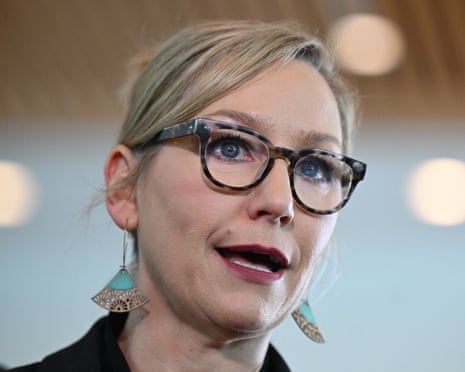
The Greens leader, Larissa Waters, said the prime minister should address the epidemic of violence against women during national cabinet today, “before it’s too late”.
The Greens put out a statement saying Australians have been waiting after a national cabinet meeting to address gendered violence was convened two years ago. But many of the commitments from that event remain “unfinished or ignored”.
Tomorrow’s National Cabinet must commit to fully fund frontline services so no woman or child is turned away when they seek to escape violence, and to increase funding for prevention work to address the worrying slide in attitudes to violence, particularly by young men. … Too many women and children are being killed by violence, primarily by men and most often by someone known to them, to wait any longer. We don’t need more ideas, we need the funding and the political will to turn them into action. The government seems to always be able to find money for war but when it comes to keeping women safe or helping us recover, Labor cries poor.
Tomorrow’s National Cabinet must commit to fully fund frontline services so no woman or child is turned away when they seek to escape violence, and to increase funding for prevention work to address the worrying slide in attitudes to violence, particularly by young men. …
Too many women and children are being killed by violence, primarily by men and most often by someone known to them, to wait any longer. We don’t need more ideas, we need the funding and the political will to turn them into action.
The government seems to always be able to find money for war but when it comes to keeping women safe or helping us recover, Labor cries poor.
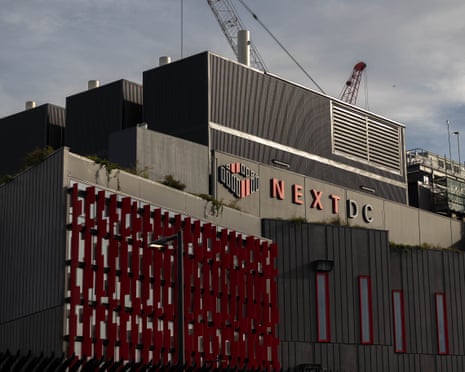
Australia may face a rush of datacentre construction as AI firms look to avoid upcoming rules
Planned datacentres around Australia may avoid strict new rules being proposed by Anthony Albanese if they can secure approvals in the coming months, amid growing calls for a moratorium.
The prime minister is aiming to come to an agreement with national cabinet on federal regulations for datacentres at a meeting on Wednesday.
The rules will require datacentres to avoid pushing up power prices – including by bringing renewable energy to the grid to cover their electricity demands – while meeting their own connection costs and minimising water use.
Developers will also need to ensure their datacentres are appropriately sized and located away from schools, homes, potential housing or agricultural locations.