The debate in the scientific world has often been about glory.
Who deserves the glory for a discovery, for an invention, for defining a procedure, a drug, a vaccine?
Does credit ever attach to the patients who were experimented upon, the participants of a clinical trial, people who gave of their time and body in order that science may advance, in order that people who come after them do not suffer.
Codes of ethics are mutable, they keep changing, and the grant of credit in science also operates on this arc.
This story is a page from such an omission, a blunder.
Nearly 150 years later, some form of reparation was attempted.
For the world, for the longest time, perhaps even till today, J.
Marion Sims was the ‘Father of Modern Gynaecology.’ Sims reportedly earned the title for his ‘groundbreaking surgical innovations, notably the development of a cure for vesicovaginal fistula.” For his achievements, Sims not only received the soubriquet, but also statues and memorials and hospitals and wards named after him.
The number of girls on whom he perfected his techniques were not even a footnote in the glorious history he covered himself with.
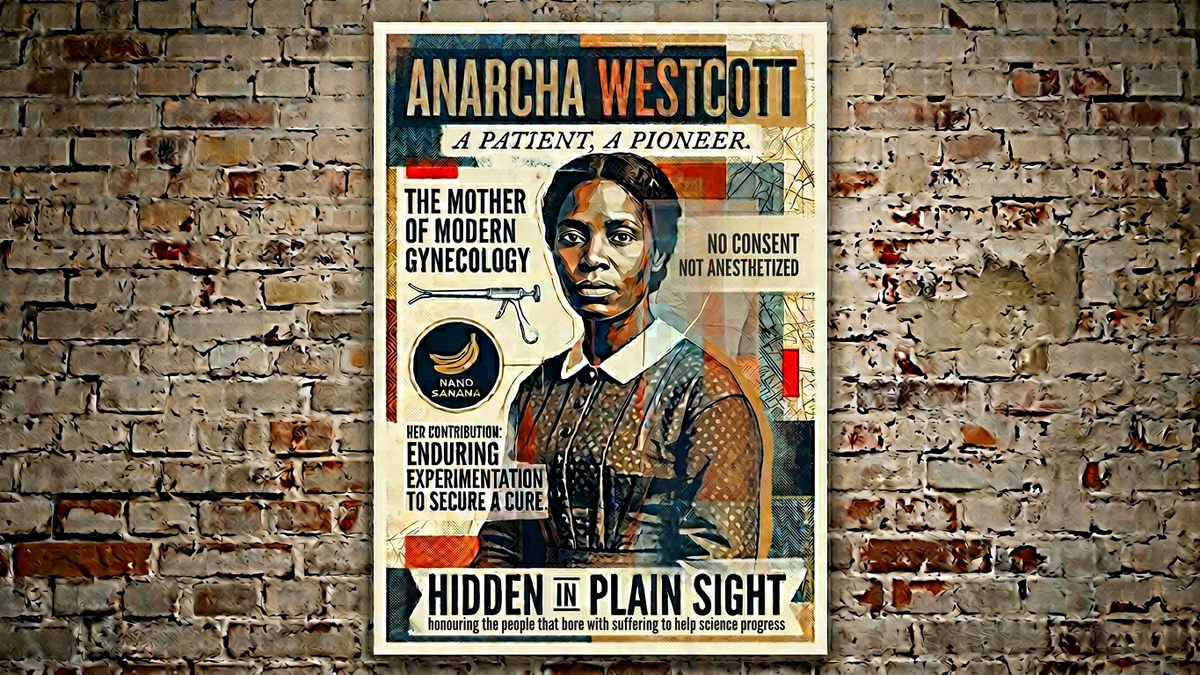
Among them was Anarcha Westcott, a teenage mother, a patient who developed a terrible vesicovaginal fistula, tears or holes that develop between the bladder and vagina, sustained after three days of labour.
The tears made it impossible to control her bowel or bladder and the condition caused her immense pain and suffering.
That is how she came under the ‘care’ of Sims, if care could be used to describe what he went on to do.
HeLa to a new world where progress in science matches dignity for patient Anarcha was a young African American woman wrested down in slavery.
Sims reportedly believed that African American women do not feel pain, so he experimented on her repeatedly (we know of two others -- Betsey, and Lucy), operating without anaesthesia (though it was available).
Sims himself records that he had performed nearly 30 procedures on her, consent was a casualty of the times, before he perfected his technique using silver to suture the fistula, that prevented infection.Before this, a vesicovaginal fistula was considered untreatable, and women would continue to suffer the rest of their life.
Anarcha did not disappear after this though.
J.
C.
Hallman, in his 2023 book Say Anarcha- A Young Woman, a Devious Surgeon, and the Harrowing Birth of Modern Women’s Health, did extensive research to uncover that far from disappearing after the Sims experiments, she went on to serve in Sims hospital, as a midwife, nurse, and ‘doctor woman’ to her own people, women who were also slaves.
Many decades after Anarcha died, a groundswell of support arose for her from women who objected to the way she was quietly erased from history, and instead calling for her to be celebrated as the “mother of gynaecology.” Say Anarcha excavates history, deconstructing the biographical smoke screen of a surgeon who has falsely been enshrined as a medical pioneer and bringing forth a heroic Black woman to her rightful place at the center of the creation story of modern women’s health care.
She was more than a medical ‘specimen’, she worked at Sims’ slave hospital near Montgomery, Alabama.
She trained and served as a surgical nurse and went on to help other women, also being experimented upon at the hospital.
‘Lady Doctors: The Untold Stories of India’s First Women in Medicine’ review: Freedom from patriarchy More recently, efforts have been made to honour her contribution to gynaecology.
The American college of Obstetricians and Gynaecologists have dedicated two days – February 28 and March 1—to Anarcha, Lucy and Betsey.
Recognition also saw expression in art: At Harvard’s Hutchins Center exhibition in 2023, a prominent exhibit was artist Jules Arthur’s paintings of Anarcha, Luch and Betsey through her work titled “Call and Response: A Narrative of Reverence to Our Foremothers in Gynaecology“.
Artist Michelle Browder created a 15-foot public monument honouring them as “the mothers of gynaecology“ in downtown Montgomery.
Tangentially, it was also seen as a victory that Sims’ statue was removed from Central Park in April 2018 and relocated.
Hallman’s book was preceded by a documentary Remembering Anarcha.
Unfortunately, Anarcha’s story is not merely a historical wrong.
It serves to remind health practitioners and policy makers that several inequities still govern access and affordability of high quality care; that for women, it could be tougher than it might be for men.
For that, we will have to keep saying her name, so it will be a reminder.
Say her name, say Anarcha.