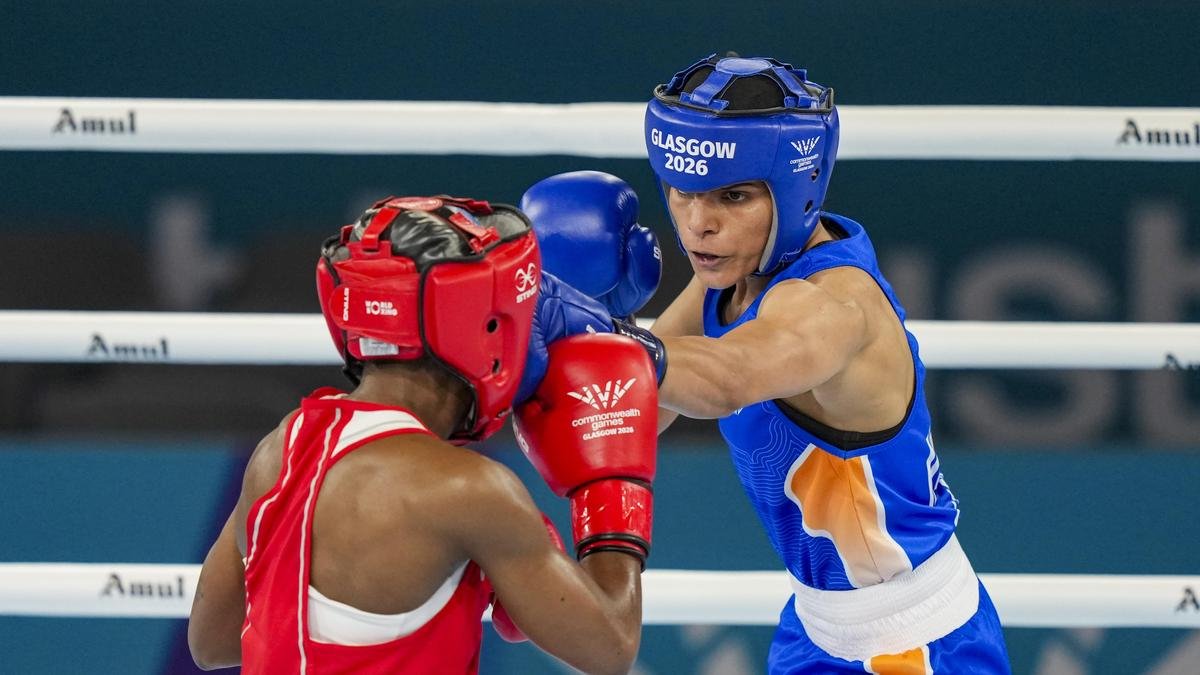
Sakshi Chaudhary, one of India’s brightest boxing prospects, led the charge as six pugilists from the country advanced to the semifinals at the Scottish Event Campus in Glasgow on Wednesday (July 29, 2026), assuring themselves of at least a Commonwealth Games bronze.
Indian boxers won their bouts with a fair degree of comfort.
Sakshi outclassed Caitlin Fryers of Northern Ireland to register a 5-0 victory in the women’s 51kg category.
Arundhati Choudhary defeated New Zealand’s Morgan Henderson 3-1 in the women’s 70kg last-eight encounter before Jaismine Lamboria won through a 4-1 split decision against England’s Elise Glynn in women’s 57kg.
Sachin Siwach overcame Moremi Treasure from Botswana with a unanimous 5-0 verdict in the men’s 60kg clash while Ankush Panghal was confidence personified in his 5-0 triumph over Jade Micock of Seychelles in men’s 80kg.
In the men’s 90+kg quarterfinal battle, Narender had to dig deep before edging past Samoa’s Michael Seko 3-2 in a split decision.
India is now assured of 10 boxing medals.
CWG 2026 India’s medal tally: Complete list of winners and table Sachin was never really stretched.
It was a cagey affair, with both boxers adopting a cautious approach and reluctant to commit in attack.
For much of the bout, they waited for each other to make the first move so that they could create an opening for a counter.
Sachin did just enough in every round, eventually securing a comfortable unanimous decision.
Ankush’s duel with Micock, too, was a tactical one, with neither willing to overcommit.
There were few close-range exchanges or sustained body attacks as both preferred to be patient before launching attacks.
Ankush, however, looked the sharper of the two, displaying lightning-quick reflexes to slip and evade the 19-year-old’s jabs before responding with crisp right-left combinations.
The Narender-Seko quarterfinal was easily the closest and most physical contest of the day.
The bout came alive after a caution-filled opening round as both of them traded punches with greater intent.
Narender enjoyed the upper hand for much of the battle, landing the cleaner scoring blows and showcasing effective right-left combinations.
The Indian forced Seko into two standing counts — one each in the second and third rounds — which may have proved decisive in earning him a place in the semifinal.