Personnel told to take cover after ‘suspected unauthorised activity’ of six drones that were repelled but not recovered
Drones reportedly swarmed a US army base in Suffolk earlier this month and were not recovered after being repelled.
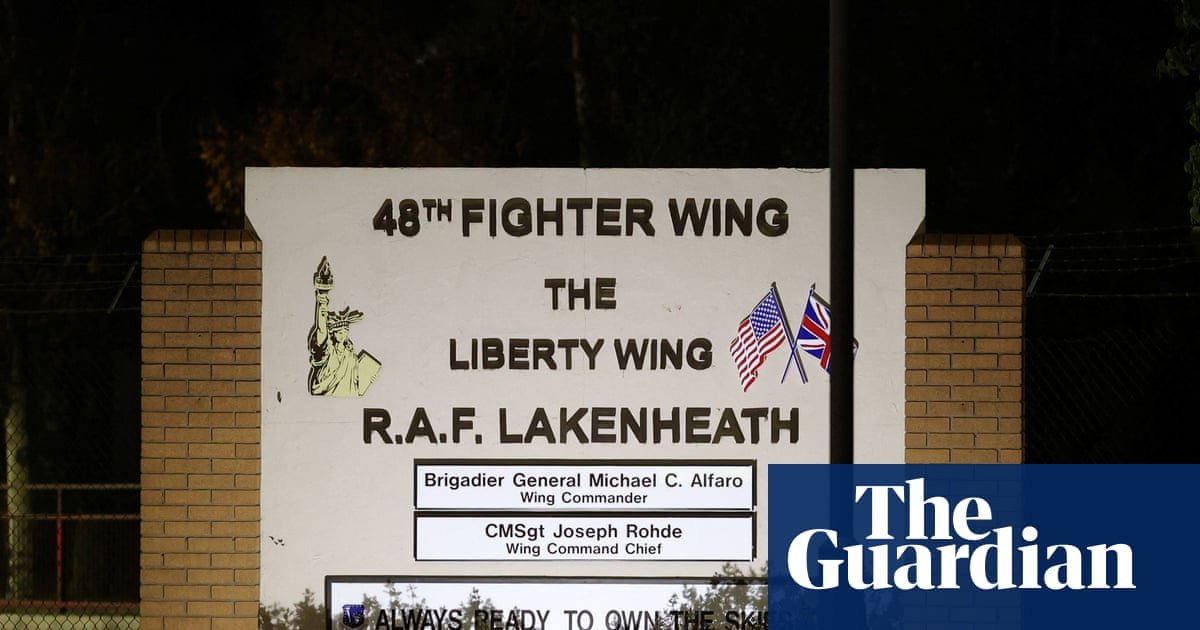
Personnel at RAF Lakenheath were told to take cover on 13 November after “suspected unauthorised drone activity”. The US air force confirmed the so-called Charlie alert at the time, the second-highest threat level, but released few details. Sirens could be heard at the base. Iran is suspected of being involved.
However, the Financial Times has now reported about six drones were seen flying around the base. RAF Lakenheath has been home to the USAF since 1948, with the US taking control in 1950.
The 48th Fighter Wing, the largest US fighter jet operation in Europe, is based there. About 7,000 personnel are on site. US counter-drone technology was used to stop the drones, but they were not recovered by British or US personnel, the newspaper reported. The US has refused to say what systems were deployed.
There are fears that the UK and US cannot rule out whether the drones were armed, or had spying equipment attached. The USAF urged personnel to be vigilant and report suspicious activity.
A spokesperson said: “For operational security reasons we will not discuss specific force protection measures or [counter drone] systems in place at any given location; however, we want to make clear that our security forces, in cooperation with our host nation partners, take a proactive integrated and layered approach to base defence and are ready to address potential threats.
“We continue to work very closely with our UK partners to ensure the safety and security of our US service members, US and host nation civilians, contractors, families and greater communities. We encourage everyone in our communities to remain vigilant and report any suspicious activity immediately to local authorities.”
A Ministry of Defence spokesperson said: “The protection of our bases is a top priority, and we continually review and strengthen our security arrangements.
“Ministry of Defence police and Suffolk police worked closely with USAF Security Forces to respond to reports of unauthorised drone activity at RAF Lakenheath on 13 November, and the situation was quickly resolved, with RAF Lakenheath returning to normal security and force protection measures.”
The incident came almost two years after a number of drones were spotted near RAF Lakenheath, as well as neighbouring RAF Mildenhall and RAF Feltwell, which is also used by the USAF.
In November 2024, it confirmed “small unmanned aerial systems” were seen over a two-day period that month. The USAF said it was unclear whether the drones were hostile. British forces were deployed to help defend the base.
Lakenheath was built during the second world war as a decoy airfield, before being converted and playing a role in bombing raids on Europe. The US arrived after the end of the conflict.
With the onset of the cold war, the US stationed nuclear-armed B-29 Superfortress bombers at the base in case of attack by the Soviet Union.
Earlier this year, a security alert was sparked when a suspected terror plot was uncovered near RAF Fairford in Gloucestershire, and an alleged trespass incident took place at RAF Molesworth in Cambridgeshire.
The incident at Fairford led to a major incident being declared. It led to dozens of residents being evacuated, and a large cordon was put in place. Both bases are used by the US.
Two men have been charged with the incident at Fairford in September. They will stand trial at Woolwich crown court next year. Separately, two men were arrested in connection with alleged trespass at Molesworth.
The US has since removed planes from Mildenhall and Fairford in response to the perceived threat from Iran. Last month, the UK’s foreign secretary, Ed Miliband, along with 35 allies, signed a statement condemning the threat posed by Iran to the UK and its allies.
Miliband also summoned the Iranian ambassador as he issued a statement which said: “Britain will not tolerate threats on our soil.”
Stephen Doughty, minister of state for the Middle East, North Africa, Afghanistan and Pakistan, later said Iran posed a “significant threat” to UK both directly and through its proxies.
UK security and counter-terrorism