Future wars may be fought with Artificial Intelligence, but they will still be won by national resolve, trained soldiers and robust military power, Defence Minister Rajanth Singh said on Saturday (July 11, 2026).
Speaking at the commissioning ceremony of INA Mahendragiri in Visakhapatnam, Mr.
Singh also said Andhra Pradesh has emerged as a new powerhouse of India’s defence and aerospace manufacturing.
“Future wars may be fought with Artificial Intelligence, but they will still be won by national resolve, trained soldiers and the capable military power.
So, I would say that new technologies and conventional platforms are not opposed to each other, but supplement each other, complete each other.
Without conventional platforms, new technologies are incomplete in themselves,” he said.
INS Mahendragiri: All you need to know about the Indian Navy’s new indigenous stealth frigate According to Mr.
Singh, it is certain that new technologies have certainly reshaped warfare, but they have not diminished the role of conventional warfare means.
The strong conventional capability that is still necessary for the fulfilment of basic principles of war is as important as it was before.
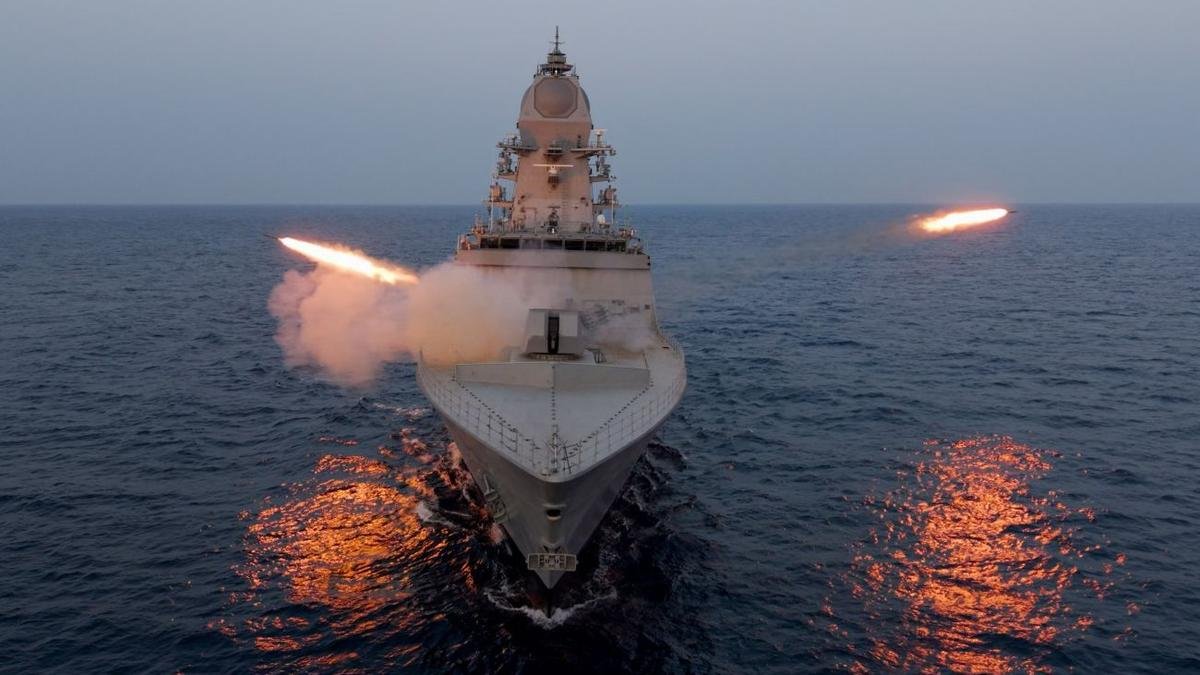
Describing INS Mahendragiri as part of the Project 17A Nilgiri-class stealth frigate programme, he said it was the sixth project 17A frigate and the last of the four warships built by MDL under the programme.
Calling it the concluding jewel of MDL’s Project 17A series, he expressed confidence that the shipyard would continue building similar advanced warships.
Recalling the induction of earlier Project 17A frigates, Mr.
Singh said INS Nilgiri was commissioned in January 2025, INS Udaygiri and INS Himgiri in August 2025, INS Taragiri in April 2026 and INS Dunagiri in June 2026 before INS Mahendragiri joined the Navy on Saturday (July 11, 2026).
‘Vanguard of self-reliance’ Named after the majestic mountain range in the Eastern Ghats, INS Mahendragiri is the first Indian Naval warship to bear the name.
“Designed in-house by the Indian Navy’s Warship Design Bureau and constructed by Mazagon Dock Shipbuilders Limited (MDL), Mumbai, the frigate is a glowing testament to the Atmanirbhar Bharat initiative, featuring over 75% indigenous content,” a press release said.
“This indigenously designed and constructed state-of-the-art warship showcases the incredible capabilities of our domestic defence industries and MSMEs, integrating a vast network of Indian industries to strengthen the nation’s defence industrial base,” it added.
Sixth Nilgiri-class frigate joins fleet, boosting naval firepower INS Mahendragiri is built for the future, blending advanced stealth features, reduced radar signatures, and a high degree of automation.
Powered by a modern Combined Diesel or Gas (CODOG) propulsion system, the frigate is a mission-primed platform capable of high-speed operations and exceptional endurance.
The vessel is equipped with an advanced suite of state-of-the-art weapons and sensors, including surface-to-surface and surface-to-air missile systems, sophisticated electronic warfare capabilities, and comprehensive anti-submarine warfare systems.
An integrated Combat Management System further enables the frigate to operate across all domains, from anti-air and anti-surface warfare to power projection and humanitarian assistance missions.
‘Guarding the extended courtyard’ Ahead of the formal induction, Mr.
Singh addressed naval personnel at a Barakhana on Friday (July 10, 2026) night at the Eastern Naval Command, commending their unwavering vigilance in safeguarding the nation’s maritime interests.
During his address, Mr.
Singh reaffirmed India’s position as the largest and most responsible stakeholder in the Indian Ocean Region (IOR).
“The region is our courtyard, and securing the courtyard is our responsibility,” he remarked, emphasising that maritime security is intrinsically linked to India’s economic health.
Indigenously built stealth frigate INS Taragiri commissioned into Indian Navy at Visakhapatnam With over 90% of India’s trade by volume transiting through maritime routes, safeguarding energy security, the Exclusive Economic Zone, and island territories has become paramount amid intensifying geopolitical competition.
The Defence Minister also cautioned that the nature of warfare is evolving rapidly, with future conflicts potentially emerging in unforeseen forms.
He urged personnel to remain mentally and physically prepared, emphasising that while the government ensures the provision of world-class technology, it is the people who wield these machines that ultimately determine the outcome of battles. (With PTI Inputs)