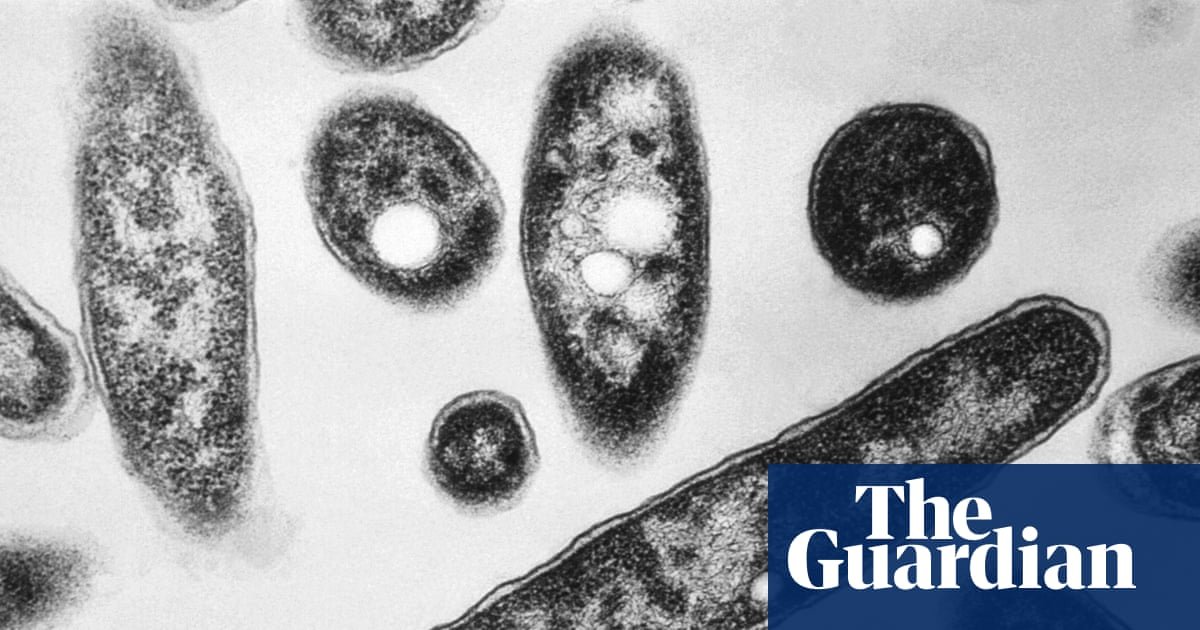
This 1978 electron microscope image made available by the CDC shows the Legionella pneumophila bacterium, responsible for causing legionnaires' disease.
Officials say climate crisis ‘worsening our exposure’ to bacteria as at least 28 people sickened in Manhattan A New York outbreak of legionnaires’ disease, a rare but severe form of pneumonia, highlights the microbe’s growing and disproportionate impacts in a warming climate.
At least 28 people have been sickened in an outbreak on the Upper East Side, a wealthy neighborhood between Central Park and the East River in Manhattan.
Health department officials, seeking to stop the outbreak, have sampled water from nearly 160 building cooling towers to test for the bacteria.
“This is now a subtropical climate,” said Dr Alister Martin, the commissioner of the New York City health department.
“It is absolutely true that climate change is worsening our exposure and increasing the propensity for legionnaires’ disease clusters like we’re seeing today.” Martin said the city has taken an “aggressive” approach to the outbreak, even as the chances of developing legionnaires’ disease are “extremely, extremely rare”.
Martin revealed to the Guardian that he signed orders for at least 19 buildings to drain, clean and disinfect cooling towers, which are part of large buildings’ heating and cooling systems.
These were described as “buildings of interest” by another official, who said the city would still need to conduct extensive tests to understand which building may have been responsible for the outbreak.
Legionnaires’ disease is a severe illness caused by the bacterium Legionella pneumophila, a microorganism ubiquitous in warm water environments.
Most of the time, this bacterium is harmless – except when inhaled in vapors and mists.
When that happens, it can cause a spectrum of illness from the relatively mild, including Pontiac fever, to legionnaires’ disease, a multi-system pneumonia which causes cough, fever, headaches, muscle aches and shortness of breath.
Although legionnaires’ affects less than three people per 100,000, as many as 10% of people diagnosed with legionnaires’ will die.
Legionella got its name from the first group of people epidemiologists found sickened: a group of American Legion veterans who gathered in Philadelphia in 1976.
Since then, the bacterium has been the cause of a rising number of outbreaks globally – from New York to Melbourne, the Lombardy region of Italy to Lincoln, New Hampshire.
Typical urban conditions such as ageing infrastructure, spotty maintenance and populations with chronic conditions can spur outbreaks.
“You’re walking down the street minding your own business, breathing in the air, and the air may be contaminated from a cooling tower you can’t even see,” said George Yates, a 54-year-old Harlem resident, who was diagnosed with legionnaires’ in an outbreak in Washington Heights in 2018.
Yates, who does not live or work in Washington Heights, said he was driving for ride-share companies at the time and believes he had a chance encounter with Legionella while simply passing though.
He was hospitalized for five days but recovered.
“The advice I would give to the average resident of New York City – don’t live in fear of this,” said Dr Benjamin Wyler, an emergency medicine physician for Mount Sinai Health System who has studied legionnaires’ disease.
He continued: “But if you’re developing symptoms like a febrile illness and cough, or malaise, gastrointestinal issues, you should maybe have a lower threshold to seek care.” The current outbreak is spread across three well-heeled zip codes on the Upper East Side.
However, multiple studies, and many past outbreaks in New York, have shown the disease disproportionately affects people living in poverty and Black Americans – to the frustration of local leaders.
“I started to believe that Legionella only knew Black and brown neighborhoods,” Marquis Harrison, chair of one of Manhattan’s community boards in Harlem, said at a public meeting in March.
“We only saw it in the South Bronx and in Harlem, and only communities of color.” While Martin said New Yorkers would soon learn the names of buildings forced to clean their cooling towers, the list would not identify the building at the center of the outbreak.
To do that, epidemiologists need to culture water samples to determine if the Legionella bacterium identified by polymerase chain reaction (PCR) tests was a live colony.
Then, lab workers need to sequence the genome of those cultures, and compare those sequences with sequenced sputum samples from legionnaires’ patients.
Critically, doctors typically test for legionnaires’ with a urine test, so some of those patients may not have even had sputum samples collected.
Still, the health department has a lot of work to do, and it could take another month before the health department can issue findings in the investigation.
In many smaller outbreaks, the CDC reports, the source of the outbreak is never found.
“Every summer we’re getting calls from people in New York who unfortunately are contracting this disease,” said Jory Lange, a Houston, Texas-based food safety attorney who represented 50 people sickened in Harlem in 2025.
However, even when the investigation is complete, the effects of climate change will likely continue to make conditions favorable for Legionella.
Legionnaires’ cases have been traced to any number of surprising reservoirs that industrialized humanity left to stagnate, including hot tubs, water jet cutters, floor scrubbers and fountains.
One study found truckers were surprisingly vulnerable to legionnaires’ because of their propensity to use “non-genuine windshield cleaner in their vehicles”.
“The bacteria don’t care,” said Dr René Najera, director of public health at the College of Physicians of Philadelphia.
“If they see a warm spot with water they’re going to thrive and multiply.” “I don’t know if we’re past the point of no return on climate change,” he added, “but certainly, it’s not helping.” Explore more on these topicsNew York US healthcare Health news Share Reuse this content