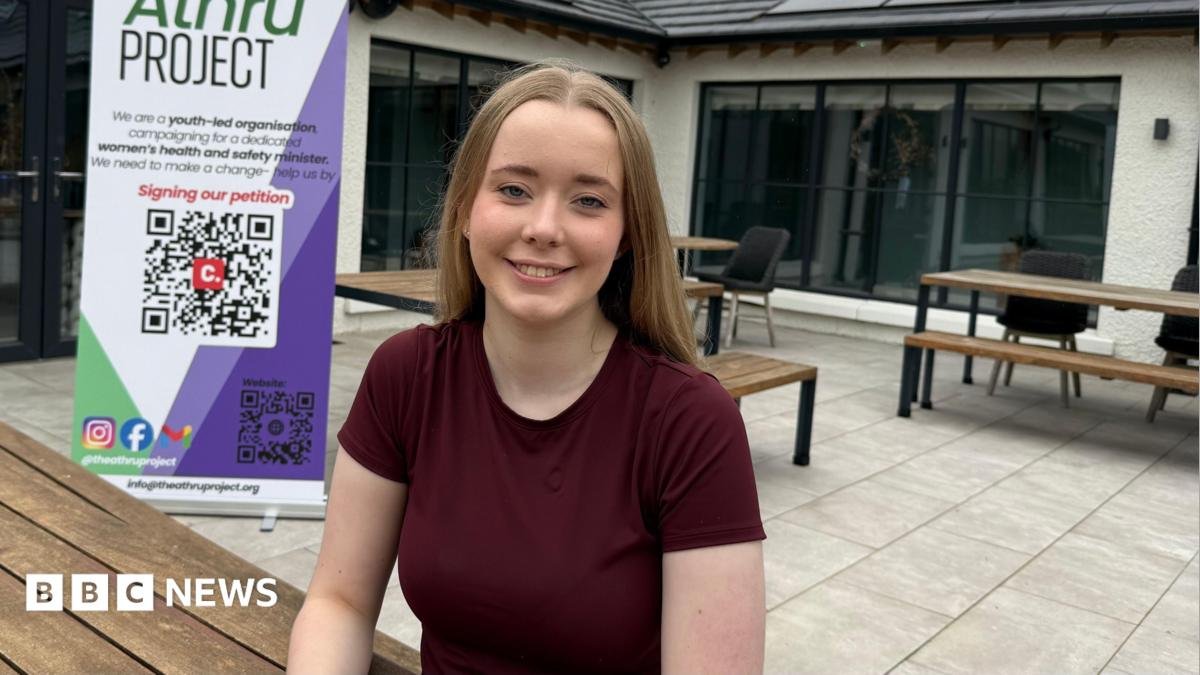
Image caption, Eimear believes a Stormont minister dedicated to improving women's safety and health will change lives ByOlivia CopelandBBC News NI Published 3 minutes ago Disappointed and disheartened by news stories about women being attacked and killed, four teenagers decided watching the news wasn't enough.
Instead of scrolling on, the friends decided to take matters into their own hands and start a campaign of their own.
Now, aged 18 and 19, they are calling for Stormont to create a dedicated Minister for Women's Safety and Health, arguing Northern Ireland needs someone whose sole focus is improving women's safety, healthcare and education.
Helping to tackle violence against women and girls (VAWG) first inspired Eimear, Pearse, Aoísha and Devyn to form 'The Athrú Project', but the group's aims go beyond one issue.
Image caption, The teenagers, from Ballycastle, feel little is being done to tackle violence against women and girls According to Women's Aid, VAWG is defined as being "directed against a woman because she is a woman or that affects women disproportionately".
The charity recently said 31 women have been killed in Northern Ireland since 2020.
In the vast majority of these cases these women were killed by a man or it is a man who has been charged in connection with their deaths.
In August 2025, Pearse O'Neill, now 19, noticed that he and his friends were seeing more and more about VAWG on the news.
At the same time, he was becoming concerned about misogynistic behaviour he was seeing among younger boys.
A few months prior, he had completed work experience with the charity Politics in Action, which he says made him realise starting a campaign was "not really this big daunting thing that was impossible and needed millions of pounds of funding".
As a friend group, they would talk about politics and current issues, and Pearse asked if anyone would like to join him in trying to do something about it.
"We thought we'd send some emails to MLAs, but even before we sent them we knew it had to be more than that.
"It seemed to be getting worse and we thought we shouldn't wait any longer to do something about it." Athrú means change in Irish and that, these young people say, is what they want to see.
Figure caption, Eimear McCloskey, 18, feels "disappointed and nervous" that more isn't being done to protect women in her community.
"If I'm walking home from work, in a seaside town and rural area, there's not a lot of CCTV coverage or proper infrastructure like lighting.
"If anything was to ever happen to me, it would be a 'he said, she said' moment, with no evidence.
It's very upsetting to know that's the case for many women today." Devyn McAlister, also 18, feels more action could be taken by politicians.
"They say things and condemn it but no real action takes place.
That needs to change.
"Seeing the news of women being killed, I feel scared to live in this country.
At night, I look over my shoulders and I have a safety alert on my bag.
I shouldn't need to take those precautions and be so aware of that." What would a Minister for Women do?
Image caption, The group have launched a plan outlining what exactly a Women's Safety and Health Minister would do The young people are campaigning for a new role to be established, similar to the Minister for Women and Equalities at Westminster, or the Deputy Minister for Social Care, Mental Health and Women's Health in Wales.
The Ballycastle-based group were drawn to the idea because, Pearse said: "A minister has a basic obligation to make legislation, and creating one could be a good step towards changing how women's safety and healthcare is approached in government." Aoísha O'Neill, 18, who is Pearse's sister said establishing a dedicated Minister for Women's Safety and Health would bring together women's issues "so they can be tackled in a more efficient way".
As well as improving infrastructure, the group is calling for a Minister to shrink healthcare waiting lists and broaden the school curriculum.
She said the group wants to see is improved sex and relationship education in schools and said young people growing up must be given "enough information about their own bodies".
Post-primary schools in NI get guidance on how to deliver classes on sex education.
"I think, currently, issues of women's health and safety are quite low on departments' priority lists," added Aoísha.
There have been efforts to take action on the issue.
The first and deputy first ministers have both been involved in work to end violence against women and girls, external and the Executive Office (TEO) launched its Ending Violence Against Women and Girls Strategy in 2024.
A spokeswomen for TEO said promoting the health and safety of women, including ending violence and abuse, is a priority.
She said this was underscored by the inclusion of the strategy.
"Addressing this long-term issue requires a coordinated, whole Executive approach, with all Ministers working collectively." In 2022 the PSNI launched an action plan aimed at reducing violence against women and girls.
The teenagers hope a dedicated women's minister would be a member of the Northern Ireland Executive, holding office as a minister within the Executive Office and appointed by the First and Deputy First Ministers.
Responsibility for tackling VAWG, healthcare and education sits across Stormont departments for justice, health and education.
"Women's safety and health is such a large and pressing issue that it's so difficult to keep up with," Eimear said.
"With a Minister's resources and attention it could be tackled effectively." Devyn says, for example, it's "abhorrent" that women in Northern Ireland face lengthly waits for gynaecology appointments.
'Everyone knows someone affected by this' The teenagers launched an online survey to gather more views on their plan and hosted a panel event with politicians, campaigners and young people.
They believe with political support, their goal could become reality.
"As far as the response from politicians goes, it's been really positive so far," Pearse says.
"We have full SDLP support and have really positive engagement from other parties.
There hasn't been any negative responses from politicians so we're looking to expand our support from anyone who will listen." Pearse says it's not just women who should be fighting to improve women's health and safety.
"Everyone needs to be involved with this.
People should feel obligated to speak out regardless of who they are.
Everyone knows someone affected by this.
It's quite simple." A Department of Health spokeswoman said women's health was a "key area of focus" and work continues to improve services.
She said work is ongoing to develop a Women's Health Action Plan for Northern Ireland and the department intends to publish it later this year after the final report of the public listening exercise has been received and considered.
The department said thousands of women have participated in a women's health survey and focus groups and their voices are helping to shape the Action Plan.
She said that, in addition to delivering against the set of actions, the plan aims to encourage "positive dialogue around women's health and wellbeing within our health and social care system and in our society".