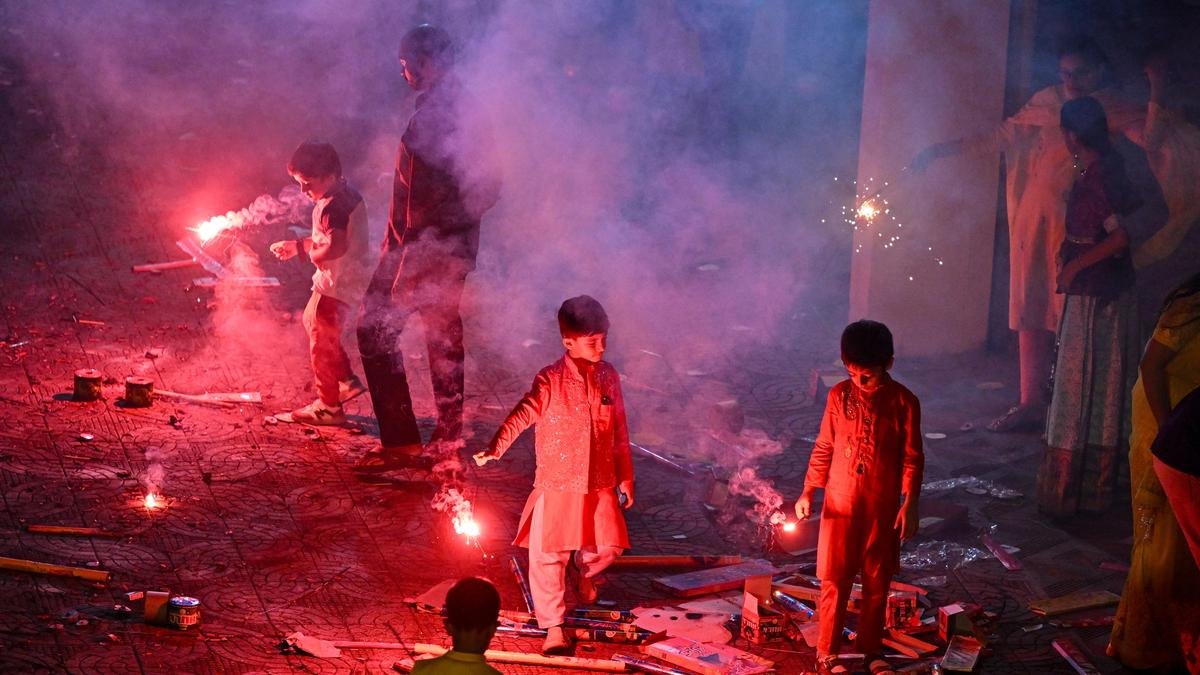
The Mumbai Police have banned the bursting of firecrackers on public roads and the use of laser lights, high-intensity lights and beams during festivities and processions until December 4, 2026, following directions issued by the Bombay High Court to curb noise and environmental pollution.
The preventive order, issued on October 5, 2026, by Deputy Commissioner of Police (Operations) Akbar Pathan, came into effect at 12.01 a.m. on October 6, 2026, and will remain in force until midnight on December 4, 2026, unless withdrawn earlier.
How are noisy celebrations and DJs affecting our hearing?
Issued under Section 163 of the Bharatiya Nagarik Suraksha Sanhita (BNSS), 2023, read with Section 10(2) of the Maharashtra Police Act, 1951, the order prohibits the bursting of firecrackers, fireworks and rockets on public streets and roads, as well as the use of laser lights, high-intensity lumen lights and beams within the jurisdiction of the Mumbai Police Commissionerate.
The restrictions follow a September 22, 2026, order by a Division Bench of Justices G.S.
Kulkarni and Neela Gokhale in a suo motu public interest litigation concerning noise and environmental pollution during festivals.
The High Court directed a complete ban on bursting firecrackers on public streets and roads during festivities and instructed authorities to prohibit laser lights, high-intensity lights and beams during processions.
The Bench also directed authorities to monitor noise levels at festival venues and processions and take action against unauthorised use of sound systems.
It ordered the seizure and confiscation of equipment found violating prescribed noise limits.
Under the court's directions, organisers seeking permission to use sound systems must undertake to install decibel meters at prominent locations, visible to both authorities and the public.
They must also furnish an undertaking or affidavit confirming that their sound systems have internal sound limiters.
Two cars destroyed in blaze triggered by firecrackers in Mumbai The court further directed organisers to prominently display their permissions, along with the names, addresses and mobile numbers of those responsible for the festivities.
It also asked authorities to consider collecting security deposits of at least ₹1 lakh from associations or groups and ₹50,000 from individuals seeking permission to use sound systems, with provisions for forfeiture in case of noise-limit violations.
Expressing concern over poor enforcement of existing regulations, the Bench observed that noise pollution during festivals adversely affected senior citizens, patients, students and children.
It also highlighted the risks posed by firecrackers on public roads, including accidents involving pedestrians and motorists, besides their contribution to deteriorating air quality.
Gen-2 joined green crackers | Explained The court directed authorities to assess the cumulative impact of multiple permissions granted within the same ward before approving the use of sound systems.
According to the police notification, violations of the restrictions may attract penal action under the Noise Pollution (Regulation and Control) Rules, 2000, the Environment (Protection) Act, 1986, the Bharatiya Nyaya Sanhita, 2023, the Explosives Act, 1884, and other applicable laws.
The High Court has scheduled the matter for further hearing on October 15, 2026.