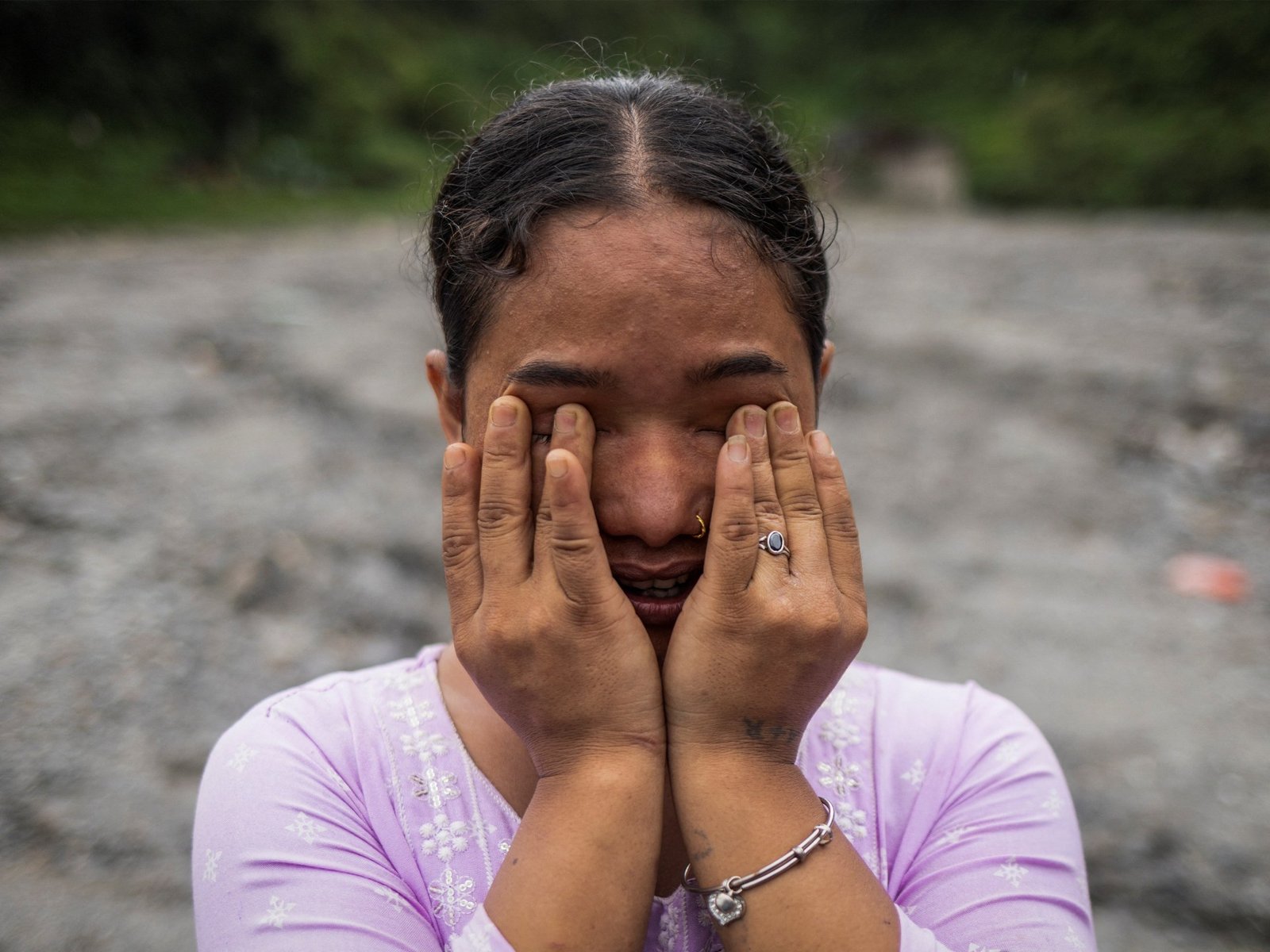
When Anusa Thapa Magar rushed home from her job in the Maldives after hearing of Nepal’s devastating floods, she clung to the hope that her grandmother had somehow survived.
Instead, when she reached Betrawati, the small riverside town where her family lived, she found only a flat expanse of hardened grey silt.
There was no house, and no Betrawati.
“If my house is buried underneath, that means my Aama is still here underneath too, right?” the 23-year-old said quietly, standing where the family’s two-storey home once stood.
Her grandmother, who could barely walk, was last seen resting on her bed.
Last month’s torrent of mud, rock and water, triggered by a glacial collapse in the mountains along the Nepal-China border, tore through settlements along the Trishuli River, killing at least 1,386 people on the Nepal side.
Authorities say 5,130 are still missing, and while searches continue, it has been days since anyone was found alive.
To reach what used to be Betrawati, survivors now climb a steep hillside, cross a narrow ridge and descend into a wasteland.
Along the route lie scattered shoes, school ties and children’s backpacks – “silent evidence”, residents say, of the panic as people scrambled to flee the surging floodwaters.
Garment business owner Kalpana Thapa Magar, 43, recalled the moment a friend phoned from upstream.
“Run!
Run!” she was told.
“I just ran.
When I looked back, everything was gone, even the people who had been running behind me,” she said.
Downstream in Devighat, shattered shells of houses still stand.
Some residents pick through the rubble for belongings, but many say there is no reason to return; the land itself has vanished beneath debris.
Advertisement For many here, the disaster reopens wounds from Nepal’s 2015 earthquake, which killed nearly 9,000 people.
Teacher Sita Thapa Magar, 45, Kalpana’s older sister, said that after the quake, families were at least able to rebuild on their plots.
“This time, we have lost everything,” she said.
“Our houses, our land, our future.” On a single broken floor tile – the last visible trace of her home – 61-year-old Shanti Dangol clutched a photograph of the three-storey lodge she once ran for pilgrims and trekkers.
“Economically, people here had started doing well,” she said.
“Now, nothing remains.” A local day labourer rests outside a flood-damaged house after hanging laundry for an employer in the aftermath of flash floods and mudslides in Devighat, Nuwakot district, Nepal. [Tyrone Siu/Reuters] Advertisement Chari Thapa Magar, 54, and Sita Thapa Magar, 45, who were displaced by recent flash floods and mudslides, weep on the sludge that buried their home in Betrawati, Nuwakot district. [Adnan Abidi/Reuters] Nani Kanchi Khatri, 60, stands inside her home where walls were destroyed by floodwaters in Galchhi, Dhading district.
Khatri, who lives alone and suffers from asthma, said the flood damaged her only property and swept away medicines she had recently purchased. [Tyrone Siu/Reuters] An aerial view shows tents at a temporary shelter for people displaced by flash floods and mudslides on a hill in Betrawati, Nuwakot district. [Adnan Abidi/Reuters] Kalpana Thapa Magar, 43, who was displaced by flash floods and mudslides, looks at a part of her damaged house that was swept away by the flood in Betrawati, Nuwakot district. [Adnan Abidi/Reuters] Arjun Prasad Gajurel, 50, and Radhika Gajurel, 50, stand outside their home, where their ground-floor grocery store was buried in mud and a foul odor now fills the air, in Devighat, Nuwakot district. [Tyrone Siu/Reuters] Advertisement Corn sprouts from mud-covered storage inside the home of Chiranjivi Pudasaini, 54, alongside a toy doll belonging to his granddaughter, a week after flash floods and mudslides struck Devighat. [Tyrone Siu/Reuters] Sachita Rai, 19, and her grandfather Man Bahadur Rai, 80, pose outside their home after thick mud flooded the interior of the structure in Ratmate, Nuwakot district.
Sachita Rai said she was helping her grandfather on a vegetable farm when floodwaters arrived, and rushed to bring him to safety. [Tyrone Siu/Reuters] Sita Subedi, 65, sits at the site where her home was completely destroyed following flash floods and a mudslide in Devighat.
Subedi, who lived alone after her daughter moved to Japan, said the disaster reduced her house to a few remaining pillars and left her uncertain about where to go next. [Tyrone Siu/Reuters] Chary Thapa Magar, displaced by flash floods and mudslides, carries a sack of aid supplies at a temporary shelter on a hill in Betrawati. [Adnan Abidi/Reuters] Shanti Dangol, 61, displaced by recent flash floods and mudslides, stands on the sludge that buried her home in Betrawati, Nuwakot district.
Shanti described Betrawati as a once-thriving town that catered to pilgrims and trekkers and had grown more prosperous in recent years as families built larger homes, rented rooms and invested in their children's education. [Adnan Abidi /Reuters]