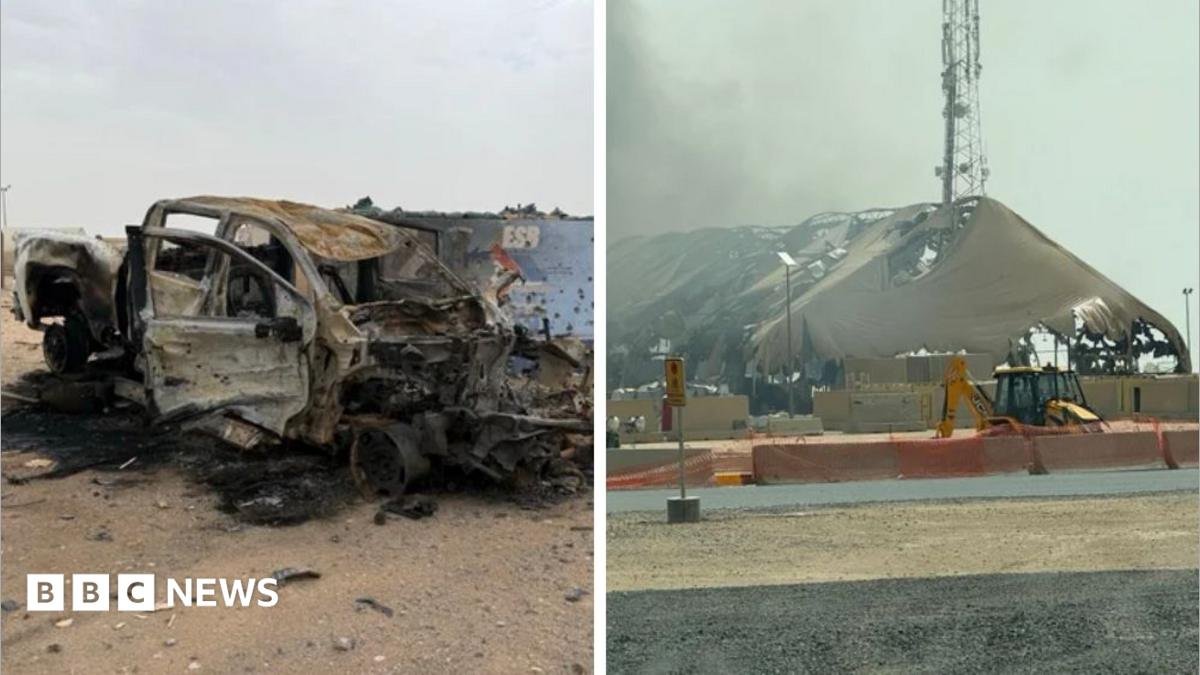
Image source, CBS News Image caption, An undated photo shows a car reportedly destroyed in an Iranian strike at Camp Buehring in Kuwait ByKayla Epstein and Bernd Debusmann Jr Published 16 September 2026, 16:23 BST Updated 48 minutes ago Images showing widespread damage to multiple US sites in the Middle East from Iranian strikes have been obtained by the BBC's US partner CBS.
The photos, provided by active military personnel, show a severed radar jet, flattened trailers and severely damaged buildings.
The undated photos were taken at US bases and sites in Saudi Arabia and Kuwait.
One member of the military, who was not named by CBS, said: "This is major damage to our bases that hasn't been communicated to the American public.
"We're standing there with our eyes closed getting punched in the face." The White House referred the BBC to US Central Command.
Centcom did not immediately respond to a request for comment.
The photos, which have not been independently verified by the BBC, were published the day after a report from the Pentagon's watchdog confirmed hundreds of buildings and structures at US bases in the Middle East have been damaged and destroyed by Iran.
One of the photos showed a destroyed Boeing E-3 Sentry at Prince Sultan Air Force Base in Saudi Arabia that has been ripped in half, its tail section crumpled into a tangled mess of metal.
Image source, CBS News Image caption, An undated photo of a destroyed Boeing E-3 Sentry at Prince Sultan air base in Saudi Arabia, about 62 miles (100km) south-east of the capital Riyadh While the photo is undated, BBC Verify previously confirmed a similar photo, apparently of the same radar aircraft in March.
The Boeing E-3 Awacs are used to detect and track potential targets at long ranges to provide an early warning of possible threats.
At the time, a US official told Reuters that 12 US personnel had been wounded, two of them seriously, in an Iranian attack on the air base.
A pair of undated images reportedly from Camp Beuhring, Kuwait, show crumpled trailers, and a large tent-like structure that had been reduced to shreds as smoke billowed from the site.
Image source, CBS News Image caption, Trailers destroyed by Iranian strike at Camp Buehring, Kuwait Image source, CBS News Image caption, Undated photo shows smoke billowing from a structure that sustained damage in an Iranian strike at Camp Buehring, Kuwait Another image shows a four-storey building damaged by an Iranian strike at Camp Arifjan, in Kuwait.
Damage to the site was reported in March, including on satellite communications hardware, though it is not clear whether this image is from the same attack.
Image source, CBS News Image caption, Damage to a building can be seen in this photo from Camp Arifjan, Kuwait The images were published on the heels of a report from the Pentagon's watchdog, which found Iranian strikes had "damaged and destroyed hundreds of buildings and structures at US bases in Kuwait, Bahrain, Qatar, UAE, Saudi Arabia, Iraq, Oman, and Jordan during the conflict".
It also noted that equipment losses have totalled $3.7bn (£2.8bn).
Overall, the US spent $33.4bn (£24.7bn) on the war up to 29 June, the report said.
In the months after the war began, "dozens of US aircraft were destroyed or damaged", the report continues.
The document lists several of the aircraft damaged, including five refuelling aircraft which were "damaged or destroyed on the ground in Saudi Arabia by Iranian munitions".
A separate report , externalfrom the Congressional Budget Office (CBO) notes that the E-3 aircraft is no longer in production and would have to be replaced with a more modern equivalent, the E-7.
The CBO noted that the E-3 aircraft alone costs $500m (£371m), and the estimated total cost of equipment lost in battle - including planes, drones and a terminal high altitude area defence system - amounts to $1.9b (£1.4b).
CBO said that its review was subject to "uncertainty" because the defence department did not respond to its requests for information, requiring the agency to rely on government databases and public reports.
Additionally, the extent of repairs and rebuilding that the US military plans to do remains unclear, according to the report.
Figure caption, Watch: What does the munitions shortage mean for the US?
Public and political pressure has mounted on the White House to find an end to the conflict with Iran, which began on 28 February when the US and Israel launched joint attacks on the country.
Since the war began Iran has repeatedly attacked US bases and allied states in the Gulf, as well as Israel.
On Tuesday night, the US House of Representatives voted for the third time to end the war in Iran, approving a measure that would force President Donald Trump to end US military action without congressional approval.
The vote passed with the help of several Republicans, in what could be the final House vote on the matter ahead of the US midterm elections in November.
It faces an uncertain path to passage - the US Senate has not indicated if it will take up the matter.
The same day, outgoing Republican Congressman Thomas Massie announced an attempt to impeach Defence Secretary Pete Hegseth as new details emerged about the Iran war's price tag for the US.
The Trump administration backed Hegseth, with US attorney general Todd Blanche telling reporters he was "doing a phenomenal job".