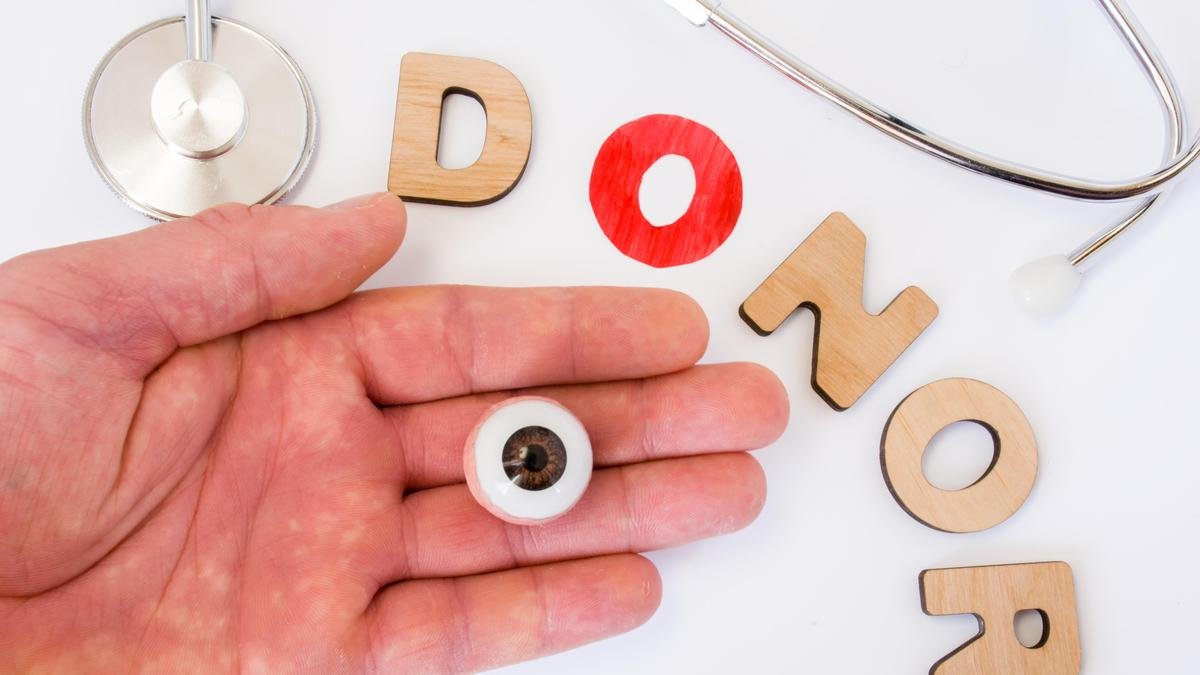
Data for 2024-25 reveals that 51,249 corneas were donated in India, which met just a quarter of the projected need of around 1,00,000 corneas annually.
The reason for this is a utilisation rate of 50% at best, with actual transplants performed ranging only between 25,000 to 30,000.
Why does this happen?
The cause for a significant proportion of this gift of vision not reaching an operating table is the donated corneal tissue not being tested or processed in time.
Other causes include improper harvesting and storage, as well as the decrease in endothelial cell density, which comes with an increase in age of donors.
While some of these factors may not have an immediate or implementable solution, what is fixable, is timing and logistics.
Eye donation in India: current scenario and way forward Understanding cornea retrival Cornea retrieval after death is a race against the clock.
First, is the six-hour window after death within which a cornea should ideally be retrieved.
This can differ in different weathers.
For instance, in winters and monsoon, it can be a time frame of 6-8 hours as well.
The second, less-publicly known factor, is the clock that starts once the corneal tissue is in storage.
Most Indian eye banks still preserve corneas in McCarey-Kaufman (MK) medium, which keeps tissue usable for about 72 hours.
A few use newer intermediate media such as Optisol-GS or Cornisol, extending that window to between 10 and 14 days.
Doctors at the Dr.
Rajendra Prasad Centre for Ophthalmic Sciences (RPC), AIIMS Delhi, along with engineers from IIT Delhi, are testing a way to recycle discarded donor corneas using a bioengineered graft.
Corneas that fail transplant standards, because of low cell counts or minor damage, can be stripped of living cells and turned into a reusable structural scaffold for patients with surface-level corneal damage.
While the trials are still at a very early stage, it does point toward a future where less of what is donated ends up being discarded.
However, until we come up with a way to reuse corneas that miss the deadline, the window closes and the tissue has to be discarded.
72 hours, or even two weeks, is not much time to test a cornea, find a compatible patient, and move tissue from an eye bank to an operating theatre.
The challenge is intensified because almost 70% of all corneal collection and use is concentrated in just six states - Andhra Pradesh, Telangana, Gujarat, Karnataka, Maharashtra, and Tamil Nadu.
A cornea retrieved in a smaller town, with no local surgeon waiting, can become unusable while it is in transit to a city that has one.
An ideal way to treat India’s corneal blindness problem What can be done Extending storage life is the first step.
Eye banks must shift from using MK medium to intermediate media, and eventually to organ-culture storage, which some countries use to keep corneas viable for up to a month.
This helps to buy precious time to find the right recipient instead of the nearest one.
A national, real-time inventory linking every eye bank directly to surgeons in 50 cities, could let a cornea about to expire in Kozhikode be offered to a waiting list in Chennai before it is thrown away.
As fresher corneal tissue survives testing and transplant better, the next focus must be on reducing the time between death and retrieval, and retrieval and preservation.
Hospital Cornea Retrieval Programmes, where hospitals proactively notify eye banks of deaths and trained counsellors approach grieving families, help to reduce this time factor and outperform voluntary home collections.
Expanding that model into more hospitals, rather than relying on a push only during Eye Donation Fortnight, will help to increase the corneal utilisation rate.
Centre eyes ‘presumed consent’ for cornea retrieval in hospital deaths Quality assurance (QA) programmes at eye banks will also help in effectively reducing the discard rate, even with an increase in the volume of donated corneas.
A study showed that the discard rate came down from around 40% to 30% with better donor acquisition processes and improvement in tissue recovery due to effective compliance with quality assurance programmes.
While we address the donation aspect with awareness and educating the people on the benefits of organ donation, we must also take care of the delivery with better storage chemistry, faster hospital protocols, and a database that shows, in real time, exactly which cornea is about to run out of time, who needs it and where. (Dr.
Suvira Jain is medical director, ASG Hospital Limited, Worli, Mumbai.