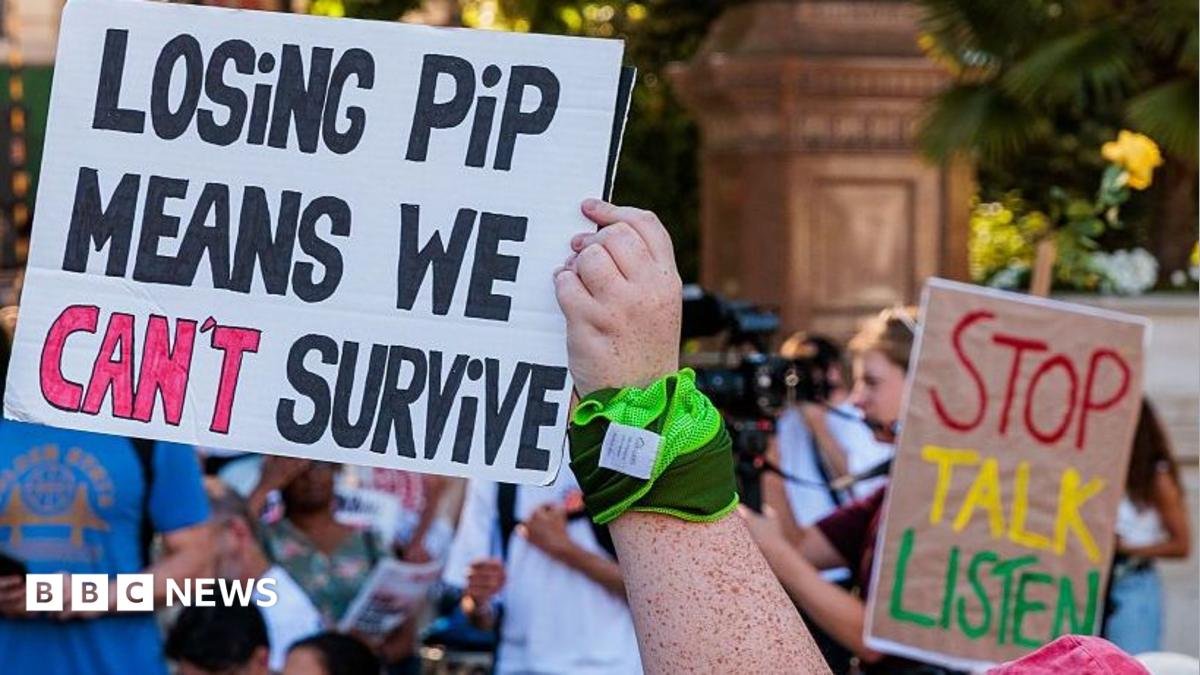
Image caption, Protestors demonsting against benefit cuts at a rally in Parliament Square in 2025 ByMichael Buchanan Social affairs correspondent Published 1 hour ago Amid widespread political concern about the rising cost of disability benefits, a new survey suggests the public does not support cutting the payments.
Research by the British social attitudes survey found 7% of respondents were in favour of reducing benefits for disabled people who cannot work.
Almost half of those who took part, 49%, said they supported more being spent on disability benefits, even if it led to higher taxes.
The findings come despite the proportion of those who support increasing welfare spending for the poor being at a near record low.
Labour, the Conservative party and Reform UK have all said there is a need to reduce the amount of money being spent on health and disability benefits, while the Liberal Democrats, Greens and SNP oppose reductions.
Efforts by Sir Keir Starmer to introduce cuts last year were opposed by many in his own party, forcing a government climbdown.
The proportion of GDP the UK spends on all welfare benefits for those of working age has remained broadly flat over the past 40 years, at just under 5%.
It has occasionally increased to over 5%, including in the 1990s, after the financial crisis in 2008, and during the Covid pandemic.
Despite that, the survey found that support for increasing welfare payments to help the poor was close to the lowest level the researchers have ever recorded.
Asked if "the government should spend more money on welfare benefits for the poor, even if it leads to higher taxes," 27% replied they should while 42% were opposed.
While wider welfare spending has, proportionately, remained stable, payments for disability benefits have taken up an increasing share of the total.
The latest figures show four million people in England and Wales are currently in receipt of Personal Independence Payment (PIP), the main disability benefit.
Annual spending has increased sharply from £16.3bn in 2019/20 to £27.3bn in 2024/25, and is forecast to rise to more than £41bn by 2030.
But around half of those polled for the survey supported higher spending on disability benefits overall, while a majority also strongly backed extra payments for the costs of having a disability.
Around 83% of respondents supported additional payments to help with cooking, 80% for budgeting, and 78% for washing.
Just 3% replied that "nobody should get any additional money" for all three tasks.
Respondents were not asked if they thought it should be harder to claim those benefits.
"Despite growing political divisions on welfare, support for disability benefits remains remarkably strong," said Dr Robert de Vries from the University of Kent, who was one of the report's co-authors.
"Very few people favour cuts, disabled people are seen as among the most deserving recipients of support, and proposals to reduce disability benefits appear politically risky across the political spectrum." Proposals to reform PIP are due to be unveiled by the government in the autumn after an interim report published in the summer found the benefit was not fit for purpose.
Around 57% of Labour voters polled for the survey favoured more spending on disability benefits.
But there was broad political consensus that cuts would be wrong – just 5% of Labour voters, 7% of Conservatives and 11% of Reform UK backers said they supported cuts to those payments.
The British social attitude survey, carried out by the National Centre for Social Research, has been gauging public opinion since 1983.
Its latest survey saw 4,656 interviews gathered between August and October 2025.
The authors noted that the timing of the interviews, just after the Starmer government had failed to reform PIP, meant it was "possible that people were particularly supportive of disability benefits at the time".
They cautioned that public attitudes to disability benefits "crucially depend on which disabled people are in the public's mind", referencing previous research which showed that "some types of disabled people are seen as 'deserving' by the public".