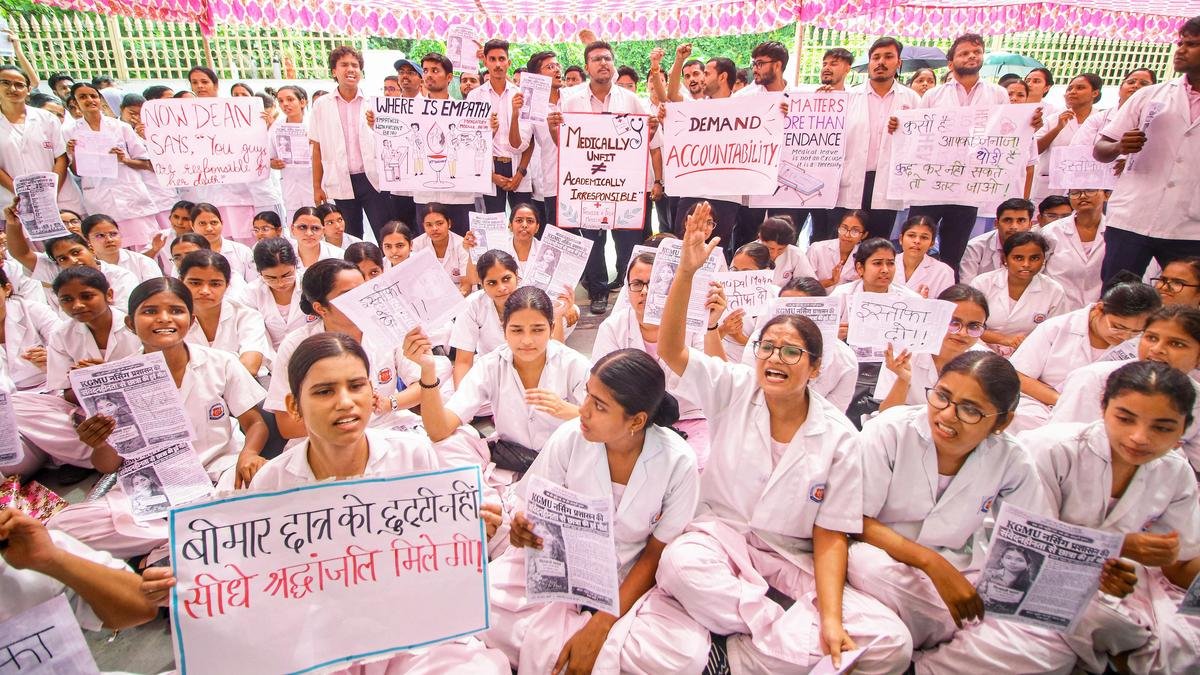
On September 21, 2026, students of King George’s Medical University (KGMU), Lucknow, protested over the death of Divyanshi Yadav, a 2025-batch B.Sc.
Nursing student who died of dengue.
A student at the protest site told PTI that though Divyanshi was suffering from the disease, she still had to attend college.
“Despite being on the deathbed, she was tense about her attendance.
Students are forced to come to the college daily to mark attendance, ignoring their medical conditions.
We get messages from teachers telling us to come to the college after taking medicine,” he said. (Sign up for THEdge, The Hindu’s weekly education newsletter.) You can’t expect 70% student attendance when classes not conducted for entire period: HC In September 2025, Subhangini, 23, another nursing student who was in her first year at Bhopal Memorial Hospital and Research Centre (BMHRC), died due to jaundice.
A current student, on condition of anonymity, told The Hindu, “There was poor quality of food and water on campus, and the case was mishandled by BMHRC Hospital; her medical leave was not approved, and she had to perform her duty even in an ailing condition.” However, the university denied the allegations.
Join THEdge LinkedIn group In most institutions, medical leave requires medical documentation and is granted for serious illness or when a student is severely injured in an accident.
The older University Grants Commission (UGC) 2003 regulations required universities to prescribe a minimum attendance of 75% for students to be eligible for examinations, but the 2025 regulations no longer set a universal 75% threshold.
Instead, they leave minimum attendance requirements to individual higher education institutions (HEIs) through their statutory bodies.
In most HEIs, the minimum attendance requirement is 75-80%, with a 10% accommodation for medical emergencies.
This minimum attendance criterion is higher in medical and engineering institutes, as per their regulatory bodies.
For nursing students like Divyanshi, the Nursing Council of India’s guidelines mandate 80% attendance in theory and 100% attendance in practical areas.
This framework leaves medical-leave protection largely to institutional rules, producing significant variation in what happens to students when illness interrupts their education.
Problems for students with chronic illnesses Alex is a third-year B.A.
Visual Communication student at a university in Hyderabad.
Having transverse myelitis, he became paralysed from the chest down at the age of 10, and the organs on the right side of his body stopped working.
Doctors said he would never walk.
Defying this, he has regained his ability to walk, but this is accompanied by chronic pain below the chest, subluxations, partial dysplasias, fatigue, and muscle spasms.
Alex holds a 100% merit-based scholarship, and in order to keep it, he must maintain a CGPA of 8 and above and 75% attendance.
After he dislocated his kneecap in college in September 2024, doctors recommended a month of complete rest.
However, he said, “I was told by the college authorities to either come to college regularly and maintain the 75% attendance or take a year's break and come back to college next year.” His medical leave was denied, stating, “Medical exemption only applies in case of hospitalisations.” “However, my scholarship would not hold the following year.
So I would have to write my exam again and apply for a scholarship again, which was not something I was able to do because of my financial situation.
So I had to continue coming to college without taking the recommended one month’s leave.
I took one day off, and I continued going back to college every single day,” Alex added.
Can’t bar law students from taking exam over lack of attendance: HC Alex had to navigate a campus that had minimal accessibility, a long commute to the university, and he was not given leniency for assignments or for showing up to class a few minutes late.
This affected his social life on campus and his health.
“If I did take that one month’s rest, there was a chance I would have recovered fully.
But since I was not able to do it, I still have not recovered.
It’s been three years, and I keep dislocating my knee and wear braces to this day.” A student of Interior Design with an autoimmune condition at a private university in Noida said, “I provided all medical documents explaining my condition; however, the department head asked me to take amla and attend classes.” The student described the process of applying for a leave as frustrating: “I was made to feel like my condition was not important; it came from my own laziness and was something that could be managed with willpower...
I was an out-of-station student and had to navigate my illness alone, which was both mentally and financially demanding.” Attendance adds to evaluation, and the student saw a marked dip in grades.
Support, such as make-up assignments, was also not extended by administration or faculty.
The student said, “As practical classes are a day long, missing one day amounts to six to eight hours of class time, dipping the attendance to 70-80 % even if two or three classes are missed.” Cases of unconventional medical proof Jay was a B.A.
English major at a university in Delhi NCR, and months before he joined the university, he had developed chronic pain due to a genetic condition.
He had to maintain 75% attendance in every subject, with an 80% requirement and 5% provision for medical leave.
Jay missed many morning classes due to his pain flaring up.
As his teachers were accommodating, he was able to sit for his first-year exams.
“I had to drop out as my situation worsened in second year.
I didn’t have a proper diagnosis; a lot of reports and tests indicated inconclusive results.
This couldn’t be taken as enough evidence at that time, and due to considerably low accessibility on campus as well as inflexible leave criteria, I dropped out.” Tejasdeep Sehgal, a fourth-year student, has had a hearing impairment since the age of 12 and uses a hearing aid.
The office of learning support at his university in Haryana provided him with a shaker alarm clock and transcription services that he says are helpful.
Last year, Tejasdeep’s hearing aid stopped working, and he could not listen properly.
He then went to Delhi to have it fixed.
“It took me two days to get it fixed, and it was a technician who fixed it; therefore, I didn’t have a prescription for it.
I had unexcused absences for the classes I missed.
However, it could have escalated into a situation where I would not be able to produce documentary proof of my condition to get medical leave.” A student of Jawaharlal Nehru University’s Japanese department had a viral fever with body pain and had to take leave for two weeks.
The student had informed the professor about it over email.
When she rejoined class, she was told she was not sick and was asked to write an application to the centre and produce medical documentation.
This dismissal by the professor caused the student severe anxiety and panic attacks.
The university administration later asked the professor to write an apology letter to the student.
A case of clipped wings?
Another student said, “We are constantly told by our seniors not to fall in the bad books of some professor, as they have access to grant scholarships and fellowships and influence your career outside college.” Describing a similar incident, a Delhi University student said they were made to stand in class.
“I was told I was a good student, but irregular in classes.
The philosophy professor quoted a scholar on resilience, which made the experience of my sickness seem like laziness.
I left the class crying.
I felt my hard work would not amount to anything because I was a sick person.” A fifth-semester student of Humanities, who had been seeking college counselling sessions, upon needing further assistance, had to seek a psychiatrist outside college.
The student later missed an exam due to an anxiety attack and was denied approval of medical leave.
“I had all the documentation from a fully accredited clinical psychiatrist, and I was told it would have been easier to vouch for me if I was seeking help from college counsellors, who were not psychiatrists and could not have helped me at that time.” The student was made to do multiple rounds to the college healthcare centre, and their leave was still not approved.
They had to take the paper again next semester.
“The process was bureaucratic and draining.” Sensitising institutions Sayan Chaudhuri, a scholar of critical pedagogy and higher education, says, “Teachers and administration need to be sensitised to how chronic illnesses or other conditions might be playing out.
I think without that understanding, you can’t have a meaningful intervention.
What administrations really need to think about is the kinds of bureaucratic hurdles that are there.
Often, administration stands at a huge distance, and you feel a sense of fear about approaching.
So there is a need for a culture where it is established that you can get leave, and it shouldn’t feel like it’s a difficult task or it needs certain kinds of skills to be able to ask for a leave.” He says the problem also lies in the hurdles students face when seeking medical leave.
“A documentation-heavy policy is going to run into a contradiction, because the assumption will be that the document can be provided well in advance to the requisite authorities who can go through it, understand it, and approve it.
And we know that’s not how it’s always going to work.
There will be many things that will fall out of this system.
We have to really think of developing a more local understanding of things where teachers can play a proactive role at times, mediate between the administration and the student, because otherwise that contextual understanding may not be there.
Medical resource centres and health centres are often very depleted.
Counsellors are not always working in a very empowered way, where they can stage interventions in a collaborative and meaningful manner,” he said.
Debaditya Battacharya, Assistant Professor in the Department of English at Jamia Millia Islamia, a researcher of Indian higher education and university histories, says, “National Education Policy 2020 lumps questions of mental health, ability, and disability together under this socioeconomically disadvantaged groups (SEDG); this rubric is indicative of the myopia of policy.
Ability is treated as meritocratic given; it is not at stake anymore; it is either the basic minimum you take for granted or simply reduced to an ability enhancement course.
But university life has to account for different capacities for ability and disability” “There is no objective parameter that can justify any figure, whether it be 75 or 65,” Dr.
Battacharya said, because students come to university with radically different circumstances.
For some, meeting a particular threshold may be relatively easy; for others, especially students from marginalised backgrounds, it may involve negotiating pressures outside the classroom as well.
He says, “It’s teachers who are expected to come with that space of understanding what a student’s real-life circumstances are, as they deal with students in the flesh”.
He suggests student-faculty committees hear cases that merit genuine attention on a case-by-case basis, in a consultative and democratic fashion.
He says the system should retain the purpose of attendance, maintaining the integrity and spirit of the teaching-learning process without reducing individual students and their circumstances to a single percentage. (Zain Younis is a Master’s student at Jamia Millia Islamia)