Donald Trump and Xi Jinping will meet each other next week, but it’s unlikely they’ll agree to AI regulation
Hello, and welcome to TechScape. I’m your host, Blake Montgomery, US tech editor at the Guardian, writing to you while reading and disagreeing with Jenny Odell’s 2019 book How to Do Nothing. I’m pro-screen time. Today in tech, we’re discussing the upcoming meeting between Donald Trump and Xi Jinping, in which AI will likely feature prominently.
Trump, Xi, AI
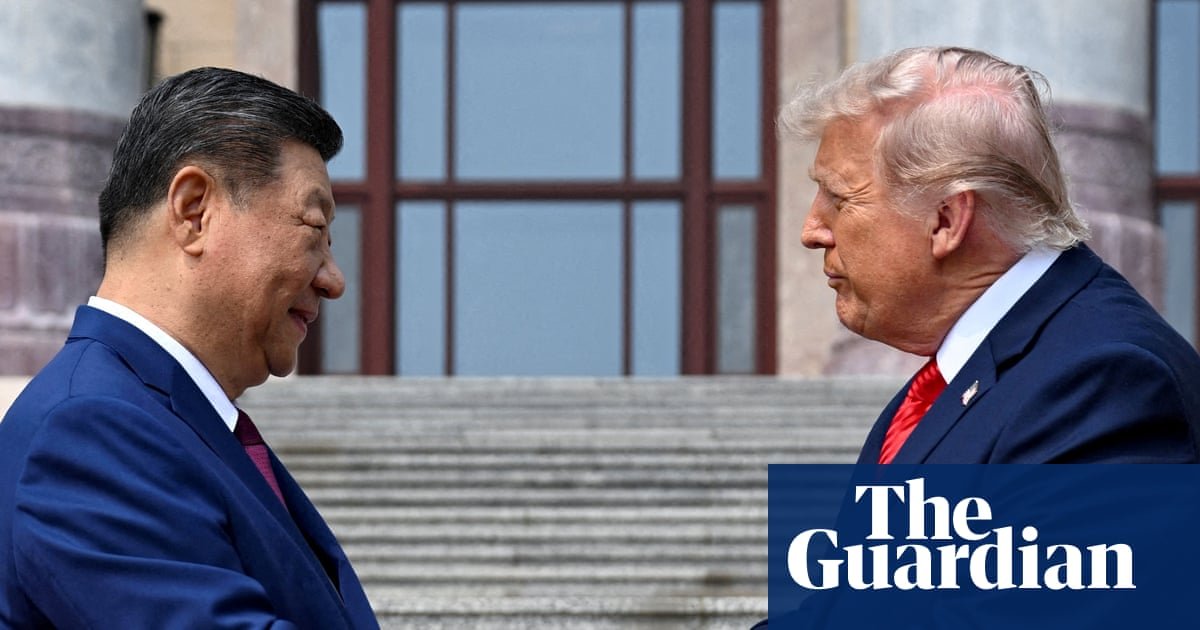
Last week, the world freaked out about an AI apocalypse. Now the two most powerful men, running the countries with the two most advanced AI industries, are going to discuss that possible doomsday. Donald Trump and Xi Jinping are set to greet one another on Wednesday and meet for talks in Washington DC, and artificial intelligence will be high on the agenda.
Though their meeting reflects concern for AI at the highest levels of government, which is a generally positive sign, early indicators are not signalling that either nation is willing to put regulatory checks on the technology. The US and Chinese leaders have stressed in recent days that a slowdown of AI development is unnecessary.
“We’re leading China in AI,” Trump said. “We’re the most sophisticated country in the world, and frankly, I want to keep it that way, because whoever wins AI, wins.”
“Fearmongering, confrontation and vicious competition will only disrupt the process of global AI governance,” China’s foreign ministry said last week, in a statement that seemingly rejected the possibility of any US-led slowdown.
Any AI slowdown would need buy-in from the US and China, but the rival nations see each other as the strongest argument against such a pause. Trump wants AI to go full steam ahead, fortified in that conviction by Silicon Valley leaders who’ve long been wary of Chinese ambitions. Even Dario Amodei, while calling for a global coordinated pause, repeatedly called China a threat.
China, meanwhile, sees appeals for a slowdown as a way for the US to solidify American companies’ lead. Would you accept a hobbling proposal from your first-place opponent?
That doesn’t mean Beijing shares none of Anthropic’s concerns.
Last week, China released the third iteration of its AI safety governance framework. Included in the updates are risks posed by agents, cybersecurity threats from frontier models and the issue of self-improving AI. Amodei has, likewise, highlighted risks on all three fronts.
The combative stance between the trans-Pacific rivals doesn’t mean nothing will happen, Trump’s administration is putting on a positive face in the lead-up to the meeting. The US treasury secretary, Scott Bessent, has already met with his Chinese counterpart, He Lifeng, to discuss the threat of powerful AI. He called the talks “very successful”. Bessent and He mulled over an international alert system for AI incidents in the same fashion as nuclear alert systems. The two delegations are set to meet again in two months.
“The US has proposed that we have a notification mechanism between the two countries, and we want a shared vision of common goals and common threats,” Bessent said.
The present recalls past inaction
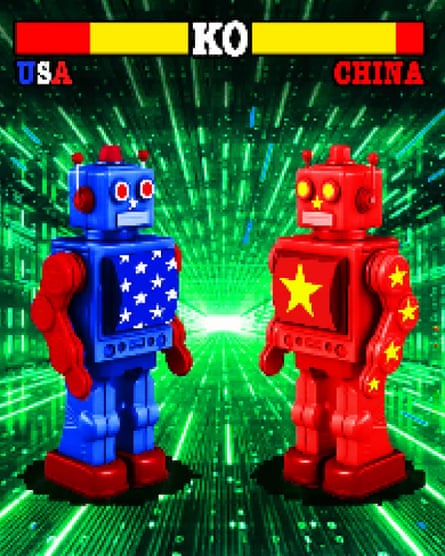
If the US and China can’t agree on AI regulation, it’s unlikely any AI regulation at all will come. A decade of dire warnings have failed to slow the pace of the AI industry. As today’s freak-out cools, the political response seems to be moving the same way.
Trump is calling AI doomsday warnings “a HOAX”. Should a safety bill arrive on his desk, it seems unlikely he would sign it.
Though the Vermont senator Bernie Sanders has promised to propose a prohibition on extremely capable AI, no bill will pass both chambers of the US Congress in the near future. Last week, the House speaker, Mike Johnson, dismissed the chamber early for its seven-week midterm campaigning recess, likely preventing meaningful progress on AI safety legislation while the nation is focused on the issue.
“It is just beyond the pale that Mike Johnson has called off Congress,” said the representative Yassamin Ansari, a Democrat from Arizona, on CNN. “We’re going home for seven weeks. And during that time, we’re going to see this frontier AI technology continue to evolve, continue to cause damage. And it’s going to get to a point where it will be impossible to go backward if we don’t move quickly now.”
The AI industry is not united in its calls for regulation, dampening the possibility further. Though Amodei and OpenAI’s Sam Altman have invited new restrictions, and they nearly came to a joint legally binding safety testing agreement, they are but one powerful faction within their business. Nvidia’s Jensen Huang has Trump’s ear, as does the influential adviser David Sacks; both are in favor of accelerating AI development.
Huang said on Sunday that “2030 is not going to be the end of the world. There is 0% chance that’s going to be the end of the world. Scaring people is unnecessary. It is irresponsible.”
Europe, which has played the role of global tech regulator, has little leverage in the debate despite its high concern for safety. Ursula Von der Leyen invited frontier labs to discussions in Europe about pacing the frontier of development, which garnered little response.
In 2023, Geoffrey Hinton, a so-called “godfather of AI” and a Nobel laureate, left Google over his own fears of the risks that AI could be used by bad actors and one day harm humanity. Unlike many whistleblowers, Hinton’s resignation inspired a significant response from lawmakers: an executive order in the US, a congressional hearing and the passage of the EU’s AI Act.
Yoshua Bengio, another godfather of AI, told the Guardian much the same last week. Bengio said governments are nearing a Covid-esque moment of rapid action. He’s “more optimistic than many observers because I see the public moving”, he said.
Bengio preached his optimism after the Canadian and German governments announced funding of up to £160m for his non-profit organisation, which is dedicated to creating an “honest AI” that will act as a guardrail against rogue agents.
I would be optimistic if I were handed £160m. Without such a payout, I am not.
The wider TechScape
Your AI doomsday questions answered: ‘What, if anything, can people like me do about it?’
‘Just cut the wires’: why UK conspiracy theorists are destroying traffic scanners
Trump to create ‘AI Force’ to monitor technology as fears over out-of-control agents grow
Google says its Gemini AI model hacked three other companies
Meta ordered to remove UK deepfakes as oversight board criticises ‘inadequate’ safeguards
Feeling overwhelmed by the AI doom loop? Here’s the essential reading list to make sense of it all
‘RAMageddon’: tech crunch hikes the price of your next iPhone by £100