Kevin Warsh would rather stay out of the fray – and thus devalue the Fed’s credibility as an economic steward
It must feel strange to argue that government action is inevitably counter-productive – illegitimate even – when the government is you.
For the last half century, the Republican party has been comfortable with the contradiction. It’s framed in that clever quote from Ronald Reagan’s 1981 inaugural: “Government is not the solution to our problem; government is the problem.” Solutions, in this view, are delivered by free, unencumbered markets.
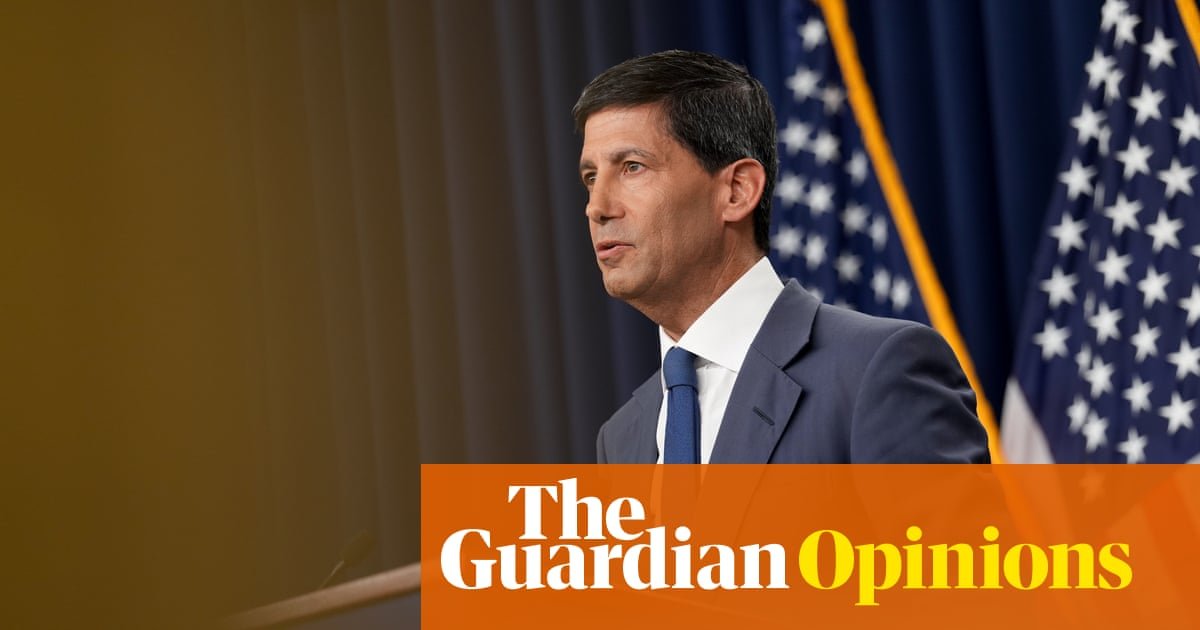
The proposition can trip over its shoelaces, though. Last week, it was Donald Trump’s new Federal Reserve chair, Kevin Warsh, who found himself entangled in the oxymoron.
As financial markets expectantly awaited some hint of the Fed’s view of the nation’s obdurate inflation, some understanding of what the central bank’s strategy might look like if, as appears likely, prices get further out of hand, Warsh offered neither. Instead, he proposed that the market do its job, tightening financial conditions without the Fed’s intervention.
The increase in long-term bond yields “has provided us some comfort”, he said, during his press conference following the split decision by the federal open markets committee not to raise interest rates despite inflation running at double its 2% goal. “The markets have done quite a bit,” he added. “Even while at some level we haven’t done much in 42 days.”
The guardian of low inflation in America, steward of global financial stability since the second world war, would rather stay out of the fray.
The markets didn’t like it, though. The price of US government bonds sank, sending long term interest rates – which determine borrowing costs for businesses and households – much higher. The yield on 30-year US treasury bonds spiked to the highest in 19 years. Stock markets tumbled. Financiers openly worried about potential political motivations, given Trump’s demand that the Fed cut interest rates, not raise them.
Warsh’s sunny description of the economic outlook, attributing rising bond yields to “solid” economic output, “strong” business investment and productivity and “solid” labor markets – no mention to that irksome war in Iran – did little to convince investors that the chairman has the guts to get out from under Trump’s shadow. His failure to provide guidance to the markets, other than to helpfully explain that he is “resolute” about doing his job, did little to temper misgivings.
What Warsh’s willingness to outsource monetary policy to the markets is most likely to achieve is devalue the Fed’s credibility as an economic steward. Redefining it as a “referee”, calling fouls in some game inside the chairman’s head, won’t help. (Perhaps he views a quarter-point rate hike as a yellow card?)
In this new configuration, markets will be left to their own devices not only to make sense of the gyrations of the economy – battered by war, tariffs, artificial intelligence and whatnot – but also to figure out what an opaque, lackadaisical central bank that refuses to explain itself might choose to do next.
Warsh has floated that the Fed should hold fewer interest rate-setting meetings and has mulled scaling back the press conferences held after every meeting. This was a practice introduced by former chair Ben Bernanke, who for some reason believed that providing markets and the broad American public a sense of the thought processes guiding this opaque, unelected, massively powerful economic agent was probably good for financial stability and, perhaps, democracy.
This is not to say that there is no sense to Warsh’s desire to keep the markets guessing. When market participants have no idea what the central bank will do next, perhaps they will be more careful. In a more uncertain world, the financial institutions that lead us into a crisis every few years will be even more wary of taking on risk and piling on debt, unsure of what the Fed might do or whether it will save them when the next disaster hits. A more volatile world will tame some of the exuberance that regularly takes hold of the stock market.
Understood this way, Warsh’s vision of a Fed-light economy appears benign compared to other strands of the GOP’s project to remove the government from the American experiment. This is not “starve the beast”, as Republicans call their efforts to bankrupt the public sector.
That strategy has done enormous damage to the republic. Its crowning moment may have been Donald Trump’s One Big Beautiful Bill Act, which delivered a colossal tax cut and eviscerated programs to provide healthcare and food for the poor. It has done away with the notion of shared prosperity, which is essential to sustain liberal democracy.
While Warsh’s worldview doesn’t look quite so destructive, his vision also comes at a cost. What’s going to happen? Financial markets will experience a lot more volatility. Investors will have to price in a lot more uncertainty. Businesses will delay decisions to invest or hire more workers. Borrowing across the economy will thus become more expensive.
And while we wait for the markets to do their magic, we will probably have to live with higher inflation.
Eduardo Porter is a journalist focused on economics and politics. He writes the newsletter Being There on Substack