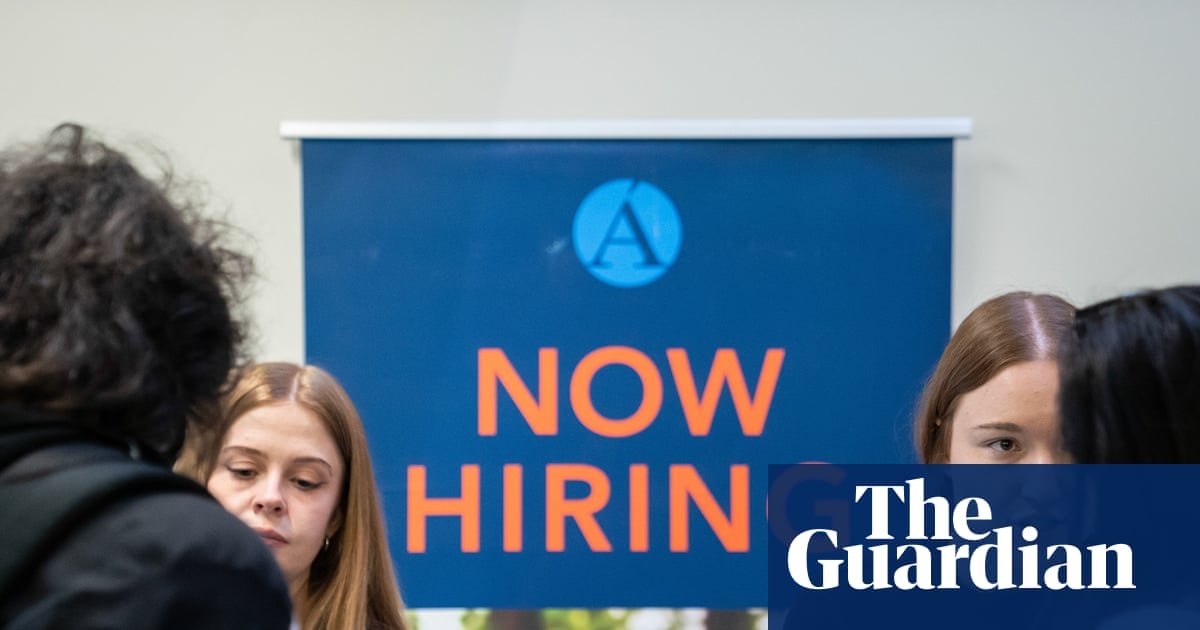
A career Fair in Seattle, Washington, on 10 February 2026.
1% Business live – latest updates US employers unexpectedly lost 23,000 jobs in July and gains for the previous two months were revised down sharply by a combined 103,000 jobs, painting a weaker picture of the labor market than past data indicated.
The unemployment rate, however, held steady at 4.1%.
Economists had projected an unchanged unemployment rate and 83,000 new jobs for the month.
The latest data from the Bureau of Labor Statistics illustrates the continued summer slump in job growth amid ongoing conflict in the Middle East.
Pressure has been mounting within the US Federal Reserve to raise interest rates to combat persistently high inflation, but July’s job report and its latest revisions may cool those expectations at the central bank’s next meeting.
July’s job losses were concentrated in local government education, with 50,000 jobs lost, and retail, which lost 19,000.
The private sector, however, gained 30,000 jobs, with growth focused once again in healthcare.
Hourly earnings of all employees changed little over the past year, increasing by 3.2% compared to last year.
Next week’s consumer pricing data will reveal whether these gains have kept pace with inflation.
Figures for May were revised to 63,000 jobs added, down from an initially reported 129,000 jobs, while figures for June dropped 37,000, to 20,000 jobs added.
In total, job figures for May and June were revised down 103,000 jobs.
In June, the US added 57,000 jobs, about half of what economists had predicted, with most of the growth concentrated in healthcare and social assistance.
The unemployment rate had also dropped to 4.2% in June, down from 4.3% in May, driven by 720,000 people leaving the workforce.
Monthly US jobs figuresOther data had pointed toward a slowdown in July.
Private employers added 44,000 jobs in July, according to the payroll firm ADP, a significant drop from the 98,000 jobs added in June recorded by the firm.
Job openings decreased by 178,000 to 7.4m in June, according to the latest Job Openings and Labor Turnover Survey.
Job openings in healthcare and social assistance, key areas of job growth, declined by 147,000 in June, the largest decline since July 2025.
Economists have long said the US labor market is in a “low-hire, low-fire” state, and recent data from outplacement firm Challenger, Gray and Christmas found that layoffs in July plunged compared with last year.
US-based employers announced about 33,500 job cuts in July, the lowest month in two years.
Though consumer spending has remained resilient, increasing by 0.3% in June 2026, the personal savings rate for Americans in June 2026 hit a four-year low at 2.7%, the lowest rate since June 2022, according to the US Bureau of Economic Analysis.
“With immigration having largely been stopped – and possibly now a net negative – the labor force is growing very slowly,” wrote Dean Baker, economist and co-founder of the Center for Economic and Policy Research, in a post on what to expect from the July jobs report.
“However, slower wage growth, even in the face of rising inflation, indicates it is not a very good labor market for most workers.
That story does not seem likely to change any time soon.” Economists are closely watching the labor market and inflation as officials at Fed have become divided on whether to raise interest rates or leave them unchanged.
Though the Fed held rates steady last month, officials indicated that they expect at least one rate hike before the end of the year to combat price increases.
The annualized inflation rate in June was 3.5% – 0.8% higher than a year prior.
Inflation data scheduled to be released next week will probably be “the deciding factor” for the next rate meeting, Ellen Zentner, chief economic strategist at Morgan Stanley Wealth Management, said in a statement.
“If those numbers come in hotter than expected, a cooler labor market may not be enough to quiet the calls for hikes inside the Fed, or lower expectations outside of it,” she said.
Democrats are already criticizing Donald Trump for the worse-than-expected report.
In a statement on Friday morning, the Democratic senator Elizabeth Warren said: “President Trump’s failing economic agenda is weakening the labor market.
“Job growth in May and June was revised down by more than 100,000 jobs, job openings have fallen and more people are out of the labor force than at any time on record.
And wage growth slowed, straining families’ paychecks even more as they struggle to keep up with Trump’s inflation,” Warren added.
Explore more on these topicsUS unemployment and employment data Economics US economy US work & careers news Share Reuse this content