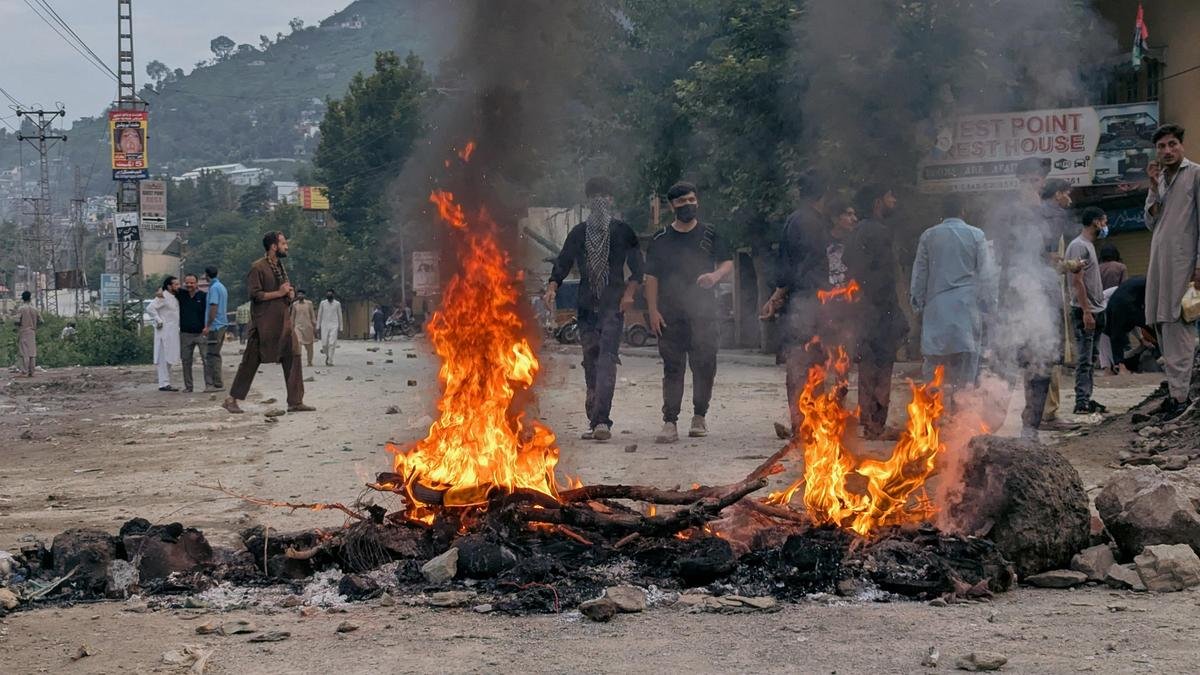
The story so far: Simmering discontent over inflation, lack of accountability and opaque governance in Pakistan-occupied Kashmir (PoK) has escalated into a violent crackdown by Pakistani security forces over the past week, leaving dozens dead and many more injured.
Security forces have reportedly used assault weapons and sniper fire against protesters gathered in the main squares of cities such as Rawalakot and Muzaffarabad, who are demonstrating against the three-phase election currently underway in PoK.
The Jammu Kashmir Joint Awami Action Committee (JKJAAC), which has been leading the protests, claims that more than 50 people have been killed over the past week as demonstrations continue against what it alleges is a rigged election process.
Why are protests taking place in PoK?
PoK is caught between an election and a popular political movement opposing the political basis of that election.
The Jammu Kashmir Joint Awami Action Committee has been protesting peacefully in Rawalakot, Muzaffarabad, Dudalkot and other locations in the region, seeking to build a more representative political system in PoK.
The three-phase election started on July 27 and will conclude on August 11.
PoK visuals heartbreaking, Pakistan must adopt humane approach: Mehbooba Mufti The movement, which emerged after the COVID-19 pandemic to campaign against the rising prices of essential items like flour, has evolved over the years into a protest against the local population’s lack of political representation in PoK’s legislature.
Protesters are particularly focused on 12 seats in the 53-seat legislature reserved for refugees from Jammu and Kashmir, and their descendants, who are settled in various parts of Pakistan.
Locals claim that the reserved seats reduce the representation of communities from the region.
As the authorities went ahead with the election process without addressing the local demand for scrapping the reserved seats, the JKJAAC called for a “long march”.
Though the authorities have responded with a harsh crackdown, the protesters have shown they are not going away anytime soon, having sustained the protests for months.
The movement gained new momentum after Osama Jaleel, a PhD scholar at Quaid-i-Azam University in Islamabad, was reportedly killed in police firing in Rawalakot.
Before his death, Jaleel had become known online for his fiery speeches at protest meetings in Rawalakot.
What is the political relationship between Islamabad and PoK?
The federal government of Pakistan has had a complicated relationship with the region for years, as mainstream political parties such as the Pakistan Peoples Party and the Pakistan Muslim League-Nawaz have failed to fulfil the developmental aspirations of the people of PoK.
In recent days, the situation has been further inflamed by comments from leading figures within the establishment about the protesters.
Pakistan’s Defence Minister, Khwaja Asif, incensed public sentiment by referring to the protesters as “enemies just like Indians”.
Locals allege that the region’s developmental needs have been neglected by Islamabad, and their complaints echo those long heard from residents of Khyber-Pakhtunkhwa and Balochistan, where protests and insurgency have continued for decades.
What has India said about the Rawalakot protests?
Over the past few months, the Ministry of External Affairs has repeatedly condemned the use of harsh methods against protesters in Rawalakot and other parts of PoK.
India calls for global scrutiny over Pakistan’s ‘ruthless’ crackdown in PoK On July 31, the Ministry blamed the “Pakistani Establishment”, saying: “This crackdown has resulted in the tragic death of over 40 civilians and serious injuries to many.
Its absolute disdain for the innocent people of PoJK was laid bare when their Defence Minister branded the protesting civilians as enemies.” Adding to this, the Special Assistant to the Prime Minister on Political Affairs openly admitted that the very “mujahideen” that the Pakistani establishment trained, armed and sent to bleed India have now turned their guns inward, weaponising themselves against the state.
Mirwaiz Dr.
Umar Farooq has expressed “deep concern” over the unrest across the LoC and called for dialogue.
“We are deeply anguished by the continuing unrest and tragic loss of precious lives during the past month and a half,” said Umar Farooq.
The Jammu Kashmir Joint Awami Action Committee has opposed India’s remarks, and in a statement on June 24, the group said it “firmly rejects any attempt by India to interpret, appropriate, or project the current situation in Azad Jammu and Kashmir in support of its own claims or geopolitical positions.
The present civil rights movement is neither a proxy nor an extension of interstate rivalries.
Any such characterisation is both inaccurate and misleading.” Is there a strategic dimension to this protest?
The protests have been concentrated in Rawalakot, which lies along the Line of Control, and Pakistan’s response so far shows it will not tolerate instability in a region of primary importance to its security.
Why are there protests in PoK? | Explained The strategic dimension of the unrest can be gauged from the fact that Kotli, Muzaffarabad and Rawalakot – the areas where protests have taken place – hosted terror-related targets that India claimed to have hit during Operation Sindoor in May 2025.
Apart from India, Amnesty International and influential leaders in the U.K. have also called for restraint from the Pakistani establishment.
Responding to the ongoing communications blackout in PoK, Amnesty said: “We urge the Pakistani authorities to restore all communications access and allow media and independent observers into the area.” Non-resident Mirpuri Kashmiris, who have a strong community presence in the U.K., have started an online campaign to restrain Pakistan’s security establishment from continuing its repressive measures.