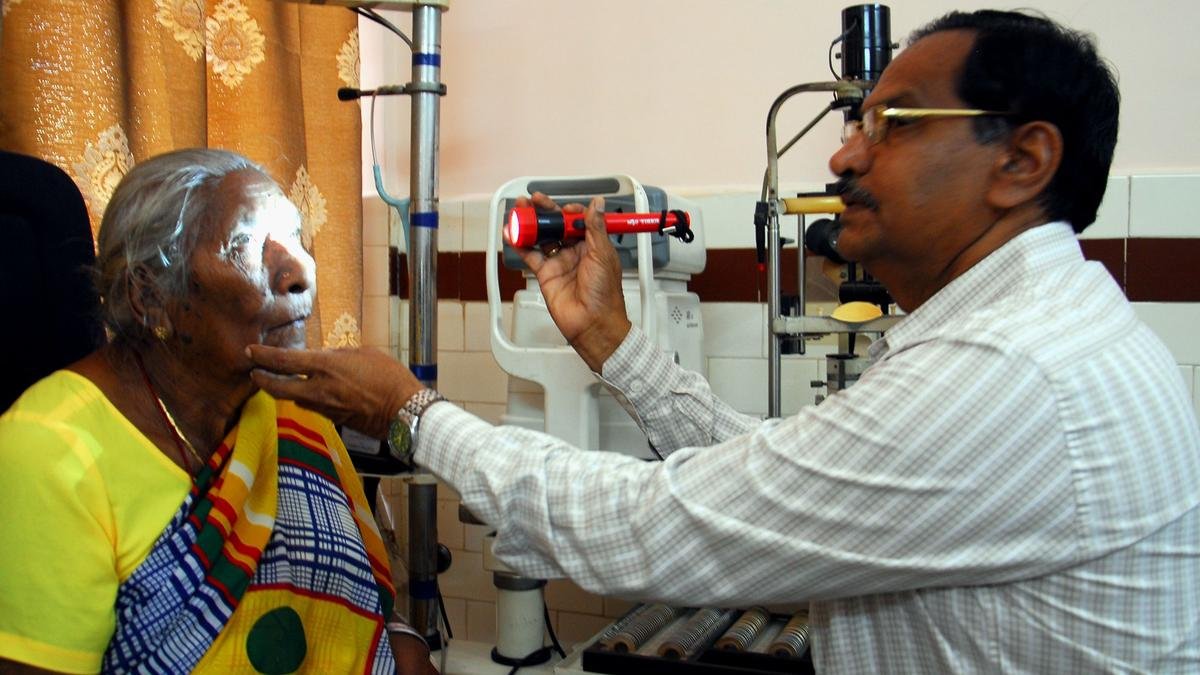
As National Eye Donation Fortnight kicks off in Keralam, a shortage of donor corneas — particularly good-quality tissue from younger donors — continues to be a major impediment to the State’s fight against corneal blindness, ophthalmologists say.
The shortage of donor corneas is not just due to a lack of awareness about eye donation.
Many people are aware of the concept, but actual eye donation often does not materialise for various reasons, including lack of family consent, fear of disfigurement, or the poor tissue quality of the retrieved corneas.
At a time when the State has been expanding facilities for corneal transplantation in public health institutions — the General Hospital, Thiruvananthapuram, became the first district-level government hospital in the country to perform a corneal transplant (keratoplasty) earlier this year — the focus should be on developing robust Hospital Cornea Retrieval Programmes (HCRP) in both the public and private sectors.
This would help ensure that there is no shortage of donor corneas while improving the chances of retrieving good-quality tissue, ophthalmologists point out.
Health Ministry simplifies rules to boost cornea transplant services “People should be made aware that anyone can donate eyes, regardless of conditions such as diabetes, hypertension or cataract, and that the eye (cornea) is the only organ that can be donated even after death, ideally within a six-hour window.
There is no disfigurement.
A team from the eye bank goes directly to the deceased person’s home, retrieves just the cornea (not the entire eye), and the process hardly takes 15 minutes,” says Reshmi P.
Haridas, Assistant Surgeon and cornea and cataract specialist at the General Hospital, Thiruvananthapuram.
She points out that while Andhra Pradesh manages to retrieve 10,000 corneas a year, Kerala’s eye donation rate is an abysmal 1,700 corneas annually, well below the target fixed under the National Programme for Control of Blindness and Visual Impairment.
According to the National Blindness and Visual Impairment Survey 2015-19, corneal problems accounted for 40% of blindness among those in the 0-49 years age group and 18% among those aged over 50 years.
As of 2022, corneal blindness accounted for 0.81% of blindness in the country, while in the southern region the figure stood at 0.66% (no specific statistics are available for Kerala).
Notably, an additional 25,000 people are added to the corneal blindness category every year, with graft failures contributing to the burden.
An ideal way to treat India’s corneal blindness problem “When it comes to corneal grafts, our shortage is primarily due to the fact that only 40-50% of the corneas we retrieve are actually utilised for corneal transplantation.
While this could be due to pre-existing corneal degeneration or medical contraindications, the primary reason for the low utilisation rate is poor tissue quality.
“The quality of the corneal endothelium, particularly the endothelial cell density, is crucial for maintaining corneal clarity after keratoplasty.
The quality of corneal endothelial cells decreases with age.
Though we do perform grafts using donor corneas from elderly people, these corneas have a higher chance of falling below safe cell density thresholds, leading to a higher rejection rate,” Dr.
Haridas points out.
According to official statistics, corneal blindness affects an estimated 1.20 lakh people in the country, and there is a projected need for one lakh transplants annually.
However, at the current utilisation rate of procured corneas, at least double the number of corneas would have to be harvested every year to meet the transplant requirement.
This is where HCRP comes in.
It is a proactive, hospital-based model that promotes eye donation after the death of a patient in hospital.
In government-sector eye banks, only voluntarily donated corneas are retrieved.
Under an HCRP, hospitals have grief counsellors and volunteers who actively counsel bereaved families about eye donation.
Most of these hospitals have dedicated cornea retrieval teams and eye banks, or they call in the nearest eye bank to harvest the tissue.
The advantages of HCRP include greater availability of high-quality corneal tissue, efficient retrieval within the short donation window, access to younger donors, and easier screening of medical history for contraindications, all of which lead to a higher utilisation rate of harvested corneas.
In 2023, Government Medical College, Kozhikode, retrieved 56 corneas, of which just 14 could be transplanted, a utilisation rate of 25%.
In the same year, Little Flower Hospital, Angamaly, which has a well-established HCRP and an eye bank, retrieved 1,624 corneas, of which 645 (48%) were transplanted.
Ophthalmologists point out that this is why the State needs to promote HCRP in a major way.
Doing so will help Kerala meet its requirement for good-quality donor corneas while ensuring a higher utilisation rate.