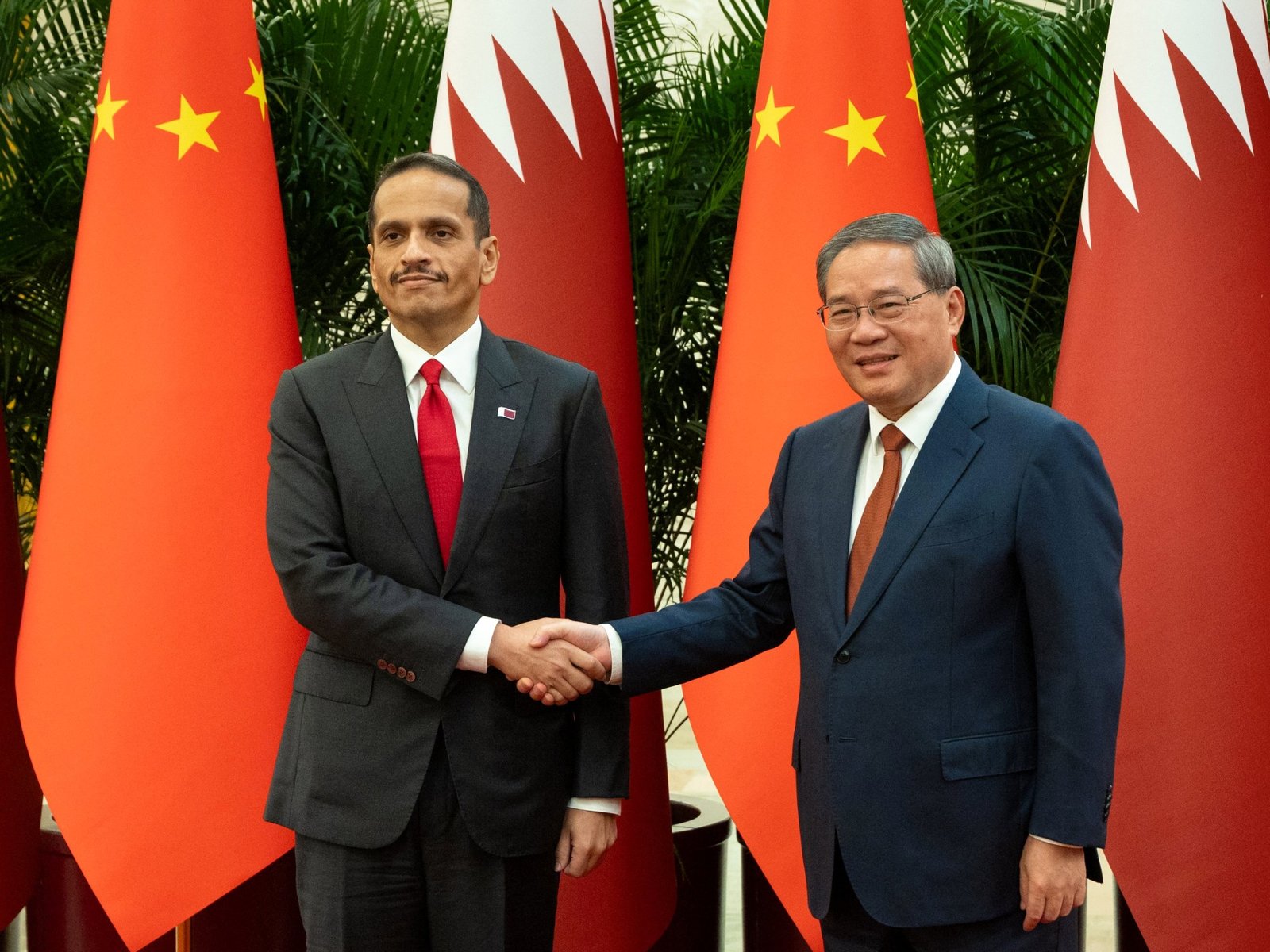
Beijing, China – Qatari Prime Minister and Foreign Minister Sheikh Mohammed bin Abdulrahman Al Thani has completed a two-day visit to China, with officials describing the relationship as entering a new “golden decade”.
China has called Qatar an “important strategic partner” in the Middle East and the Gulf, and the two sides have agreed to expand cooperation in energy, investment and advanced technologies.
Recommended Stories
list 1 of 4Iran and Ukraine wars: Why ship fuel is running short, and why it matters
list 2 of 4Oil prices surge as US-Iran strikes intensify in Strait of Hormuz
list 3 of 4IAEA warns over Iran nuclear access as Western powers push UN referral
list 4 of 4Qatar says reopening Strait of Hormuz ‘unconditionally’ is a priority
But it’s clear the continuing US-Israeli war on Iran, and ongoing Qatari efforts to mediate between Tehran and Washington, were central to discussions.
“It’s not acceptable at all to have this state of no war and no peace. This is not beneficial to the region, the countries of the region, and the people,” Ibrahim bin Sultan al-Hashmi, director of the Department of Media and Communications at Qatar’s Foreign Ministry, told reporters in Doha on Tuesday following the meetings. “Qatar is working hard with its partners, including China. Diplomatic efforts are being exerted and new ideas are being discussed.”
Beijing pledged to increase communication and coordination with Doha to help restore regional peace and stability. Qatar has told China it would prioritise its energy supply despite the difficulties.
Raised stakes
The disruption to shipping through the Strait of Hormuz has raised the stakes for both sides.
Qatar is one of the world’s biggest exporters of liquefied natural gas (LNG), while China is the world’s largest importer of crude oil. Both have a significant interest in restoring stability to the strait, through which around one-fifth of global oil and LNG normally passes.
Energy is also the backbone of the relationship. China is Qatar’s largest trading partner, with bilateral trade worth $23.8bn last year. Qatar is China’s second-largest source of LNG, supplying 19.4 million tonnes in 2025. QatarEnergy has signed 27-year LNG supply agreements with Chinese state-owned energy giants CNPC and Sinopec, which have also taken stakes in Qatar’s massive North Field gas expansion.
Overlapping interests, different approaches
But despite these shared interests, Doha and Beijing have different ways of dealing with Tehran.
China has repeatedly voiced support for Qatar’s mediation efforts but has largely refrained from direct criticism of Tehran’s attacks or its disruption of the Strait of Hormuz. It’s also consistently placed primary blame for the conflict on the US and Israel, a conflict Chinese officials say “never should have happened”.
Beijing is arguably Tehran’s most important economic and diplomatic partner. China has for years been the largest buyer of its oil and continues to oppose unilateral sanctions against it.
During talks with Al Thani, Chinese Foreign Minister Wang Yi repeated calls for a diplomatic solution, saying “pressure exerted through military means is not a solution; dialogue and negotiations are the only viable path”.
For its part, Qatar has publicly condemned Tehran for attacks on its own territory and on neighbouring Gulf states. It has grown increasingly frustrated with failed or stalled attempts to resolve the crisis, while continuing to facilitate dialogue.
From Doha’s perspective, closer coordination with Beijing potentially brings another influential player into its efforts to end the conflict, one with unusually strong economic and political ties to Tehran.
Balancing act
China is also aware of Qatar’s longstanding security and military partnership with Washington, Beijing’s biggest strategic rival.
Qatar hosts Al Udeid, the largest US military base in the Middle East. On March 3, Iran fired two ballistic missiles at Qatar. One was intercepted while the other struck Al Udeid, causing no casualties. This prompted Doha to call for even stronger security ties with Washington.
Still, China has no interest in replacing the US as a security guarantor, says Zoon Ahmed Khan, a research fellow at the Center for China and Globalization in Beijing. “What we are seeing is Beijing positioning itself as a relevant political and economic actor at a moment when several states in the region are looking for additional options,” Khan said.
The question is how much of its own influence Beijing is prepared to use when it comes to Iran. China has so far shown little appetite for using its leverage to exert significant pressure on Iran’s Islamic Revolutionary Guard Corps (IRGC).
Broader horizons
The Qatari prime minister’s two-day visit was, of course, about more than Iran. If anything, the conflict has increased the incentive for Doha and Beijing to expand their relationship towards what Qatar has described as “broader horizons”. China’s Premier Li Qiang called for deeper cooperation in traditional and renewable energy, infrastructure, artificial intelligence and finance, while Al Thani singled out high technology and advanced manufacturing.
Invest Qatar reports that 520 Chinese companies operate in the country, with Chinese investment projects generating more than $3bn and creating more than 3,200 jobs this past decade.
The visit underlines a partnership that is becoming broader economically, and potentially more important diplomatically, as the Iran war tests both countries’ ability to protect the interests that bind them together.