The United Kingdom has announced a ban on the import of all goods produced by illegal Israeli settlements in the occupied West Bank, in the country’s most significant policy since London’s historic recognition of Palestinian statehood last year.
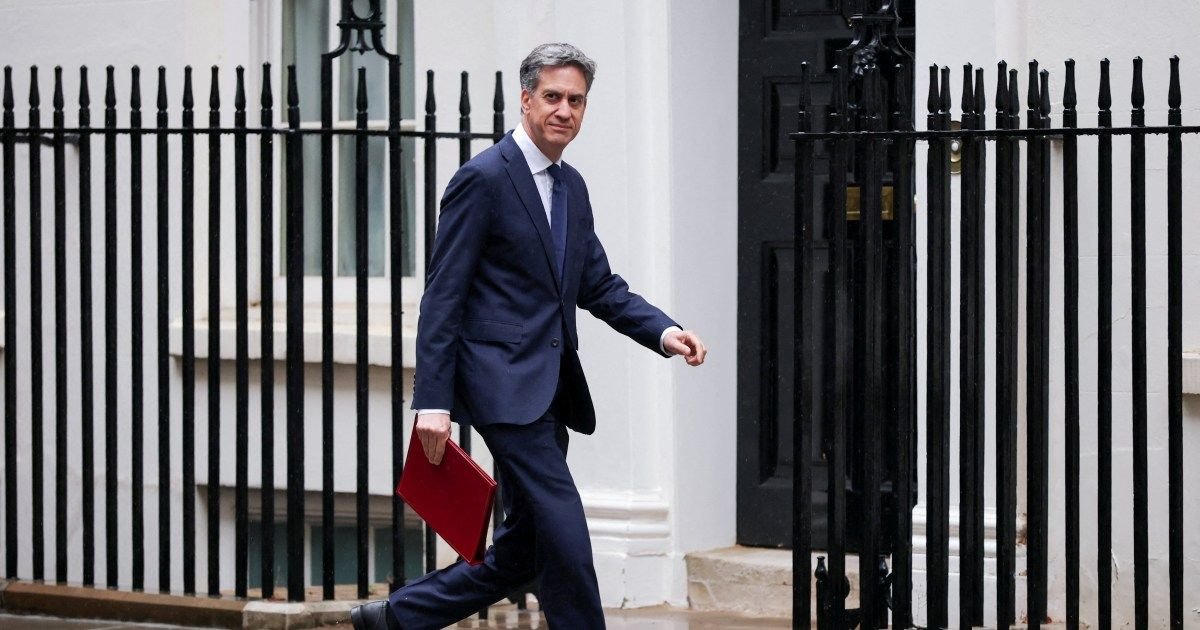
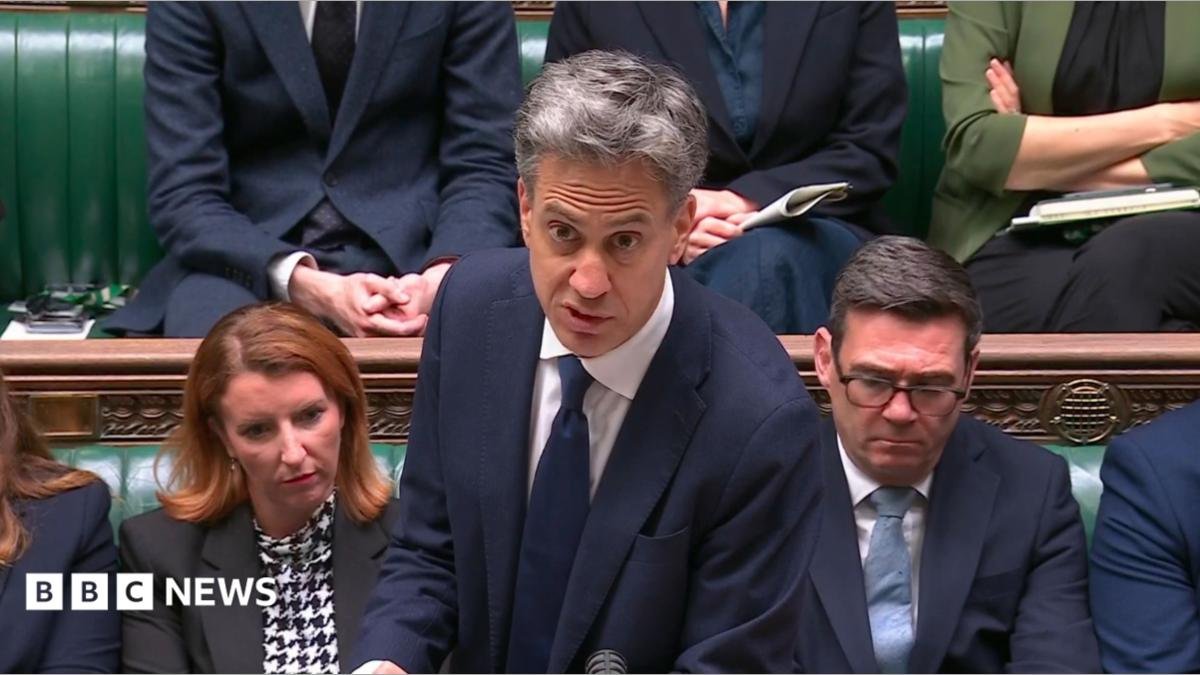
In a speech to Parliament, UK Foreign Secretary Ed Miliband accused Israel of carrying out “ethnic cleansing” in Palestine and affirmed that it is official UK policy that the Israeli settlements rapidly expanding across the occupied West Bank are “unlawful”.
Recommended Stories
list 1 of 4Nigel Farage heckled as he denies Reform UK took illegal funding
list 2 of 4UK gov’t condemns masked anti-immigrant protesters blocking Dover port
list 3 of 4UK has billions in contracts with firms tied to illegal Israeli settlements
list 4 of 4UK government refuses slavery reparations as Jamaica urges king to act
He said he did not believe “the British people want us supporting the occupation by accepting products from settlements in our shops”.
Miliband also announced tougher new restrictions on arms sales to Israel.
Israel announced four “counter measures”, including banning 12 British MPs from entering Israel and closing the British consulate in Jerusalem, following his speech.
The UK’s trade ban on goods from illegal settlements comes amid an intensifying wave of Israeli settler pogroms on Palestinian communities in the occupied West Bank and controversial settlement expansions that have prompted a UK-led debate on Europe-wide trade restrictions.
After Miliband’s speech, 12 countries shared a joint statement supporting the two-state solution and announcing their own intentions to impose restrictions on trade with illegal Israeli settlements.
France, the UK, Canada, Denmark, Spain, Finland, Ireland, Iceland, Norway, Poland, Portugal and Sweden called on the Israeli government to immediately halt the expansion of settlements.
Here’s what we know.
What did Miliband say in Parliament?
Ahead of Tuesday’s announcement, Miliband said new trading bans and sanctions would represent a “comprehensive reset” of the UK’s policy on Israel, amounting to an approach that “not only calls out the injustice [in Palestine], but acts”.
However, he added: “The sanctions regime will target illegal settlements and settlement expansion, not Israel.”
“I can also announce that we’re extending the existing global human rights regime such that it will enable swifter action to deter settlement expansion, including crucially seeking to prevent the development of E1,” Miliband added. E1, a proposed settlement in the West Bank, would divide the Palestinian territory in two and put an end to hopes for a two-state solution, he said.
In support of Israel, Miliband also announced new sanctions against the financing arm of the Lebanese group Hezbollah – Al-Qard al-Hasan – and said the UK will reimpose sanctions on Iran, in line with those imposed by the European Union and United States.
However, he said the UK government “agrees” that settler violence in areas of the West Bank amounts to ethnic cleansing and labelled those carrying it out as “settler terrorists”. He accused the Israeli government of turning a blind eye to the violence and intimidation of Palestinians.
Miliband reaffirmed the UK’s commitment to a two-state solution for Palestine and sharply criticised the rhetoric of Israeli politicians, such as Minister of Finance Bezalel Smotrich, who have called for an end to any notion of a Palestinian state.
Miliband, who is himself Jewish, said the UK government will take a tougher approach towards rising anti-Semitism in the UK. He emphasised that measures by the UK government are being taken against the government of Israel, not the Israeli people, and that targeting Jewish people in the UK for the acts of the Israeli government is “anti-Semitism, pure and simple”.
Britain is a country “that upholds its values at home and around the world, a Britain that fights against oppression and suffering wherever it occurs, a Britain that stands up for what is right”, he said.

What is being banned?
The UK ban on trading with illegal Israeli settlements covers the following:
A ban on the import of all goods from illegal Israeli settlements in the West Bank.
Sanctions on all organisations, businesses and individuals providing construction, infrastructure, financing or real estate for settlement expansion.
A total ban on advertising in the UK for the sale of properties in illegal settlements in the West Bank.
Sanctions against extremist settlers who have supported or incited violence against Palestinians.
All new export licences for weapons and other exports which “materially contribute to the occupation” will be refused. The UK has already suspended more than 30 arms licences used by the Israeli army in Gaza, he added. The ban on such exports will remain in place as long as the occupation persists, Miliband said.
Products and services from Israel itself.
How much does the UK trade with settlements?
The UK is an important trading partner for Israel as a whole.
Trade between the UK and Israel totalled 6 billion pounds ($8.1bn) in 2025, according to the House of Commons. While it is difficult to estimate exactly how much of this is from goods produced by settlements, an estimated 38 million pounds ($51.4m) worth of goods was imported from the occupied territory in 2025, Parliament records show.
Precious stones and metals, technical and medical equipment, plastics, machinery and fresh produce including fruit are the major goods imported from Israel. In return, the UK exports, among other things, defence equipment including drones, helicopters and aircraft components.
In 2024, the UK suspended about 30 arms export licences due to Israel’s actions in Gaza. However, exemptions were made for F-35 combat aircraft components, which Israel can access via other partners like the US.
The UK has long tried to distinguish between goods imported from Israel and those from settlements, which do not receive preferential tariffs under a free trade agreement.
To claim preferential tariffs, importers are required to provide UK customs with documentation showing where their goods are manufactured in Israel, and to demonstrate they were not produced in a “location within the territories brought under Israeli administration since June 1967”.
Guidelines were also introduced outlining how products originating from Israeli settlements should be labelled before entering the UK, although concerns have been raised about goods produced in occupied Palestinian territory being mislabelled as “produced in Israel”.
In May 2025, the UK suspended negotiations to modernise the trade agreement to cover digital trade and other areas.
Does this mean the UK is removing support for Israel?
No. In his speech to Parliament, Miliband took pains to emphasise that these measures are not being taken against the Israeli people, with whom the British people have “unshakable bonds”.
“Our argument” is not with the people of Israel, but with the “conduct of its government”, he said. “I wholeheartedly oppose the boycott divestment sanctions, or BDS, campaign,” he added.
He said the Hamas-led attacks on southern Israel on October 7, 2023 demonstrated the grave threats that Israel faces, and announced that the UK is also implementing new sanctions against the Iran-backed Hezbollah in Lebanon, as well as reimposing sanctions on Iran in line with those of the EU and the US.
To “those who question Israel’s right to exist”, he said: “You are wrong, and we will call you out.”
He added that Hamas must decommission its weapons and dismantle its “terrorist infrastructure” in Gaza. “Hamas can play no role in the future governance of Gaza.”
The foreign secretary said Israel has the right to live without fear.
Miliband said he is “proud” of his own Jewishness and added that his support for the state of Israel is not a “contradiction” of his support for Palestine.
How has Israel responded?
Israel’s Foreign Minister Gideon Saar has announced counter measures against the UK.
Israel is closing the British Consulate in Jerusalem.
UK representatives will be removed from the International Gaza Support Center in Kiryat Gat in southern Israel.
British training of Palestinian Authority forces in the West Bank will be terminated.
Twelve British MPs are banned from entering Israel.
Saar accused the UK government of trying to interfere in Israel’s October election by making this announcement so close to the polls.
He added that the Israeli public is overwhelmingly opposed to the establishment of a Palestinian state “in the heart of our land”.
On Tuesday, National Security Minister Itamar Ben-Gvir called on Prime Minister Benjamin Netanyahu to recognise Argentina’s sovereignty over the Falklands, an overseas UK territory that Argentina claims, in retaliation.
Smotrich, Israel’s finance minister, called for the expulsion of the British ambassador.
How has the US responded?
Burnham spoke with President Donald Trump in a phone call on Monday and stressed the importance of a two-state solution, UK media reported. Trump has, however, not commented on the new ban.
Mike Huckabee, the US ambassador to Israel, has not minced words, however. Over the weekend, he accused the UK government of “Jew hate”. He described any plan for sanctions or trading bans as “discrimination against the Jewish people”.
“I don’t know if [the British government is] really aware of the implications and how it’s going to affect Brits,” he told the UK’s BBC Radio 4 Today programme on Tuesday.
Huckabee claimed that 25 percent of pharmaceuticals in the UK are produced in Israel and that British businesses in the US could face “great damage” in the case of a US reprisal.
Ahead of Miliband’s announcement, Florida Republican congressman Randy Fine warned that UK companies could be barred from Florida and accused the UK of carrying out a “vanity project in support of Muslim terror”.
On Tuesday, US Secretary of State Marco Rubio said: “We think it has implications on our ability to make progress with regards to Gaza, on the 20-point plan and the Board of Peace that we’re very committed to. Obviously we’re not going to do what the UK did.”
What other response has there been?
Palestine’s Ambassador to the UK Husam Zomlot said the UK’s decision to impose sanctions and a trading ban was “long overdue” but represented a “turning point in UK-Palestine relations”.
“Today, Britain begins to move from condemnation to consequences, from words to action,” he wrote on X.
Human rights groups have also welcomed the move.
Human Rights Watch said the import ban and sanctions were a “long-awaited and positive change in Britain’s policy”.
Amnesty International UK said the new measures could be “the sea change that is needed”.
However, following Miliband’s address in parliament, the Jewish Leadership Council, which represents Jewish organisations in Britain, accused the government of placing an “increased target on British Jews”.
The council said the move was “deeply irresponsible” and claimed that the government was “yielding to pressure from the most extreme elements of British society”.
The UK’s Chief Rabbi Ephraim Mirvis said it was a “truly a dark day for British Jews” and warned that they would be at greater risk of extremist attacks as a result.
“Today our government has chosen to ignore the deep concerns expressed by so many of us,” he wrote on X. “These measures will succeed only in bolstering the very extremism they seek to target.”
Does the ban go far enough?
Under former prime minister Keir Starmer, the UK’s Labour Party was strongly criticised for failing to take action over Israel’s genocidal war on Gaza and the pogroms against Palestinian communities in the occupied West Bank. This was an issue that the new prime minister, Andy Burnham, pledged to correct when he took over as leader.
But the ban on Israeli settlement products represents less than 1 percent of UK-Israel trade.
Zena Agha, interim director of the British Palestinian Committee, which advocates for Palestinian rights in the UK, told Al Jazeera the move is a “bare minimum”.
“These are measures we would expect any government to take in accordance with the international legal framework to which it subscribes. So it shouldn’t be celebrated in that regard. Nevertheless, it is something which the previous administration didn’t do, and so it should be welcomed.”
Advocates say the ban’s proper implementation is crucial.
Chris Doyle of the Council for Arab-British Understanding, which has long lobbied for a trade ban with Israel, said it is important to ensure products from settlements are not misleadingly labelled as being from Israel. He also called for a ban on all investments and financial services in the settlements.
“Trading with these settlements should never have been allowed in the first place, built as they are in occupied territory, on the land and resources of Palestinians,” Doyle said.
“I think what we are seeing here is, for the first time, Britain is taking significant action against illegal settlements. It’s long overdue. We’ve heard previous prime ministers from Thatcher to Blair to Cameron all saying settlements are illegal and an obstacle to peace, but they did nothing … It should act as encouragement for other European actors to do the same … Collectively this will make a difference as the EU is Israel’s largest trading partner.”
Given the extent of what he said were Israeli war crimes in Palestine, however, “the UK must be prepared to go further in the event that Israel does not end its settlement enterprise”, Doyle added.