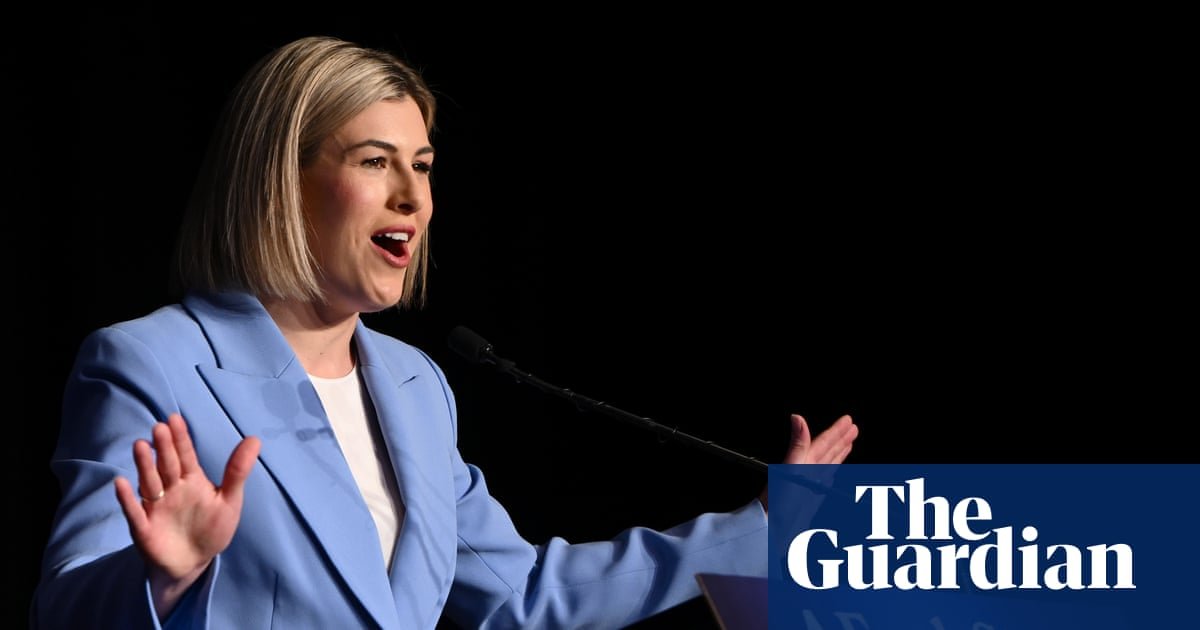
Jess Wilson to become state’s first popularly elected female premier as Ben Carroll loses seat in 2026 state election, and Greens and One Nation surge
Victoria election live results: votes tracker, map and seat counts
‘Worse than anyone feared’: how Victorian Labor unravelled after 12 years in government
See all of our Victorian state election coverage
Get our daily political email, free app or daily news podcast
Victorian Labor has suffered a historic defeat, ending 12 years of government, with the Coalition winning a majority and the Greens securing a record number of seats.
One Nation was on course to win more than 20% of the primary vote, but struggled to pick up lower house seats on a night when huge swings and three- or even four-party contests in many electorates made preference flows difficult to calculate.
At 36, Wilson will become Victoria’s youngest leader since federation and the first woman to be popularly elected as the state’s premier – a feat neither Jacinta Allan nor Joan Kirner achieved.
In her victory speech, Wilson spoke directly to Labor voters who had abandoned the party and said her team would “work every single day to demonstrate that you were right to place your trust in us”.
“I know that for many of you this is the first time that you have ever voted Liberal. And for others, it was the first time you have ever given us your preference,” Wilson said.
“I realise that you have lent us your vote. We don’t own it.”
Carroll lost his seat of Niddrie in Melbourne’s north-western suburbs, which Labor had held for its entire 50 year history. It is the first time a Victorian premier has lost their seat at a state election.
In a speech to party faithful shortly after 8.30pm, Carroll took full responsibility for Labor’s crushing defeat.
“This is a significant loss for Labor,” Carroll said. “It’s not the result we wanted, but it is a result we accept.
“As leader of the party, I take full responsibility. Democracy is both beautiful and brutal. Beautiful, because we get to witness the will of the people. And brutal, because it is so difficult and painful to lose.
“But Victorians have spoken. And their message is clear. They want change.”
The Greens were on course to secure eight seats – holding Brunswick, Richmond and Melbourne and winning Pascoe Vale, Preston, Northcote and Footscray from Labor, and Prahran from the Liberals.
If voting trends from Saturday night’s counting continued, it appeared possible the Greens might win more lower house seats than Labor, making it the official opposition.
The party’s state leader, Ellen Sandell, told ecstatic supporters the result was “not an overwhelming endorsement of the Liberals or One Nation”.
“This result is a rejection of the Labor party that has moved so far away from the values they once held, and it is a rejection of the old party politics that just is not working for people,” Sandell said.
“We are sending more Greens to parliament than ever before at a time that could not be more crucial.
“When we say we have to replace the major parties, we are serious. It was always about more than just winning seats in parliament. It was about building a movement and a progressive political force with the courage and the conviction to stand up for what it believes.”
One Nation secured more than 20% of the statewide primary vote – up from 0.22% in 2022 – but seemed likely to gain very few lower house seats. The party is in contention the regional district of Murray Plains, held by the Nationals, and in Sunbury on Melbourne’s north-western fringe, previously held by Labor.
At One Nation Victoria’s campaign event, it was the federal leader Pauline Hanson who addressed the party faithful. The state leader, Warren Pickering, failed to win the seat of Pakenham, which went to the Liberals.
Hanson congratulated Wilson and said she “had a big job ahead of her to clear up Labor’s mess”.
“For Victoria’s sake, I wish her and her team well,” Hanson said.
One Nation’s lower house prospects appear to have been hurt by a complex preference count in Labor-held seats it targeted. As Labor fell to third place in some seats, its preferences flowed to the Liberals.
Early in the night several former Labor seats were called for the Liberals, including Frankston and Mordialloc in the south-east, Hastings on the Mornington Peninsula and Box Hill and Ringwood, in the eastern suburbs. The seat of South Barwon also went to the Liberals, the first time the party has won the seat from Labor since the 1990s.
Kororoit, Tarneit, Point Cook, Sydenham, Werribee and Melton – traditional Labor strongholds in Labor’s west and north – also fell to the Liberals.
Only about a fifth of upper house votes had been counted on Saturday night, but the Coalition looked likely to pick up at least 15 seats, with One Nation on eight and the Greens and Labor on six.
Labor MP Steve Dimopoulous, who is seen by some as a potential leader of the party if he holds on to his seat, offered a sincere apology to Labor faithful.
“This is an absolutely unequivocal report card on the Labor government,” Dimopoulous said.
The deputy Labor leader, Gabrielle Williams, another potential leadership candidate, said she was “deeply saddened” by the result and the party needed to learn from its mistakes.
“Clearly we have to be deeply humbled by the results and take the lessons from them,” Williams said.
Federal Labor sources quickly began to distance themselves from the state election result. One described the result as the “perfect storm-of-shit moment in Victoria” that would not be repeated federally.
“There are upsides federally to the Liberals being in power and cutting and privatising stuff, and One Nation’s bluster and hollowness getting tiring,” they said.